Is Kinosaki Gero’s Endgame? MarriageToxin Romance Theory and Final Ship Analysis
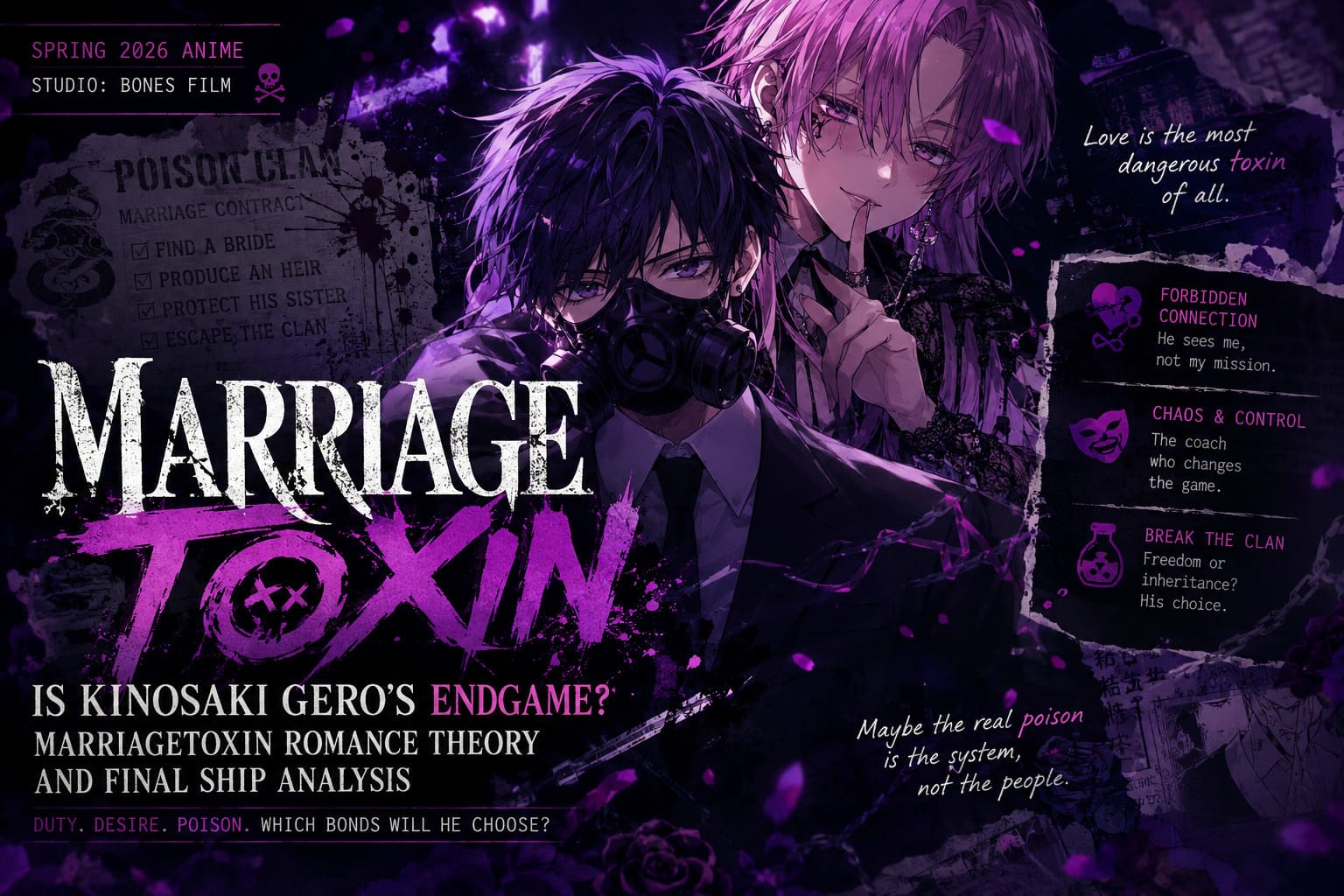
The discussion around MarriageToxin has evolved far beyond casual fandom debate. With the series by Joumyaku and Mizuki Yoda gaining massive attention ahead of its Spring 2026 anime adaptation by Bones Film, one question keeps dominating every corner of the community: is Mei Kinosaki actually meant to be the endgame partner for Hikaru Gero?
From Reddit theory threads to TikTok edits and YouTube breakdowns, this is no longer just a shipping argument. It has become a deeper conversation about identity, narrative structure, and what kind of romance the story is truly building toward.
Is Kinosaki the Real Endgame in MarriageToxin? Gero Relationship Analysis
The Core of MarriageToxin: More Than Assassins and Marriage Contracts
At first glance, MarriageToxin looks like a chaotic mix of assassin action and romantic comedy. But underneath the surface, the story is built on a surprisingly serious emotional foundation centered on control, tradition, and personal freedom.
Hikaru Gero is not just an elite poison-user from a powerful clan. His entire life is shaped by a system where marriage is not about love, but about inheritance, obligation, and survival of lineage. His mission is painfully specific: find a bride to satisfy the clan’s heir requirements, protect his younger sister from being forced into an arranged marriage, and ultimately escape the toxic structure of the Poison Clan.
This already creates a contradiction that fuels the entire fandom debate. If Gero’s goal is tied to producing a biological heir, then logically his endgame partner must fit that structure. However, the narrative itself constantly pushes against this kind of rigid interpretation.
Why Kinosaki Disrupts the Entire Story Structure
Mei Kinosaki enters the story not as a typical romantic candidate, but as a disruption to the entire system. On the surface, he is a cross-dressing marriage scammer who manipulates wealthy targets through carefully constructed romantic personas. He also openly states that he is male from the very beginning of his interaction with Gero.
However, in practice, Kinosaki becomes something far more complex. He is not just a side character or comedic support. He becomes Gero’s emotional mirror, the one person who interacts with Gero as an individual rather than a mission objective.

The key difference is simple: other characters engage with Gero’s duty, while Kinosaki engages with Gero himself.
Fandom Interpretations: Two Competing Readings
The fandom surrounding MarriageToxin is sharply divided, but both interpretations are logically consistent depending on what you prioritize: structure or emotion.
Traditional Endgame Theory
This interpretation argues that the story ultimately remains grounded in inheritance, duty, and consequence. Gero still exists inside a clan system that demands biological continuation, and emotional attachment alone is not enough to override that reality.
Key points of this interpretation:
- Gero must still fulfill heir requirements for the Poison Clan
- Kinosaki functions as a mentor or emotional catalyst, not a final romantic partner
- Female candidates like Himekawa or Ushio are structurally positioned as endgame options
- The story resolves by balancing duty and personal growth rather than rejecting tradition entirely
Emotional Endgame Theory
This interpretation focuses on thematic evolution rather than structural expectations. In this reading, the entire point of the story is to break away from toxic systems rather than conform to them.
Key points of this interpretation:
- The clan system is meant to be rejected, not obeyed
- Gero’s growth is about emotional freedom, not strategic marriage planning
- Kinosaki represents the only fully realized emotional connection in the story
- Every other romantic path feels secondary in comparison
The Gender Debate Around Kinosaki
One of the most persistent discussions in the fandom revolves around Kinosaki’s identity. He explicitly states that he is male early in the story, but fans continue to analyze visual framing, symbolism, and narrative ambiguity.
Some readers argue that the character’s presentation is intentionally designed to challenge gender expectations in shonen romance. Others believe the story is being misinterpreted and that Kinosaki’s identity should not be redefined or rewritten through fan theories.

What makes this debate interesting is that it reflects two different reading approaches: one focused on emotional interpretation, and one focused on textual consistency.
Gero and Kinosaki: Relationship Dynamics Breakdown
When comparing Gero’s interactions with different characters, a clear pattern emerges. While multiple candidates exist for his romantic future, none match the emotional consistency of his relationship with Kinosaki.
| Relationship Type | Emotional Depth | Narrative Role | Romantic Tension |
|---|---|---|---|
| Female Candidates | Moderate | Structured marriage options | Medium |
| Clan Influence | Low | Systemic pressure | None |
| Kinosaki | Very High | Emotional anchor and partner-in-chaos | Extremely High |
Kinosaki consistently functions as Gero’s emotional support system while also challenging him intellectually and socially. The “coach don’t play” dynamic becomes especially important because the person guiding Gero through romance is also the one who generates the strongest emotional reaction from him.
Final Question: Is Kinosaki Really Endgame?
From a purely structural standpoint, a traditional ending with a female partner still makes sense. It resolves clan obligations and maintains the inheritance system logic within the story world.
However, from an emotional and narrative standpoint, Kinosaki is positioned as the most significant relationship in Gero’s development arc. Even when not framed as the official romantic option, he consistently functions as the emotional center of the story.
Two Possible Directions
- Traditional ending: Gero chooses a female partner, Kinosaki remains his closest ally
- Emotional ending: Gero rejects clan expectations and chooses Kinosaki
- Hybrid possibility: The story redefines what “marriage” and “endgame” actually mean
Conclusion: What MarriageToxin Is Really Building Toward
At its core, MarriageToxin is not just a story about assassins or arranged marriages. It is a narrative about breaking inherited systems, questioning identity, and deciding whether duty or emotion defines a person’s future.
Whether Gero ends up with Kinosaki or not, the story has already achieved something significant: it has made the audience question what “endgame” even means in the first place.
Is it biological continuation, emotional fulfillment, freedom from tradition, or simply the person who understands you best?
Right now, the manga refuses to give a definitive answer, and that uncertainty is exactly what keeps the debate alive.