Rimuru vs Milim: Who Wins in the Final Arc of Tensura?
The power system in That Time I Got Reincarnated as a Slime (Tensura) is one of those rare anime universes where “strong” doesn’t even feel like a big enough word. It’s a setting where gods, dragons, and abstract forces of creation and destruction all coexist—and still somehow manage to escalate every major arc.
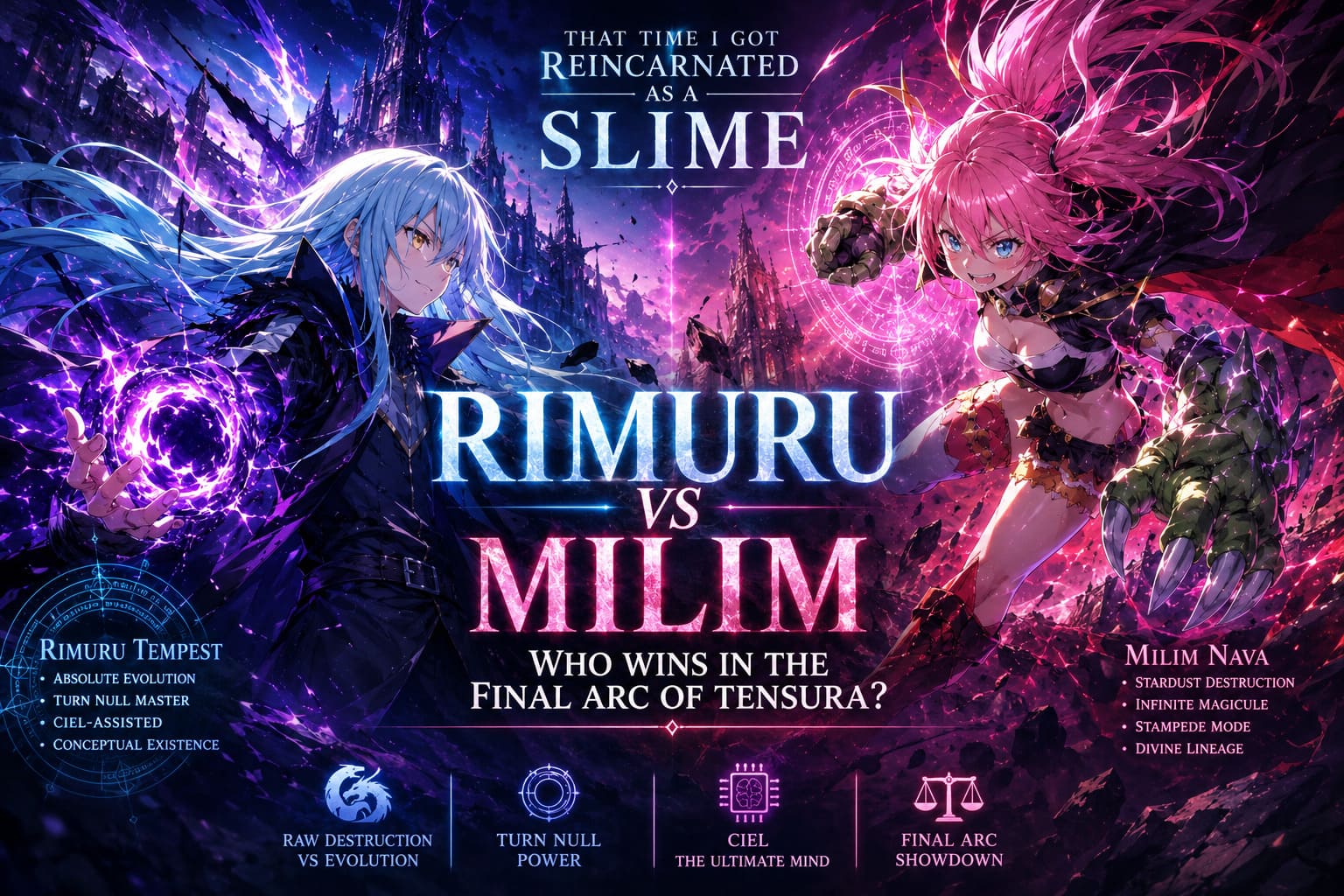
Among all the discussions fans keep coming back to, one matchup never really dies: Rimuru Tempest vs Milim Nava in the final arc. It’s the classic question of whether raw, uncontrollable destruction can overcome refined, god-tier evolution and absolute control.
And honestly? Both sides have a case—but the deeper you go into the light novel’s late arcs, the more the answer starts to lean in a very specific direction.
Benimaru’s Amaterasu Skill Explained: Powers, Origins, and Why It’s So Strong in Tensura
The Core Clash: Raw Power vs Abs
olute Control
At its heart, this fight isn’t just about who hits harder. It’s about two completely different philosophies of power.
- Milim Nava represents pure destructive force—unstoppable, emotional, and overwhelming
- Rimuru Tempest represents adaptive evolution—calculated, limitless, and increasingly conceptual
This contrast is what makes their matchup so iconic in fandom debates. Milim is like a cosmic explosion that never stops expanding. Rimuru is like a system that learns how to rewrite the explosion itself.
Milim Nava: The Walking Catastrophe
Milim is not your typical “strong character.” She’s essentially a natural disaster with emotions.
Key Strengths
- Stardust Energy: A primordial destructive force that bypasses normal magic systems
- Infinite Magicule Output: Her energy doesn’t realistically bottom out in combat
- Stampede Mode: A berserk state that boosts her power beyond rational limits
- Divine Lineage: Daughter of Veldanava, the original creator god
In most arcs, Milim is treated as a “don’t solve this the hard way” problem. Even other Demon Lords and True Dragons tend to avoid direct confrontation with her at full power.
Diablo vs Guy Crimson: Who Is Stronger in Slime?
What makes her especially dangerous is that her attacks don’t just deal damage—they overwrite stability itself. When Milim swings, she’s not just attacking a target; she’s destabilizing existence around it.
But there’s a weakness hidden in all that power: lack of control in extreme states. Once she enters full Stampede Mode, strategy disappears. It becomes force vs force.
Rimuru Tempest: The Evolution That Never Stops
Rimuru’s growth is the opposite of Milim’s static god-tier strength. He doesn’t just “get stronger”—he changes what strength even means.
By the final arcs of the light novel, Rimuru is no longer just a slime who became a Demon Lord. He evolves into something closer to a conceptual existence.
Key Developments
- Ultimate Slime Evolution (Demon Viscous God state)
- Absorption and integration of True Dragon-level existence data
- Mastery over multiple Ultimate Skills
- Reality-adjacent manipulation abilities
But the real turning point isn’t just Rimuru himself—it’s what exists inside him.
Ciel: The True Game Changer
If Rimuru is the body, Ciel is the mind that never sleeps.
Ciel is not just an upgraded skill—it’s a fully sentient super-intelligence that operates on a completely different level of computation.
What Ciel brings to the fight
- Near-instant analysis of enemy abilities
- Predictive combat modeling
- Optimization of every attack and defense in real time
- Ability to manage otherwise unstable powers like Turn Null
While Milim fights like a force of nature, Rimuru fights like a perfectly simulated outcome. And that difference matters more than raw energy.
Turn Null: The Real Endgame Power
One of the most debated elements in Tensura scaling is Nihility Energy (Turn Null).
This isn’t just another magic system—it’s described as primordial “nothingness energy,” tied to the origin of creation itself.
Why it matters
- It exists outside normal magicule systems
- It can erase matter, energy, and even conceptual structures
- It’s unstable unless controlled (which is where Ciel becomes essential)
- It represents both destruction and creation potential
When Rimuru starts properly mastering Turn Null, the scaling gap between him and everyone else—including Milim—begins to widen dramatically.

Milim vs Rimuru: Direct Comparison
| Category | Milim Nava | Rimuru Tempest |
|---|---|---|
| Raw Power | Extreme | Extreme+ |
| Control | Low in berserk states | Near-perfect (Ciel-assisted) |
| Energy Source | Stardust / Emotion | Turn Null / Conceptual Void |
| Combat Style | Overwhelming offense | Adaptive + predictive |
| Stability | Unpredictable | Highly stable |
| Battle IQ | Moderate | Supercomputer-level |
What stands out here isn’t just strength—it’s consistency. Milim is terrifying in bursts. Rimuru is terrifying all the time.
The Final Arc Interpretation
In the final stages of the story, Rimuru is portrayed as something increasingly detached from normal existence.
At that point, a fight with Milim stops being a straightforward “who wins” scenario and becomes more like a question of whether her attacks can even interact with Rimuru’s evolved state.
- Can Milim land a meaningful hit?
- Can Stardust override Turn Null?
- Can raw force overcome predictive reality control?
Most interpretations of the light novel’s progression suggest the answer trends toward no, mainly because Rimuru’s abilities evolve into systems that don’t just defend—they rewrite conditions.
So Who Wins: Rimuru or Milim?
If we’re talking early or mid-series, the answer is far more balanced. Milim absolutely dominates large portions of the story and remains one of the strongest destructive beings in existence.
But in the final arc context, especially when Rimuru fully stabilizes his higher forms and Ciel reaches full operational dominance, the matchup shifts.
Final Verdict
- Milim wins in raw destruction or uncontrolled chaos battles
- Rimuru wins in structured final-arc full power scaling conditions
It’s less about Milim becoming weaker—and more about Rimuru evolving past the framework she operates in.
Final Thoughts
What makes this matchup so fascinating isn’t just the outcome—it’s how Tensura handles escalation. Milim represents the ceiling of natural-born power, while Rimuru represents the idea that growth has no ceiling at all.
And in long-running power fantasy stories like this, that difference usually decides everything.
In the end, Rimuru vs Milim isn’t just a fight. It’s a statement from the story itself: raw power is terrifying, but evolution without limits is inevitable.