
Ghost in the Shell and Jaadugar Crossover Visual: Science SARU Explodes Summer 2026 Anime Season
There are anime crossovers that feel like someone in a marketing department threw two popular names into the same image and called it a day. Then there are crossovers that make you stop scrolling for a second and think, “Wait… why does this actually work?” Science SARU’s new THE GHOST IN THE SHELL and Jaadugar: A Witch in Mongolia collaboration belongs firmly in the second category.
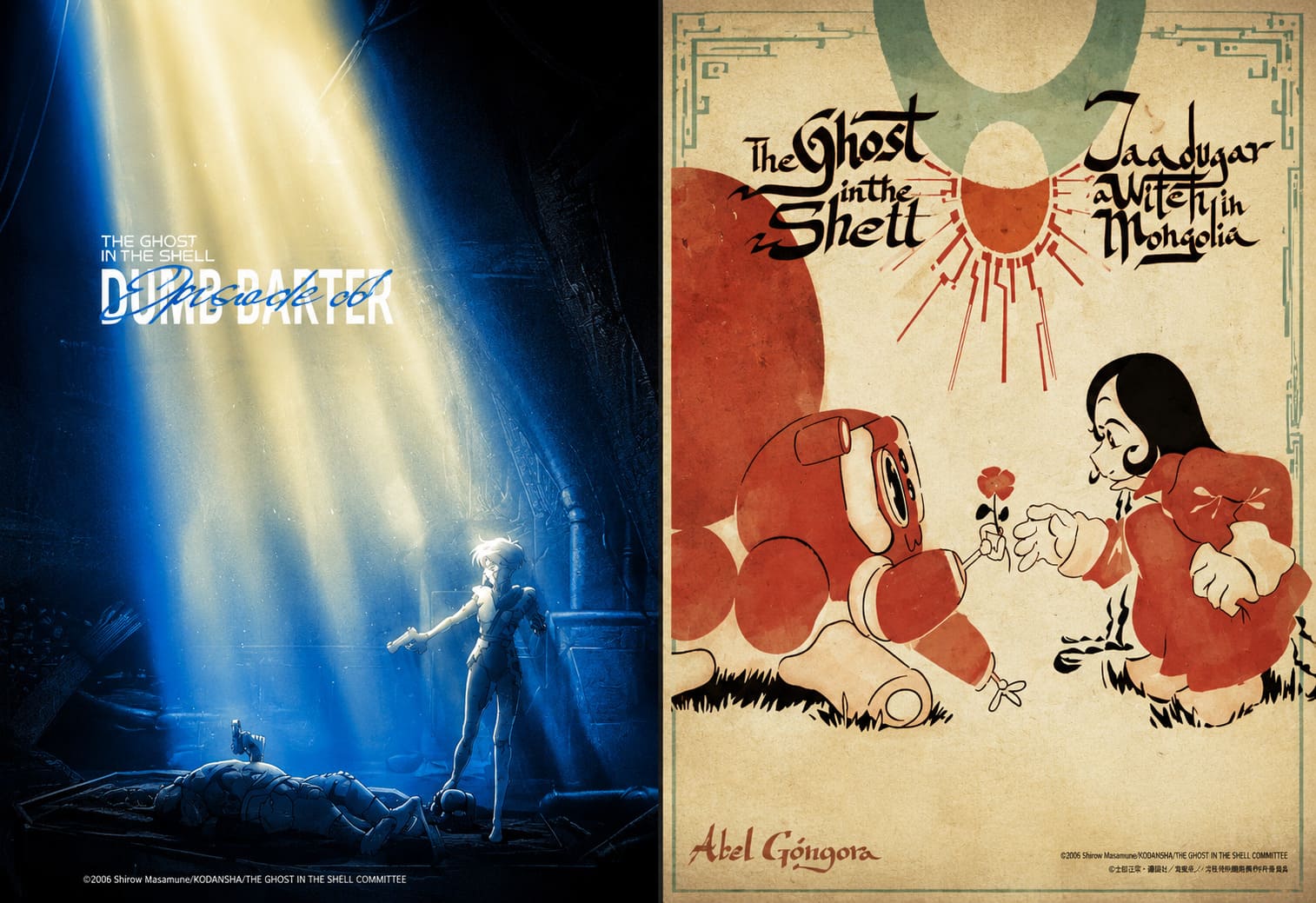
The studio has released a gorgeous crossover visual illustrated by Abel Gongora, director of Jaadugar: A Witch in Mongolia, bringing together two of the most radically different anime of Summer 2026. One is a colorful cyberpunk story packed with machines, hackers and questions about what makes someone human. The other is a historical drama about knowledge, survival, politics and female intelligence inside the Mongol Empire. On paper, they should have almost nothing in common. Somehow, Science SARU has found the connection.
The Ghost in the Shell and Jaadugar Crossover Is Weirdly Perfect
The first thing that caught my attention about the artwork is what Gongora doesn’t do. There is no obvious futuristic battle scene, no ridiculous attempt to make the characters look like they’re about to fight, and no forced “versus” gimmick. Instead, the illustration lets the personalities and worlds collide naturally, which makes it much more memorable.
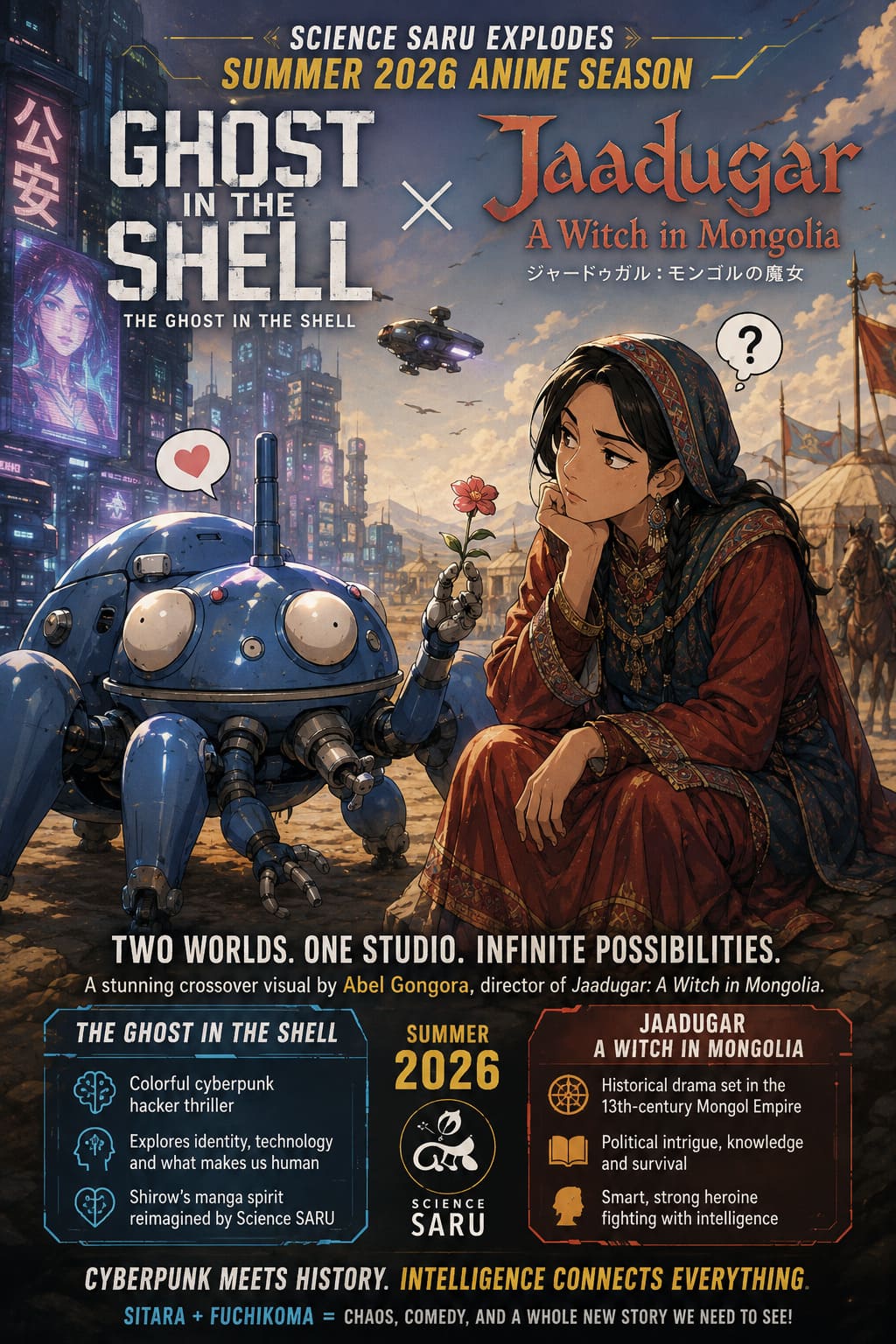
At the center is a Fuchikoma, the wonderfully strange little thinking tank associated with Masamune Shirow’s Ghost in the Shell. Standing beside it is Sitara from Jaadugar, a Persian-born former slave whose intelligence and medical knowledge become crucial to her survival. The contrast is fantastic. You have a tiny, mischievous machine capable of navigating a cyberpunk battlefield next to a woman whose greatest weapons are knowledge, observation and sheer stubbornness.
And honestly, I would watch an entire comedy series about that pairing. Imagine Sitara trying to explain 13th-century medicine while a Fuchikoma casually rolls around the Mongol court with enough advanced technology to completely destroy the historical timeline. It is absurd, but that absurdity is exactly why the visual works so well.
Science SARU Is Having an Almost Ridiculous Summer
What makes the crossover more interesting is the fact that these aren’t two disposable side projects from the same studio. Both shows have become major talking points of the Summer 2026 anime season, and they represent completely different sides of Science SARU’s creative identity.
The studio has always had a reputation for animation that refuses to sit still. From Devilman Crybaby to Scott Pilgrim Takes Off and Dandadan, Science SARU tends to give its projects a visual personality that you can recognize almost immediately. This season, that philosophy is being pushed in two completely different directions.
| Anime | What Makes It Stand Out |
|---|---|
| THE GHOST IN THE SHELL | Colorful cyberpunk visuals, expressive animation and a return to Shirow’s manga sensibilities |
| Jaadugar: A Witch in Mongolia | Historical drama, political tension, detailed worldbuilding and a powerful female lead |
That’s the part I find most impressive. Science SARU isn’t simply repeating the same visual formula twice. The studio is allowing each production to breathe differently, and that makes the pairing feel much more exciting than a typical seasonal double-header.
Ghost in the Shell Looks Nothing Like the Version Some Fans Expected
If your image of Ghost in the Shell is still dominated by Mamoru Oshii’s 1995 movie, I honestly can’t blame you. That film established such an influential visual language that every new adaptation has to fight against decades of expectations. Science SARU’s 2026 interpretation seems to have decided that the best way to deal with that pressure is simply to go somewhere else.
Rather than copying the heavy, cold atmosphere of previous adaptations, the new series reaches back toward Masamune Shirow’s original manga. The result is much more colorful, expressive and occasionally playful. That doesn’t mean the familiar themes have disappeared. Cybernetic identity, corporate power, technological evolution and the mysterious Puppet Master remain central, but the show is less interested in looking relentlessly miserable while discussing them.
Personally, I think that is a smart decision. Ghost in the Shell doesn’t need another imitation of the 1995 movie. We’ve already got that masterpiece. What I want from a new adaptation is a reason for it to exist, and Science SARU is at least making a serious attempt to give the franchise its own visual voice.
Jaadugar Takes the Exact Opposite Route
Then there is Jaadugar: A Witch in Mongolia, which couldn’t feel more different if it tried. Instead of cybernetic bodies and futuristic cities, the series drops viewers into the political and cultural world of the 13th-century Mongol Empire. Its protagonist, Sitara, survives through intelligence rather than brute strength, and the show’s tension often comes from watching her navigate people who possess vastly more political power than she does.
The series is based on Tomato Soup’s historical manga and features the involvement of Naoko Yamada, with Abel Gongora directing. Its attention to clothing, culture and everyday details gives the setting a weight that many historical anime struggle to achieve. More importantly, the story understands that political survival can be just as suspenseful as a fight scene.
That’s why putting Sitara next to a Fuchikoma is such a clever idea. Both Ghost in the Shell and Jaadugar are ultimately interested in intelligence. One explores what happens when human intelligence becomes inseparable from technology. The other asks what an intelligent person can accomplish when knowledge is one of the few things she can truly control.
The Human Touch Makes the Comparison Even More Interesting
There is another reason this particular Science SARU collaboration has attracted attention: the discussion surrounding human-made animation. At a time when generative AI is becoming an increasingly uncomfortable subject throughout the entertainment industry, productions built around visible human craftsmanship naturally stand out.
The reported production workload behind THE GHOST IN THE SHELL is particularly eye-catching. Character designs can require huge numbers of unique outfits, environments contain dense hand-crafted details, and even background typography contributes to the personality of the world. Those little imperfections and strange visual choices are part of what makes hand-drawn animation feel alive.
There is also a delicious irony here. Ghost in the Shell is fundamentally obsessed with technology, artificial bodies and the question of whether humanity can survive its own technological progress. Yet the series itself becomes more interesting when viewers can feel the human labor behind every frame. The machine-heavy story is being brought to life by people, not by removing people from the process.
Why Fans Can’t Stop Talking About This Image
I think the biggest reason the crossover has landed so well is that it doesn’t feel like an advertisement first. It feels like an animator had fun with two worlds that happened to share a studio. That distinction matters. Anime fans can smell corporate synergy from miles away, especially when a crossover exists purely to sell something.
This one has personality. The Fuchikoma looks ridiculous next to Sitara, Sitara looks completely unimpressed by the technological nightmare standing beside her, and the whole thing somehow feels like a tiny alternate-universe story waiting to happen.
For me, the visual also highlights something that has been easy to miss during the weekly release schedule: Science SARU’s biggest strength isn’t a particular genre. It’s the studio’s willingness to make radically different stories look and feel like themselves.
- Ghost in the Shell embraces colorful cyberpunk experimentation.
- Jaadugar leans into historical atmosphere and character-driven drama.
- The crossover proves those two approaches can coexist without either one losing its identity.
Science SARU Might Be the Studio to Watch This Season
Summer 2026 has no shortage of anime worth discussing, but having these two productions arrive from the same studio creates a fascinating snapshot of where Science SARU is right now. The studio isn’t afraid of established franchises, but it also isn’t treating them like museum pieces. At the same time, Jaadugar shows that the same creative team can move into historical storytelling without losing its distinctive visual confidence.
That makes the Abel Gongora crossover more than just a cute promotional illustration. It is a reminder that anime can connect wildly different stories through ideas rather than genre. A cyberpunk hacker and a medieval scholar don’t need to share a plot to feel like they belong in the same artistic conversation.
And yes, I still want to see Sitara get a Fuchikoma now. Give her one. Give her five. Let her unleash a fleet of futuristic thinking tanks on the Mongol court and watch history completely implode. Science SARU has already created the visual; now I’m demanding the spinoff.
Jokes aside, this collaboration captures what makes the studio’s Summer 2026 lineup so exciting. THE GHOST IN THE SHELL is challenging expectations surrounding one of anime’s most famous cyberpunk franchises, while Jaadugar: A Witch in Mongolia is quietly building its own identity through character, history and atmosphere. Seeing them celebrated together is strangely satisfying—and probably the clearest sign yet that Science SARU is having one hell of a year.


