Cells at Work Kabuki Stage Play Announced for April 2027: Cast, Details, and Fan Reactions Explained
There are anime adaptations that make perfect sense on paper, and then there is Cells at Work! getting a Kabuki stage play. Honestly, I love it. At first glance, putting anthropomorphic blood cells, bacteria and immune-system battles into one of Japan’s most traditional theatrical forms sounds completely ridiculous. Give it a minute, though, because the more I think about it, the more obvious the connection becomes. Cells at Work! has always been about taking something familiar and turning it into larger-than-life drama, and Kabuki is basically built for exactly that.
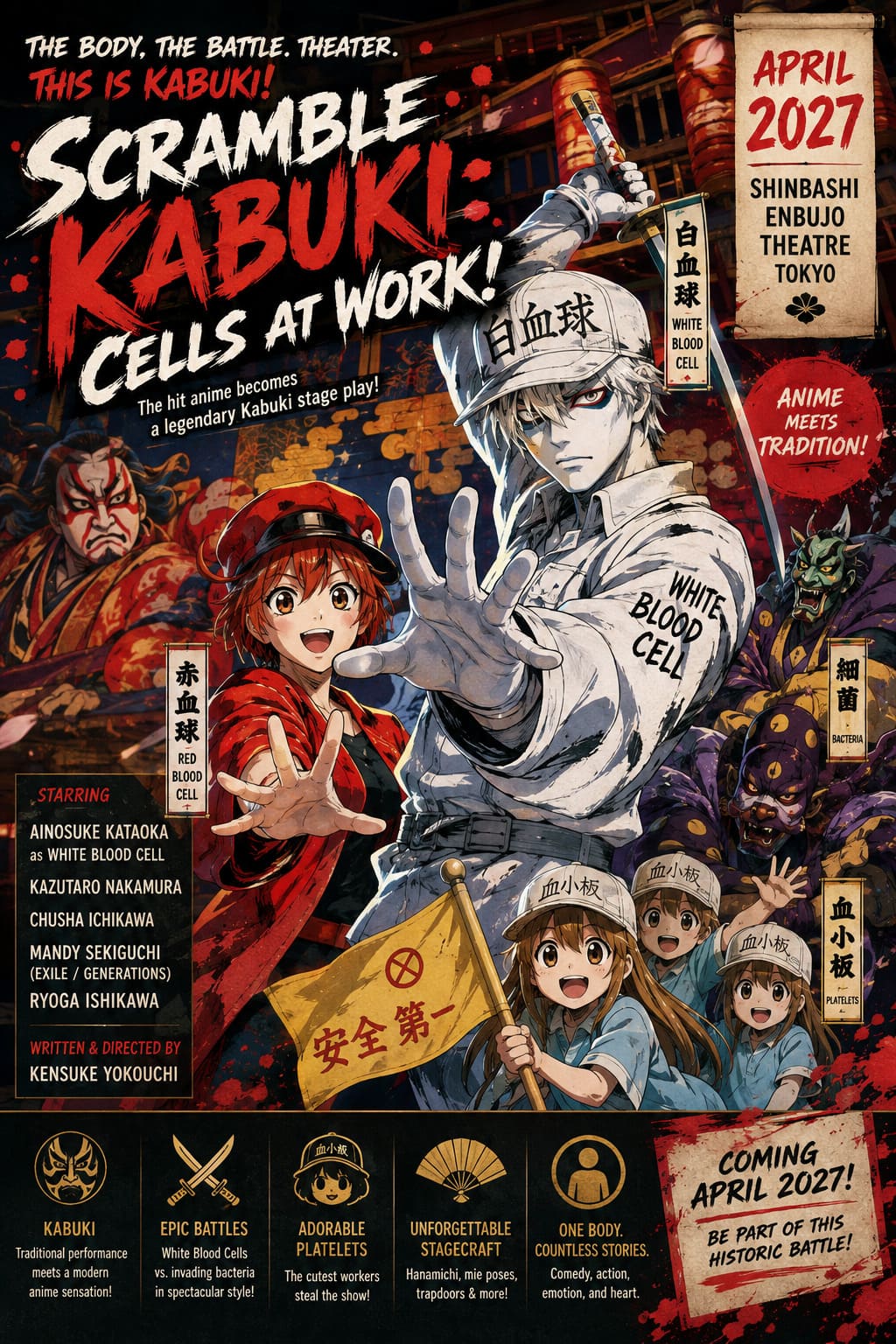
Shochiku has announced Scramble Kabuki: Cells at Work!, a new stage production scheduled for April 2027 at Tokyo’s Shinbashi Enbujo Theatre. The project will bring Akane Shimizu’s famous biological characters into a theatrical format that relies on stylized movement, dramatic poses, elaborate costumes and highly expressive performances. As an anime fan, I’m much more interested in this than I expected to be. The idea is strange, but strange in the best possible way.
Mugendai Mewtype Uchuu no Fushigi MV: BanG Dream YUME MITA Ending Explained
From Blood Cells to a Japanese Cultural Phenomenon
The original Cells at Work! manga started serialization in Monthly Shonen Sirius in 2015 and quickly found its audience because the concept was so simple and clever. Instead of explaining human biology like a textbook, Akane Shimizu turned the inside of the human body into a functioning city populated by exhausted workers.
Red Blood Cells are delivery employees trying not to get lost. White Blood Cells are essentially terrifying security guards who spend their working hours stabbing invading bacteria. Platelets look like tiny construction workers and somehow became some of the most recognizable characters in the franchise.
That basic idea gave the series an unusual advantage. You could enjoy Cells at Work! purely as an action-comedy anime, but you could also accidentally learn something about the immune system while watching White Blood Cell absolutely destroy a pathogen. That balance between education and exaggerated entertainment is what made the franchise stand out.
The anime adaptation from David Production helped push the series to an international audience, while Cells at Work! Code Black showed how much darker the same basic concept could become. The franchise has also expanded through manga spin-offs, conventional stage productions and a successful Japanese live-action movie.
So a Kabuki adaptation isn’t really coming out of nowhere. It feels like the next bizarre chapter in a franchise that has never been afraid of experimenting.
What Exactly Is Scramble Kabuki?
This isn’t simply another anime stage play with actors wearing colorful costumes. Scramble Kabuki is being positioned as a project that mixes traditional Kabuki performance with modern entertainment properties.
That distinction matters.
Kabuki has its own vocabulary of movement, voice, makeup and stagecraft. Performers aren’t trying to imitate naturalistic acting in the way you might see in a Hollywood movie. Everything is heightened. A character’s entrance can become an event. A pose can communicate an entire emotional state. Facial expressions and movement can be deliberately exaggerated.
And suddenly Cells at Work! starts making a lot more sense.
Imagine a White Blood Cell entering through the hanamichi, the raised walkway that extends through the audience. Imagine an invading bacterium appearing dramatically from beneath the stage. Then picture a Kabuki actor freezing in a powerful mie pose as the immune response reaches its climax.
Tell me that doesn’t sound ridiculously fun.
The production is being written and directed by Kensuke Yokouchi, giving the project a creative lead who has to solve one particularly strange challenge: how do you translate the microscopic world of human biology into a theatrical language that is hundreds of years old?
That is the part I really want to see.
The Cast Is Where Things Get Even More Interesting
The announced cast brings together experienced Kabuki performers and entertainers from outside the traditional theater world. Leading the production is Ainosuke Kataoka as White Blood Cell, which is arguably the perfect casting choice for a role that needs physical intensity.
There is also a funny bit of franchise history here. Kataoka previously appeared in the Cells at Work! live-action movie as Pneumococcus, meaning he’s essentially going from playing a pathogen to playing one of the body’s most aggressive defenders.
That is exactly the kind of casting detail longtime fans will appreciate.
- Kazutaro Nakamura, an accomplished Kabuki performer known for onnagata roles.
- Chusha Ichikawa, a veteran performer with experience in both Kabuki and television.
- Mandy Sekiguchi, the former GENERATIONS from EXILE TRIBE and EXILE performer, making his Kabuki debut.
- Ryoga Ishikawa, a young singer and musical theater performer entering the Kabuki world for the first time.
I particularly like the decision to mix traditional Kabuki specialists with contemporary performers. If everyone came from exactly the same theatrical background, the production might feel too rigid. Bringing in performers from music and modern entertainment could give the show the kind of energy that Cells at Work! needs.
Akane Shimizu Is Excited, and That Matters
For me, one of the most encouraging parts of this announcement is Akane Shimizu’s reaction.
The creator has publicly celebrated the production and shared an illustration connected to the announcement. She has expressed excitement about seeing her characters enter such a prestigious theatrical environment.
And honestly, that’s probably the reaction I would want from the original creator.
There are plenty of adaptations where you get the feeling that the original material has been squeezed into a completely different format simply because someone thought the brand could sell tickets. Cells at Work! is different. Its characters are already exaggerated enough that theatrical reinterpretation feels natural.
Shimizu being enthusiastic about seeing the microscopic battles translated into Kabuki gives me more confidence that this won’t just be a novelty project.
How Could the Anime’s Action Work on a Kabuki Stage?
This is the million-yen question.
Anime has unlimited freedom. A camera can suddenly zoom inside a blood vessel, cut to a giant bacterium, switch perspectives and explode the entire scene into a wall of effects.
A theater doesn’t have that luxury.
But Kabuki has something animation doesn’t: the physical presence of the performer.
A White Blood Cell standing directly in front of the audience and holding an exaggerated pose could potentially communicate more personality than a dozen fast anime cuts. The hanamichi could be used for sudden entrances and attacks, while trapdoors and other traditional stage mechanisms could create unexpected appearances.
The bacteria could also become visually spectacular. Instead of trying to make them scientifically realistic, the production could lean into theatrical exaggeration.
That’s what I hope they do.
I don’t want live-action anime cosplay. I want Kabuki interpreting Cells at Work!. There is a huge difference between those two things.
Why This Adaptation Feels Right for the Franchise
Looking at the history of Cells at Work!, the franchise has repeatedly crossed boundaries.
It started as educational manga material. Then it became an anime. It expanded into a darker spin-off. It moved into live-action cinema and conventional stage productions. Now it is heading into one of Japan’s most recognizable traditional theatrical forms.
That progression sounds strange when you list it like that, but it actually reflects one of the franchise’s biggest strengths: the characters are flexible enough to survive different storytelling formats.
The basic roles never change. Red Blood Cell is still trying to do her job. White Blood Cell is still hunting threats. Platelets are still adorable little workers. The body is still the battlefield.
The presentation can change completely around them.
| Element | What I Expect From The Kabuki Version |
|---|---|
| White Blood Cell | Dramatic, physical and probably terrifying |
| Bacteria | Larger-than-life theatrical villains |
| Platelets | A major source of charm and comedy |
| Action | Stylized rather than realistic |
| Stagecraft | Heavy use of traditional Kabuki techniques |
| Overall Tone | Comedy, action and spectacle |

The Fan Reaction Is Easy to Understand
Looking at the broader anime community, I can understand why this announcement immediately grabbed attention. Cells at Work! is already one of those franchises where the premise sounds like a joke until you actually watch it.
A Kabuki version takes that same idea and pushes it even further.
Some fans will probably look at the announcement and think, ‘Of all anime, why Cells at Work!?’ My answer is: why not?
If One Piece and Naruto can be reinterpreted through Kabuki, there is no reason the human immune system can’t get the same treatment. In fact, Cells at Work! might be unusually well suited to it because its characters already behave like theatrical archetypes.
The stoic warrior. The frantic worker. The cute supporting team. The monstrous invader. The body itself as an enormous stage.
It practically writes itself.
My Biggest Hope for the April 2027 Production
I’m hoping the creators resist the temptation to make everything too serious.
The best version of Cells at Work! is one that understands the absurdity of its own premise. Yes, the biology can be surprisingly accurate. Yes, the immune response can become a dramatic battle sequence. But watching tiny platelets work on a construction site is also inherently funny.
Kabuki gives the production an opportunity to amplify that contrast.
One moment could be grand and intimidating, with a White Blood Cell striking a powerful pose in the middle of an imagined bloodstream. Then the show could immediately cut the tension with the Platelets doing something ridiculously cute.
That tonal whiplash is part of the franchise’s DNA.
Final Thoughts
Scramble Kabuki: Cells at Work! could easily have been nothing more than a bizarre headline designed to make anime fans click. Instead, the more I think about it, the more I believe this might be one of the most interesting Cells at Work! adaptations yet.
The April 2027 production at Shinbashi Enbujo Theatre brings together an unusual cast, a distinctive theatrical tradition and a franchise that has already proven it can survive outside the manga and anime formats. Ainosuke Kataoka’s transition from Pneumococcus to White Blood Cell is a fun bit of continuity, while the combination of veteran Kabuki performers and modern entertainers gives the production plenty of room to develop its own identity.
Will it work? I have no idea.
And that’s exactly why I want to see it.
If the creative team fully commits to the weirdness instead of trying to make Kabuki look like anime, this could become something genuinely memorable. I would much rather watch Cells at Work! become a strange, ambitious piece of Japanese theater than see another predictable stage adaptation that simply copies the anime’s visuals.
April 2027 suddenly feels a long way away.