Snowball Earth Manga Hits 1 Million Copies as Final Arc Begins
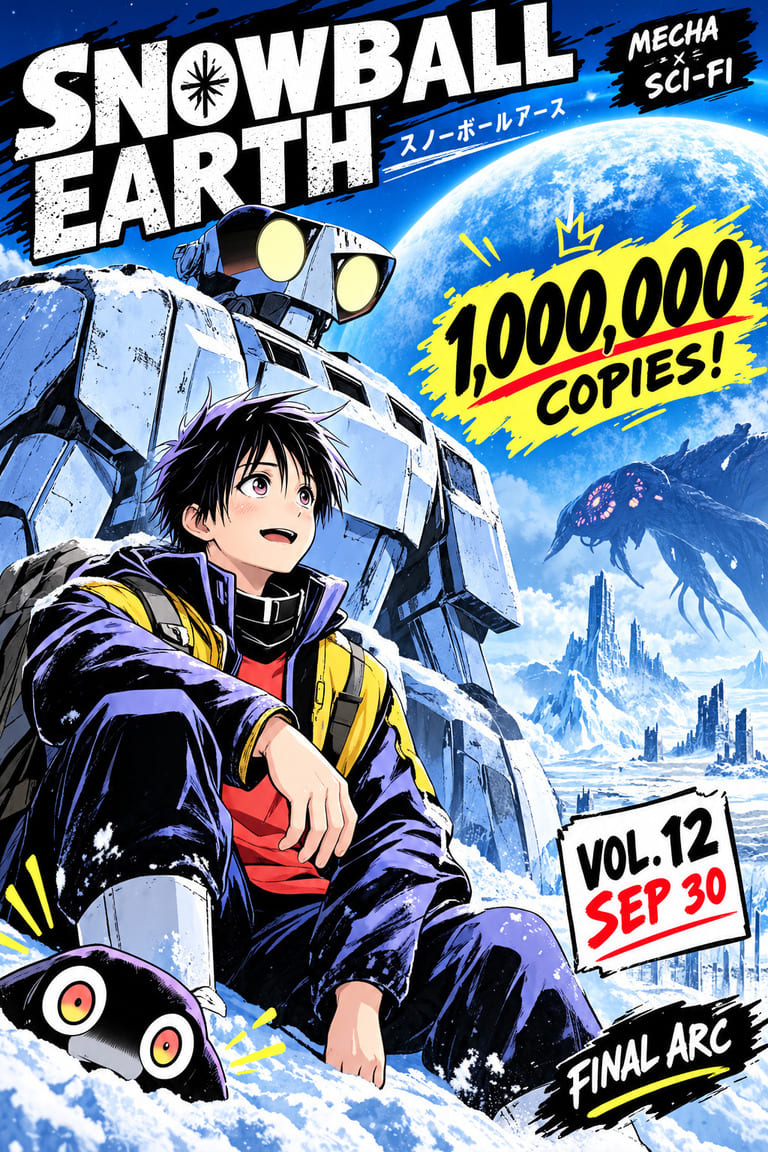
I’ll be honest: Snowball Earth is one of those manga that feels almost impossible to explain with a normal elevator pitch. You have giant robots, space monsters, a frozen post-apocalyptic Earth, and a protagonist whose biggest struggle isn’t simply surviving — it’s figuring out how to connect with other people. Now that Yuhiro Tsujitsugu has announced that the manga has passed 1 million copies in circulation worldwide and has entered its final arc, it feels like the right moment to look back at why this strange sci-fi series has connected with so many readers.
The timing is especially interesting because Volume 12 is scheduled to release in Japan on September 30. For readers who have been following Tetsuo Yabusame’s journey from the beginning, this is no longer just another volume announcement. The story is heading toward its ending, and suddenly every little detail about Tetsuo, Yukio, the frozen Earth, and the mysterious creatures roaming the planet feels much more important.
Phantom Busters Anime Officially Announced for 2027 Release: Everything We Know So Far
Why Snowball Earth Stands Out From Other Mecha Manga
When someone says ‘mecha manga,’ my brain naturally goes toward familiar ideas: enormous robots, military organizations, pilots dealing with impossible battles, and some huge enemy threatening civilization. Snowball Earth certainly has pieces of that formula, but Tsujitsugu approaches it from a much quieter and more personal direction.
At the center of everything is Tetsuo Yabusame, a painfully shy boy who struggles with human interaction. His relationship with Yukio, the autonomous giant robot that becomes his closest companion, is arguably more important than any individual monster fight. Yukio isn’t simply a machine Tetsuo happens to pilot. Their friendship gives Tetsuo something he desperately needs, and that makes the eventual separation between them hit much harder.
That emotional foundation is what kept me reading. You can have the coolest robot design imaginable, but if I don’t care about the person inside it, the battles eventually become background noise. Snowball Earth understands that the relationship between Tetsuo and Yukio is the real engine of the story.
A Frozen Earth Is the Perfect Setting for This Story
The basic premise is already wild. After a decade-long war against enormous extraterrestrial monsters, Tetsuo and Yukio make a desperate final attack in deep space. The battle ends horribly, Yukio is apparently destroyed, and Tetsuo escapes in a survival pod before entering cold sleep.
Eight years later, he returns.
And Earth is gone.
Well, technically the planet is still there, but the world Tetsuo remembers has disappeared beneath an enormous layer of ice and snow. The entire planet has effectively become a Snowball Earth, leaving Tetsuo stranded in an environment that feels almost alien despite being his former home.
I really like this choice because the setting mirrors Tetsuo’s emotional state. He wakes up alone on a frozen planet after losing the one companion who truly understood him. The landscape is cold, empty and hostile, but so is Tetsuo’s life at that point.
His promise to Yukio gives the journey a surprisingly simple goal: Tetsuo has to go out into the world and make real human friends.
That sounds almost cute when written down. In practice, it becomes a fascinating challenge because this is a world filled with survivors, monsters, ruins and unanswered questions. Tetsuo isn’t simply searching for civilization. He’s learning how to become part of it.
The Story Is About Loneliness More Than Survival
This is probably the aspect of Snowball Earth that I think gets overlooked when people describe it as a post-apocalyptic mecha series.
Yes, there are giant monsters. Yes, there are robots. Yes, the frozen wasteland looks spectacular. But underneath all of that, the manga is surprisingly interested in loneliness and human connection.
Tetsuo starts his journey with an almost impossible emotional disadvantage. He has lost his home, his familiar world and Yukio, while also having very little experience forming relationships with other humans. Every new person he encounters therefore carries more significance than you might expect.
The series keeps asking a simple question: what does it actually mean to rebuild your life after everything familiar has disappeared?
That question gives the manga considerably more weight than a straightforward monster-of-the-week adventure.
The Artwork Makes the Frozen World Feel Huge
Tsujitsugu’s artwork is another major reason the series works for me. There is a very particular contrast between the scale of the mecha and the emptiness surrounding it.
A giant robot standing in a ruined city should make the machine feel powerful. In Snowball Earth, sometimes it has the opposite effect. Put that same robot against an enormous frozen landscape and suddenly even a machine designed for war can look incredibly small.
The manga also gets a lot of mileage out of its creature designs. The galactic behemoths and mutated kaiju give the series the kind of visual identity that makes individual encounters memorable, while the ruined Earth provides a constant reminder that humanity has already lost.
Some of the imagery has that classic sci-fi feeling where you can almost imagine the camera slowly pulling backward to reveal just how enormous the world really is.
The 1 Million Copy Milestone Matters
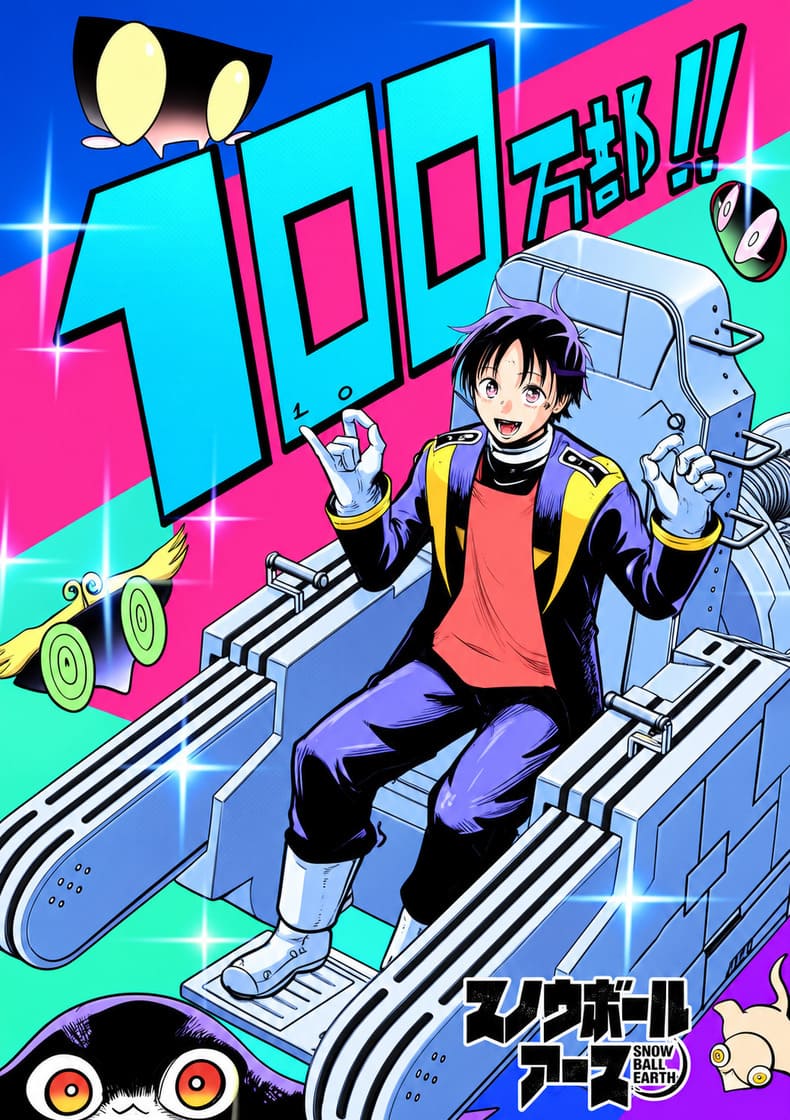
Crossing 1 million copies in circulation worldwide is a significant moment for a relatively unusual seinen science-fiction manga. Snowball Earth began serialization in Shogakukan’s Monthly Big Comic Spirits in January 2021, and its international audience has continued growing through official English releases.
For readers outside Japan, the availability of the manga through VIZ Media has also made it much easier to follow the story officially. The English edition recently reached its ninth volume, giving international readers a substantial amount of material to explore before the Japanese publication moves toward the conclusion.
| Snowball Earth milestone | Current status |
|---|---|
| Manga serialization | Began January 2021 |
| Publisher / magazine | Shogakukan / Monthly Big Comic Spirits |
| Worldwide circulation | Over 1 million copies |
| Japanese Volume 12 | September 30, 2026 |
| Story status | Final arc |
| English publisher | VIZ Media |
| Anime adaptation | Studio Kai |
For me, the most interesting part isn’t the number itself. It’s what the milestone says about the audience. A story this unusual has managed to build enough momentum to reach readers far beyond its original market.
The Anime Changed the Conversation
The 2026 anime adaptation also brought a completely new audience into the Snowball Earth fandom. Studio Kai’s television adaptation premiered on April 3, 2026, and immediately gave fans another way to experience Tetsuo’s lonely journey.
The anime’s atmosphere was particularly important. Snowball Earth can be quiet and introspective one moment and completely enormous the next, so translating that contrast into animation was always going to be a challenge.
The soundtrack, direction and giant-scale combat helped sell the idea that this wasn’t simply another robot show. The opening theme ‘Zero’ by tuki also became part of the show’s identity for a lot of viewers.
I think the anime works best when it allows the quieter scenes to breathe. The giant battles are obviously the material that gets people clicking on clips and screenshots, but Tetsuo sitting alone, exploring abandoned places or slowly interacting with survivors is where the story’s personality really comes through.
Now the Final Arc Changes Everything
This is where I’m most curious.
Once a manga officially enters its final arc, all the unanswered questions start feeling different. A mystery that might previously have been something to enjoy for another five years suddenly becomes something the author needs to resolve.
There are several major questions hanging over Snowball Earth:
- Can Earth actually recover from its frozen state?
- What caused the planet to freeze so dramatically?
- What exactly happened to Yukio?
- How much of Yukio’s consciousness might still exist?
- What kind of future can humanity build in this new world?
- Will Tetsuo finally find the human connections he was searching for?
The Yukio question is probably the one I care about most. Their relationship is so central to the manga that simply treating Yukio’s disappearance as a finished chapter would feel strange. The possibility that some part of the robot’s consciousness could still exist somewhere in the remnants of civilization is exactly the kind of sci-fi mystery that makes me want to keep theorizing.
At the same time, I don’t necessarily need the story to bring Yukio back in the most obvious way. Sometimes the more powerful ending is one that accepts loss instead of undoing it.
What I Hope the Ending Does
I’m hoping the final arc remembers what made Snowball Earth interesting in the first place.
It doesn’t need to become a giant explanation dump where every mystery gets a perfectly convenient answer. The series has always worked because its huge science-fiction ideas are connected to something very human.
Tetsuo started this journey as someone who barely knew how to communicate with other people. He then lost the friend who mattered most to him, woke up in a world he didn’t recognize, and had to keep moving despite having every reason to shut himself away.
If the ending can bring that emotional journey full circle, I’ll be satisfied.
Whether Earth becomes habitable again is almost secondary to me. What matters is whether Tetsuo can finally build a life that belongs to him rather than simply trying to restore the life he lost.
Snowball Earth Has Become a Series Worth Watching Until the End
The 1 million-copy milestone is a nice celebration, but the timing makes it feel even more significant because we’re approaching the end of the story. After years of watching Tetsuo cross a frozen Earth, fight bizarre creatures and search for answers about the world around him, readers finally have a destination.
That’s both exciting and a little sad.
Snowball Earth has never felt like a conventional mecha story to me. Its robots and monsters are the obvious hook, but the loneliness, friendship and strange beauty of its frozen world are what kept the series interesting. With Volume 12 arriving in Japan and the final arc now underway, longtime readers have plenty of reasons to start looking at old chapters again and wondering which seemingly minor details were actually clues.
And honestly, that’s exactly where I want a manga like this to be at the end: making me think about its mysteries while still caring about the people inside them.
Snowball Earth reaching one million copies is a major milestone, but the real test is still ahead. Now Yuhiro Tsujitsugu has to bring Tetsuo’s journey home.