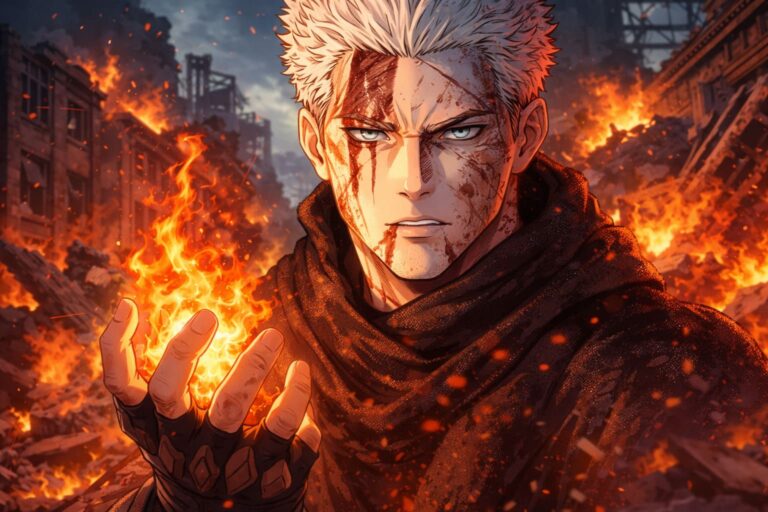
Graykeith: Translator Daemonica Chapter 7 Fan Analysis, Release Date, and Chapter 6 Recap
Some manga series make their protagonists stronger by giving them bigger weapons, more destructive attacks, or another transformation that conveniently arrives when the situation looks hopeless. Graykeith: Translator Daemonica takes a different route, and honestly, that’s what makes it so interesting. Here, understanding a language can be more dangerous than throwing a punch, and one poorly translated sentence might be the difference between summoning a harmless spirit and inviting something truly terrifying into the human world.
Chapter 6, titled “The Archon of Fire,” is a particularly good example of what this series does well. The latest chapter combines an urban fantasy crime investigation with dark comedy, introduces a memorable new supernatural character, and gives us a closer look at the consequences of treating demonic magic like an easy way to make money.
More importantly, the ending raises the stakes without abandoning the manga’s central idea. Graykeith doesn’t win because he suddenly discovers a more powerful attack. He wins because he understands something his enemies don’t.
And after that cliffhanger, Chapter 7 has plenty of interesting directions to explore.
Graykeith: Translator Daemonica Chapter 6 Recap – A Translation Job Gone Wrong
Chapter 6 begins with Tokyo struggling to deal with a series of mysterious fires. The police have reached the point where conventional investigative methods aren’t enough, forcing them to seek help from Graykeith, a professional translator whose expertise extends far beyond ordinary languages.

The unusual part is that the fires aren’t simply supernatural accidents. Someone is deliberately using demonic magic to commit arson, and the people responsible have discovered a disturbing business opportunity.
Rather than mastering the dangerous language themselves, they pay inexperienced translators to do the work for them.
It’s a clever setup because it turns the chapter’s central mystery into something more than a search for a criminal. Graykeith is investigating what happens when people acquire access to a powerful system without understanding its rules.
Mister Shigi and Tokyo’s Underground Spellbook Market
The investigation eventually leads to Mister Shigi, a shady middleman dealing in forbidden occult materials. His inventory includes dangerous spellbooks, unusual magical substances, and texts that respectable translators would never willingly touch.
Shigi’s business model is built around one simple idea: even the most dangerous spellbook is useless if its owner cannot read it.
That creates an opening for desperate amateurs who are willing to translate linguae daemonica, the language of demons, for money. One of Shigi’s customers is an ordinary corporate employee who has become obsessed with the destructive beauty of the fires he helped create.
The employee’s behavior is unsettling precisely because he doesn’t resemble a traditional fantasy villain. He’s an unhappy office worker who discovers an easy way to destroy something that once made him miserable. Instead of confronting his problems, he finds satisfaction in watching his workplace burn.
I’ve always found this kind of character more interesting than another generic power-hungry sorcerer. His motivations are painfully recognizable, even if his actions are completely indefensible. The supernatural element doesn’t create his resentment; it simply gives that resentment a horrifying outlet.
Uvlor Reveals the Darker Side of Demonic Magic
The corporate arsonist isn’t working alone. His summoned companion, Uvlor, is a tall, pale creature with multiple eyes and a mouth full of sharp teeth. More importantly, this demon feeds on human souls.
Chapter 6 gives us a particularly disturbing explanation of how Uvlor perceives his food. When the conversation turns to the taste of human souls, he compares the experience to alcohol from a human perspective, although he clarifies that demons don’t become visibly intoxicated in the same way.
It’s a small detail, but it makes the supernatural world feel stranger and more specific. Demons aren’t simply monsters that attack humans because the plot requires a fight. They have their own appetites, preferences, and relationships with the people who summon them.
Uvlor also exposes the weakness in Shigi’s operation. The middleman keeps supplying human arsonists, and the demon continues cooperating because that arrangement gives him access to more souls.
The criminals believe they’re controlling supernatural power, but they’re also feeding a creature that sees human beings as a resource.
That imbalance makes the entire scheme feel considerably more dangerous than an ordinary black-market operation.
How Graykeith Solves the Arson Mystery Without Throwing a Punch
While Shigi and his associates discuss their activities, Graykeith and his team examine the evidence left behind at the fire scenes.
The police have discovered that the Molotov cocktails used in the attacks bear identical occult markings. Graykeith recognizes the design as a summoning circle intended to attract Will-o’-the-Wisps, relatively minor entities from the Daemon Realm.
Kisaragi, his aspiring translator, has already helped by producing an accurate forensic sketch of the symbol. The Letter-Mate Fairies provide another useful clue: their ability to sense nearby members of their own supernatural kind allows them to help track the creatures back toward their source.
This is where the manga’s approach to magic really starts to stand out.
In many battle-focused fantasy series, an investigation like this would eventually lead to a confrontation where the protagonist reveals a hidden ability. Graykeith instead approaches the problem like a linguist examining a badly constructed sentence.
He notices that the criminal’s summoning circle was copied from an existing spellbook and then carelessly altered. The arsonist originally attempted to summon something far more powerful than a Will-o’-the-Wisp, but he lacked the skill to complete the ritual correctly.
His solution was to remove sections of the original Pyreth text, effectively trying to reduce the rank of the intended summon.
Unfortunately for him, demonic language doesn’t work like a video game difficulty setting.
The ritual was butchered so badly that the intended entity never answered. The criminal ended up with weaker spirits trapped inside glass bottles instead.
Graykeith’s criticism goes beyond the man’s technical incompetence. He understands that the real problem is the complete lack of respect for the language and the beings it invokes.
In this manga, translation isn’t just about converting words. It’s about understanding the structure, intention, and consequences behind them.
That’s a much more distinctive foundation for a supernatural power system than simply assigning characters increasingly large energy attacks.
Baron Du Flaim: The Archon of Fire Steals the Show
The confrontation escalates when the corporate arsonist orders Uvlor to attack Graykeith. Instead of panicking, the translator produces a metallic lighter engraved with a powerful demonic crest.

He activates it and recites an incantation:
“Every misfortune, every blight… The Crimson Forge shall double their might. Come forth…”
The result is spectacular. A tremendous shockwave accompanies the arrival of Baron Du Flaim, Lord of Hellfire, a being the terrified criminals recognize as the Archon of Fire.
His appearance is one of Chapter 6’s strongest visual moments. Du Flaim takes the form of a towering humanoid silhouette made of black shadow and white-hot flames, wearing a formal Victorian tailcoat and cravat.
The contrast is fantastic. He looks less like a conventional fire monster and more like an aristocratic demon who has reluctantly agreed to attend an appointment beneath his station.
And, as it turns out, that is practically the situation.
Du Flaim immediately complains that Graykeith has summoned him to deal with pathetic opponents despite their previous agreement. He clearly considers the entire affair beneath him, which makes the scene funny without diminishing his power.
Then comes the final threat. Looking toward Uvlor and the criminals, the Archon proposes giving them a dose of searing heat while leaving their bones behind.
It’s a wonderfully nasty cliffhanger, and the character’s personality is just as memorable as his entrance.
My favorite part of this reveal is that Graykeith doesn’t summon a powerful demon who obediently follows every command. He summons a powerful demon who has opinions about the quality of his assignments. That single detail opens up plenty of possibilities for future chapters.
Graykeith Chapter 7 Predictions: What Happens After the Cliffhanger?
Chapter 6 leaves several story threads unresolved. The immediate confrontation is the obvious priority, but the illegal spellbook trade and Graykeith’s relationship with his summons could prove more important in the long run.
The following predictions are based on the events and clues established in Chapter 6 rather than confirmed information about the next chapter.
1. Baron Du Flaim Will Overwhelm Uvlor
The most immediate question is whether Uvlor has any chance against the Archon of Fire.
Based on their presentation, the power gap appears enormous. Uvlor is dangerous to ordinary humans, but Du Flaim belongs to a much higher level of the demonic hierarchy. The criminals’ reaction suggests that they understand the difference, too.
I expect Chapter 7 to begin with a short, one-sided demonstration of the Baron’s strength. Uvlor might attempt to defend himself or escape, but a prolonged battle would undermine the setup of the previous chapter.
The more interesting question is what happens to Shigi and his client afterward. Graykeith will presumably want answers, and the police will need enough evidence to connect the suspects to the arson attacks.
Du Flaim’s intervention could end the immediate threat quickly, leaving the investigation to deal with the consequences.
2. Shigi’s Spellbook Supply Chain Could Expand the Story
Shigi is an important character because he doesn’t appear to be the mastermind behind the entire operation. He buys dangerous materials from an unidentified supplier and passes them to customers who lack the knowledge to use them safely.
That raises an obvious question: who is putting forbidden demonic texts into circulation in the first place?
The next chapter could use Shigi’s interrogation to introduce another figure in Tokyo’s supernatural underworld. A hidden library, an occult organization, or a network of illegal translators would all fit the groundwork established so far.
The possible connection to the House of the Veiled Book is especially intriguing. If the series intends to develop its episodic investigations alongside its larger mystery, the spellbook trade could provide a natural bridge between the two.
I wouldn’t expect every question to be answered immediately. However, even one concrete clue about Shigi’s supplier would make the arson case feel like the beginning of something much larger.
3. Graykeith’s Contract With the Archon May Have Serious Limits
Du Flaim’s arrival is impressive, but it isn’t entirely comfortable for Graykeith.
The translator visibly struggles with the heat generated by the summon, and the Baron is clearly unhappy about being called into the human world for such a minor dispute. Their interaction suggests that summoning powerful entities involves more than knowing the correct words.
There may be contractual restrictions, physical costs, or practical limitations that Graykeith has learned to manage through experience.
Chapter 7 could explore these rules without needing another major fight. Perhaps Graykeith must dismiss Du Flaim quickly, negotiate with him, or deal with the consequences of keeping such a dangerous entity nearby.
I would particularly like to see the manga establish that Graykeith’s knowledge doesn’t make him invulnerable. A protagonist who understands the rules but still has to work within them is usually more compelling than one who can solve every problem simply by knowing more than everyone else.
4. Kisaragi Could Take Another Step Toward Becoming a Translator
Kisaragi’s contribution to the investigation may look relatively minor compared with the arrival of the Archon, but it serves an important purpose.
Her forensic sketch helps the team identify the summoning circle, and Graykeith’s explanation demonstrates exactly why precision matters when dealing with linguae daemonica.
That creates an excellent teaching opportunity for the next chapter. Graykeith could give Kisaragi a more demanding translation exercise or ask her to examine one of the recovered occult texts.
I don’t expect her to suddenly master demonic magic. That would undermine the careful distinction between Graykeith’s expertise and the criminals’ amateur shortcuts.
Instead, a small breakthrough would be enough. Learning to recognize a dangerous grammatical structure, identify a deliberately altered inscription, or understand why a particular translation is unsafe would represent meaningful progress.
It would also reinforce the idea that Kisaragi’s development depends on knowledge and patience rather than a convenient burst of supernatural power.
What Chapter 6 Means for the Future of the Manga
The strongest aspect of Chapter 6 is the way it connects the immediate criminal investigation to the series’ broader themes.
The arsonists treat demonic language as a shortcut to power. Shigi treats forbidden knowledge as a product to sell. Uvlor sees humans as food. Graykeith, by contrast, understands that language creates obligations and consequences that cannot simply be edited away.
That conflict gives the series a consistent identity.
| Story Element | Why It Matters |
|---|---|
| The failed summoning circle | Establishes that precision is essential to demonic magic. |
| Shigi’s illegal spellbooks | Introduces a potential larger criminal network. |
| Uvlor’s appetite for souls | Expands the mythology of the Daemon Realm. |
| Baron Du Flaim’s arrival | Demonstrates the difference between demonic ranks. |
| Kisaragi’s investigation work | Gives the supporting cast room to develop. |
The chapter also benefits from its balance of horror and comedy. The arsonist’s obsession with destruction is genuinely disturbing, while Du Flaim’s outrage at being summoned for such an insignificant job provides a welcome change of tone.
Neither element completely overwhelms the other.
The Ura Files Chapter 8: Release Date, Full Chapter 7 Recap, and Fan Breakdown
Final Verdict: Chapter 6 Gives Graykeith a Stronger Identity
Chapter 6 of Graykeith: Translator Daemonica delivers a satisfying supernatural mystery while making the manga’s central gimmick feel like a genuine storytelling advantage.
The criminal investigation has a clear resolution in sight, the magic system rewards careful reading, and Baron Du Flaim arrives with enough personality to become one of the chapter’s most memorable characters. Meanwhile, Shigi’s connections to the illegal spellbook trade leave the door open for a larger conflict.
For Chapter 7, the most likely immediate development is the confrontation between Du Flaim and Uvlor, followed by the aftermath of the arson case. The more exciting possibility is that Graykeith discovers the criminals were only a small part of a much bigger operation involving forbidden texts.
What I hope the manga avoids is rushing through these consequences just to introduce another powerful demon. The series is at its best when the mystery, the language, and the characters’ personalities work together.
If Chapter 6 is any indication, Graykeith doesn’t need to win the biggest battle in Tokyo. He just needs to be the only person in the room who actually understands what everyone has summoned.
And after meeting the Archon of Fire, I suspect even Graykeith’s enemies will think twice before attempting another amateur translation.