Goodbye Lara Anime Ending Explained: Memorial Visual, Final Episode Controversy, and Yuri Backlash
I went into the finale of Goodbye Lara expecting the usual emotional payoff: a big confession, tears, maybe a last-minute miracle, and Lara finally getting the kind of happy ending a modern fairy-tale anime seems to promise. Instead, the series decided to pull the rug out from under me. The 12th episode leaves Lara and Mari in a painfully complicated place, and honestly, I can understand why the anime community is split.
What makes the ending especially interesting is that Goodbye Lara never felt like a straightforward romance in the first place. From the beginning, it was playing with The Little Mermaid, but it wasn’t simply replacing the original prince with a Japanese high-school boy and calling it a day. Kinema Citrus built something much more personal around Lara’s story, turning her search for love into a question about identity, dependence, loneliness, and whether a person can actually learn to live for themselves.
And yes, the Yuri discussion is impossible to ignore.
Goodbye Lara’s Final Episode Takes a Completely Different Path
The basic setup still works beautifully in retrospect. Two hundred years before the main story, Lara was a mermaid princess who fell in love with a human prince. She made a deal with the sea witch Grace to become human, but the price was brutal: without true love, she would eventually disappear into sea foam.
The prince married someone else, Lara vanished, and that should have been the end of her fairy tale. Instead, she wakes up centuries later in modern Japan near Lake Biwa. That’s where she meets Mari Otsu, a girl who initially seems like the grounded human counterpart Lara desperately needs.
The first time I watched their relationship develop, I naturally started reading it as romantic. I don’t think I’m alone there. The anime spends so much time showing Lara and Mari learning each other’s habits, dealing with emotional baggage, sharing a home, and becoming each other’s safest place that it is almost impossible not to see romantic subtext in certain scenes.
But episode 12 refuses to give us the obvious answer.
Rather than staying with Mari, Lara decides to leave. She chooses independence over a comfortable life together, and Mari is left standing there with all the emotions the show has been carefully building for the entire season.
That’s a bold choice.
It’s also exactly why so many viewers are angry.
Was Goodbye Lara Actually Yuri?
This is probably the biggest question surrounding the Goodbye Lara ending.
The anime never gives Lara and Mari the straightforward romantic confession that many Yuri fans were waiting for. At the same time, their relationship is far more emotionally intimate than the average friendship presented in a fantasy adventure. The writers clearly understood that viewers would read their connection in different ways.
For me, this is where the finale becomes both fascinating and frustrating.
The contrast with Lara’s earlier relationship with Luca makes the situation even more complicated. Her romance with a male character is presented through more recognizable fairy-tale conventions, while her relationship with Mari receives the deeper emotional development.
| Element | What the Anime Shows |
|---|---|
| Lara and Mari | Extremely close emotional bond |
| Domestic relationship | They share a strong everyday life |
| Romantic confession | Never explicitly happens |
| Lara’s final decision | She leaves to live independently |
| Mari’s reaction | Deeply emotional and clearly hurt |
| Ending | Intentionally open to interpretation |
So when Lara leaves Mari without a romantic resolution, it is understandable that some viewers interpreted the finale as Yuribait.
I wouldn’t personally reduce the entire anime to that accusation, though. There is clearly more going on here.
Why Some Fans Feel Betrayed by the Finale
The frustration isn’t really about Lara leaving by itself. It’s about what the previous eleven episodes appeared to promise.
If you’ve spent an entire season watching two girls become inseparable, survive painful experiences together, and repeatedly act as emotional anchors for each other, you naturally expect that relationship to lead somewhere. Anime fans are used to reading these kinds of narrative signals.
Then Goodbye Lara basically says: maybe the relationship itself was the destination.
I can see why that doesn’t satisfy everyone.
The most painful moment for me is Mari’s reaction. She isn’t angry in some dramatic anime fashion. She’s simply devastated, and the quietness of the scene makes it worse. After everything the two characters have experienced, watching Mari lose Lara without receiving a clear answer about what their relationship actually meant feels deliberately cruel.
Some fans have also argued that Lara’s decision arrives too quickly. Her final emotional shift happens near the end of the episode, and viewers who expected a traditional romantic climax may feel that the transition doesn’t receive enough time.
That criticism makes sense.
The anime spends so much time developing Lara’s dependence on Mari that the sudden emphasis on independence can feel like the writers are changing the rules during the final act.
The Other Interpretation Makes a Lot of Sense
At the same time, I think the people defending the finale have a very strong argument.
Goodbye Lara may never have been about Lara finding someone who could complete her.
That’s a much more interesting idea.
Think about Lara’s entire history. Two centuries ago, she was willing to completely transform herself because she believed romantic love would give her a place in the human world. When she wakes up in modern Japan, she continues searching for a version of that same emotional security.
Mari becomes incredibly important to her, but that doesn’t automatically mean Mari is supposed to become her romantic savior.
Instead, Mari might represent the first person who gives Lara the freedom to discover herself.
That’s why Lara leaving becomes so important.
She’s finally refusing to make another person the center of her existence.
The Little Mermaid Influence Is Still Everywhere
The Andersen connection also becomes much clearer when you look at the finale this way.
The original The Little Mermaid isn’t simply a cute romance story. Its themes include sacrifice, longing, transformation, and the painful consequences of trying to become someone else for another person.
Goodbye Lara takes those ideas and pushes them into a modern character drama.
Lara begins the story believing that becoming human will solve her problems. She then believes that finding love will give her life meaning. By the finale, she realizes that neither transformation nor romance can define who she is.
That’s actually a pretty powerful message.
I just wish the anime had communicated it more clearly.
The finale asks the audience to understand Lara’s decision emotionally rather than explaining every step of her thinking. For viewers who enjoy ambiguity, that’s probably part of the appeal. For everyone who wanted a clear romantic conclusion, it feels like being asked to fill in too many blanks.
That Last Scene With Mari Changes Everything
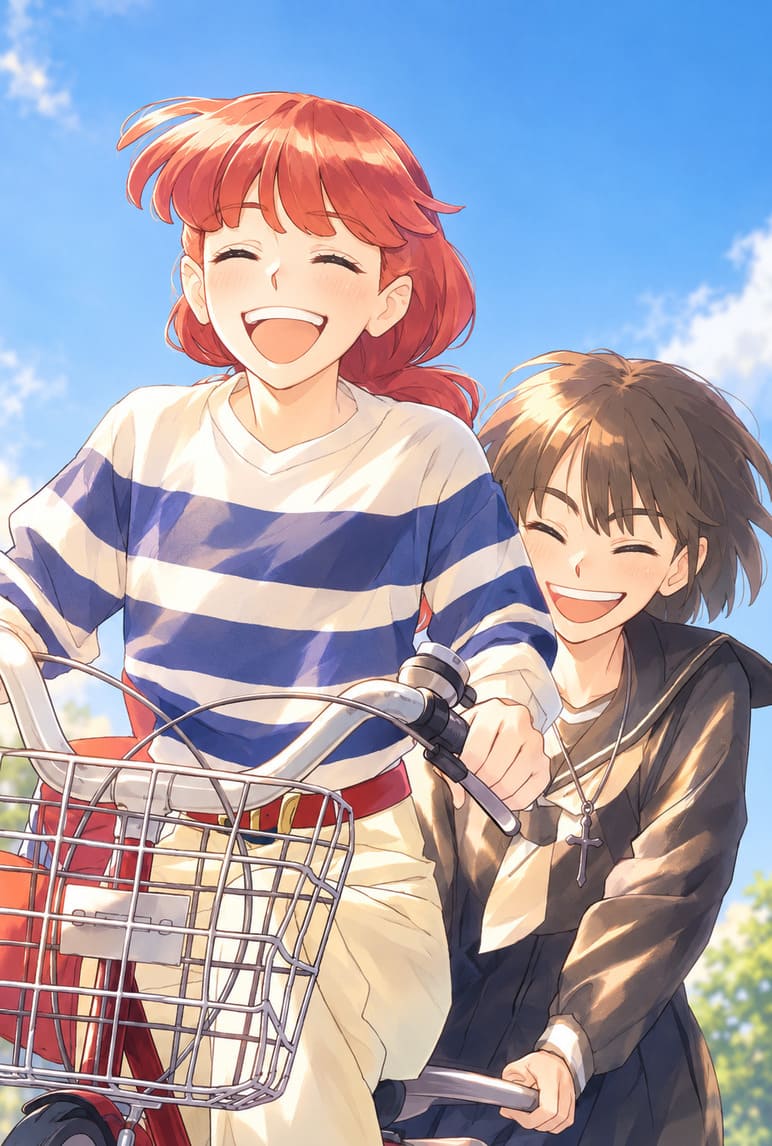
The station sequence is probably going to be the scene everyone remembers from Goodbye Lara.
Lara leaves, Mari is visibly emotional, and the series refuses to give us the conventional goodbye that would settle the relationship once and for all.
There is no clean ‘I love you.’
There is no magical promise that they will definitely reunite.
There isn’t even a standard happily-ever-after montage.
Instead, Lara walks forward alone.
That’s why I don’t think the ending should automatically be interpreted as Lara rejecting Mari. In some ways, it’s the opposite. Mari has become important enough to Lara that she can finally imagine a life beyond needing someone to survive.
The symbolism surrounding the soul-eating fish dagger adds another layer to the sequence. Lara has spent the entire story surrounded by external threats, magical rules, and expectations about what she is supposed to become. Walking away from all of that is essentially her first decision that belongs entirely to herself.
The Memorial Visual Makes the Ending Feel Even More Bittersweet
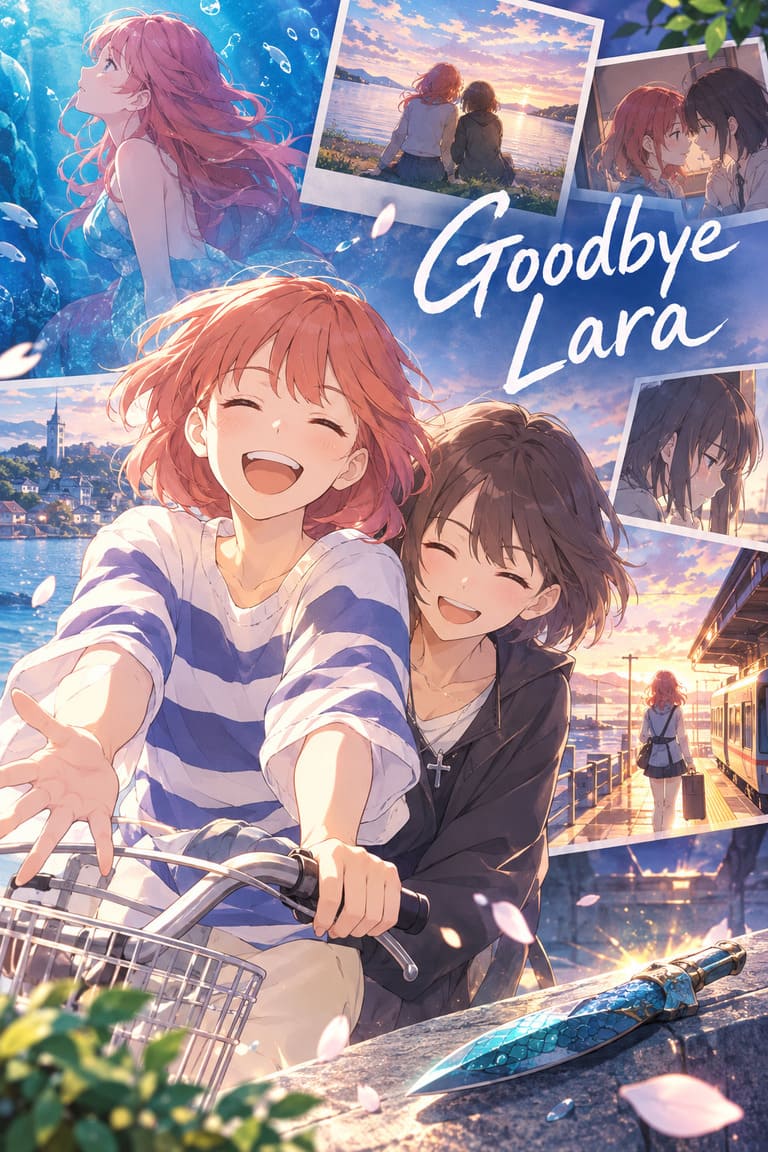
After the final episode, Kinema Citrus released a memorial visual celebrating the conclusion of the series, along with a special music video built around Ikimonogakari’s opening theme.
I really like the decision to end the anime’s promotional campaign this way because the music video functions almost like a goodbye letter from the production itself. It revisits important scenes and character moments from the twelve episodes, making the finale feel less like a conclusion to one plot and more like the end of a specific period in Lara’s life.
The music also deserves credit here.
Yuma Yamaguchi’s score gave Goodbye Lara a distinctive emotional atmosphere throughout the season, while Hana Hope’s ending theme, Hearts Glow, fits the show’s melancholy mood almost suspiciously well after seeing the finale.
The whole presentation makes it difficult to stay angry at the anime for long.
Goodbye Lara Ending: My Take
If I wanted a satisfying romance ending, I’d be lying if I said episode 12 didn’t disappoint me.
I wanted Lara and Mari to have that moment. I wanted the anime to finally say what their relationship was. After twelve episodes of emotional buildup, I wanted something unmistakable.
But after thinking about the finale, I also appreciate what the writers were attempting.
Lara doesn’t need another person to validate her existence. Her entire tragedy began because she believed love could solve everything. Ending the story with her choosing herself creates a strange symmetry with the original fairy tale.
The problem is that the anime gets there in a way that can easily be mistaken for emotional abandonment.
That’s where Goodbye Lara is going to remain divisive.
Some viewers will remember a beautiful story about two girls whose relationship helped them grow, even if it never received a romantic label. Others will remember an anime that spent eleven episodes building what looked like a Yuri romance before refusing to acknowledge it directly.
Both readings come from things that are actually present in the show.
What Could Happen Next?
The manga adaptation gives this story another interesting possibility.
If the printed version expands the material around Grace, Lara’s past, or the relationship between Lara and Mari, it could potentially provide additional context that the anime simply didn’t have room to explore. I’m especially curious about whether the manga will spend more time on Lara’s decision to leave.
A future reunion would also be fascinating, although I wouldn’t want it to completely erase the meaning of the finale.
For me, the best continuation would be one where Lara returns to Mari not because she needs Mari, but because she finally chooses Mari.
That’s a very different kind of love story.
And honestly, that’s probably why people are still arguing about Goodbye Lara after the credits have rolled. A forgettable finale gives everyone the same reaction. This one doesn’t. It leaves viewers debating what love means, whether emotional intimacy needs a romantic label, and whether choosing yourself can sometimes mean walking away from the person you care about most.
Whatever side you land on, Goodbye Lara clearly wasn’t interested in giving us the easy fairy-tale ending.
And after twelve episodes, I’m still not completely sure whether I love that decision or wish the writers had given Lara and Mari five more minutes.