Oh Boy Was I Wrong About Her Light Novel Ending Explained: Volume 11 Details and Final Spoilers
If you’ve followed Oh Boy Was I Wrong About Her from the very beginning, you probably know the strange feeling of wanting Hayato to wake up already. I lost count of how many times I wanted to yell at him through the pages. At the same time, that slow emotional progress was exactly what made this romantic comedy different from dozens of similar school romance light novels.
Now that Volume 11 has officially closed the story, I can honestly say something I wasn’t expecting a year ago—I think the ending was worth the wait.
A lot of romance series either stretch their relationships until readers lose interest or rush everything into a last-minute confession. Somehow this one managed to avoid both mistakes. It isn’t perfect, but it feels genuine, and that’s becoming surprisingly rare in modern romantic comedy light novels.
BanG Dream YUME MITA Episode 8 Preview Theory Mugendai Mewtype Viola Drama
A Childhood Friendship That Never Felt Like a Cheap Gimmick
At first glance, the premise sounds almost too ridiculous.
Hayato returns to his hometown expecting to reunite with the childhood buddy he always believed was another boy. Instead, he finds Haruki, now an elegant and incredibly beautiful high school girl who looks nothing like the rough kid from years ago.
That misunderstanding could have become nothing more than a comedy gimmick.
Instead, it became the emotional center of the entire series.
What always impressed me was how Haruki switched between two completely different personalities. Around everyone else, she carried herself with grace and confidence. Around Hayato, she dropped the act almost instantly, revealing the sarcastic, energetic friend she had always been. Those private moments gave the relationship a natural chemistry that many romance series struggle to create.
Rather than feeling like two strangers falling in love, they always felt like two people rediscovering someone they had never truly forgotten.
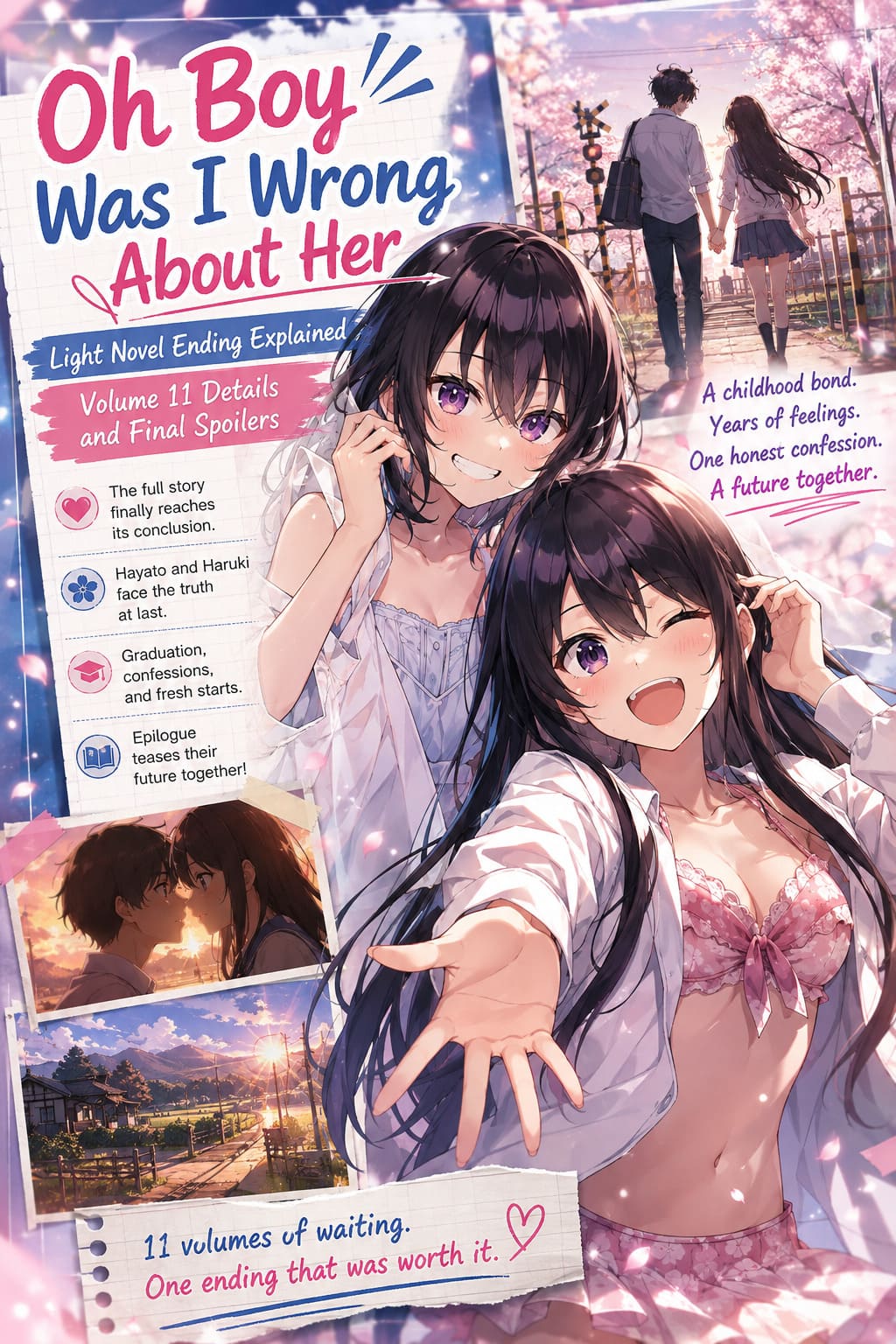
Volume 11 Finally Gives Readers the Conversation We Waited Years For
After ten volumes of emotional hesitation, misunderstandings, and almost-confessions, the final novel finally puts everything on the table.
Graduation becomes the emotional deadline hanging over both characters. Everyone around them seems to realize what has been obvious for ages, and the supporting cast wisely stops getting in the way. I appreciated that choice because this wasn’t the moment for unnecessary drama.
Instead, the story slows down.
It lets Hayato and Haruki simply talk.
That’s honestly where the novel shines the brightest.
Rather than relying on exaggerated comedy or forced misunderstandings, the climax focuses on memories, regrets, and promises made during childhood. Returning to the countryside where everything originally began felt surprisingly emotional instead of overly nostalgic.
When Hayato finally admits that the feelings he carried for years have transformed into romantic love, it doesn’t feel like a shocking twist.
It feels overdue—in the best possible way.
Why Hayato’s Growth Actually Works
I’ve seen plenty of readers call Hayato dense.
They’re not wrong.
Still, I think there’s an important difference between being oblivious for comedy and being emotionally confused.
Hayato wasn’t ignoring Haruki because he was written to be frustrating. He genuinely struggled to separate the childhood image burned into his memory from the young woman standing in front of him.
That’s a subtle distinction that made his development believable.
By the final volume, he isn’t suddenly a different person.
He’s simply honest for the first time.
That honesty makes the confession far more satisfying than if it had happened halfway through the series.
Things I Personally Loved About the Ending
- The romance actually reaches a clear conclusion instead of stopping at another tease.
- Haruki gets to express her emotions without hiding behind her ‘perfect girl’ image.
- The final chapters avoid unnecessary love triangle drama.
- The epilogue gives readers a glimpse beyond high school instead of abruptly ending.
Those might sound like small victories, but longtime light novel readers know they’re surprisingly uncommon.
The Epilogue Was Exactly What I Wanted
One of my biggest fears before reading Volume 11 was getting an ending that immediately cut to the credits after the confession.
Thankfully, that isn’t what happened.
The additional scenes showing Hayato and Haruki moving toward college life together gave the relationship room to breathe. It wasn’t overly dramatic or filled with huge twists.
Instead, it simply showed two people finally becoming comfortable with feelings they had been avoiding for years.
Sometimes that’s all a romance needs.
How This Ending Compares to Typical Rom-Com Finales
| Element | Oh Boy Was I Wrong About Her | Typical School Rom-Com |
|---|---|---|
| Romantic confession | Clear and mutual | Often delayed or ambiguous |
| Childhood friend storyline | Fully resolved | Frequently left unfinished |
| Main couple | Official relationship | Open ending in many cases |
| Epilogue | Future teased beyond graduation | Sometimes skipped entirely |
| Emotional payoff | Strong focus on closure | Mixed depending on the series |
Looking at it this way, I think the series succeeds because it respects the reader’s investment.
Eleven volumes is a long commitment.
Readers deserved a real ending.
The Anime Now Has an Even Brighter Future
One thing that excites me even more is what this means for the anime adaptation.
Now that the original light novel has officially wrapped up, the studio has a complete roadmap instead of guessing where future arcs are headed. That usually helps adaptations maintain a steadier pace and avoid awkward filler decisions.
Watching the anime while already knowing that the source material sticks its landing actually makes the experience more enjoyable.
Instead of wondering whether all this emotional buildup will eventually pay off, I already know that it does.
And that’s honestly refreshing.

Not Every Romance Needs Endless Drama
Something I’ve noticed over the last few years is that many romantic comedies mistake frustration for tension.
- Characters refuse to communicate.
- Confessions get interrupted.
- Relationships reset every few chapters.
This series definitely flirted with those tropes, but it knew when to stop.
Volume 11 remembers that readers spent years following these characters because they wanted to see them together—not because they wanted another fake-out confession.
That decision alone elevated the finale for me.
Will Everyone Love It? Probably Not
Of course, no ending satisfies every reader.
Some fans will probably argue that the romance could have progressed sooner.
Others may wish supporting characters had received more attention before the story wrapped up.
Those are fair criticisms.
Personally, though, I’d rather have an ending that stays focused on its central relationship than one that tries to please everyone and loses its emotional core along the way.
My Final Take After Finishing Volume 11
When I closed the last page, I didn’t feel shocked.
I felt relieved.
Not because the series was over, but because it respected everything that came before it. Hayato and Haruki finally earned the happy ending that had been quietly building since their childhood days, and the story never forgot why readers cared about them in the first place.
Years from now, I probably won’t remember every joke or every side character. What I’ll remember is how a seemingly silly misunderstanding grew into one of the more heartfelt childhood-friend romances I’ve read recently. In a genre filled with endless hesitation and unfinished relationships, Oh Boy Was I Wrong About Her actually delivers closure—and as a fan, that’s exactly what I wanted.