Taira Backstory in You and I Are Polar Opposites Season 2 Explained
When You and I Are Polar Opposites Season 2 started, I expected more adorable moments between Suzuki and Tani. They’re still one of the most refreshing romance couples we’ve had in years, but somewhere along the way I realized I was waiting for a completely different character every week. That character is Shuuji Taira. I honestly didn’t expect the series to make me care this much about the sarcastic guy sitting in the background.
During the first season he mostly felt like comic relief with a gloomy personality. Season 2 completely flips that impression upside down. Instead of making him simply ‘the edgy kid,’ the anime slowly peels back every layer until you understand exactly why he became this way. As someone who’s watched more romance anime than I’d like to admit, I think Taira has become one of the most believable supporting characters in recent years.
If you’ve been browsing anime communities lately, you’ve probably noticed the same trend. Discussions aren’t just about the main romance anymore. Fans keep coming back to Taira because his struggles feel painfully real, and that’s exactly what separates this series from countless other romantic comedies released over the past few years.
Where To Watch The Ribbon Hero English Subtitles Worldwide: Streaming Guide For The 2026 Anime Movie
More Than Just the ‘Negative Guy’
At first glance, Taira looks like the stereotypical pessimist every school anime seems to include. He constantly expects disappointment, jokes about himself, and behaves as if every social interaction has some hidden motive. The difference is that You and I Are Polar Opposites doesn’t ask us to laugh at him forever. Instead, it slowly reveals how years of insecurity shaped his entire outlook on life.
What happens when someone spends years believing they’re worth less than everyone else? That single question defines almost every decision Taira makes throughout the season. He sees high school as a competition where popularity determines everything. Friendships aren’t genuine in his eyes—they’re transactions designed to improve someone’s social standing.
Once you understand that’s how he interprets the world, nearly every sarcastic comment suddenly becomes heartbreaking instead of funny. I’ve seen plenty of viewers compare him to other cynical anime protagonists, but Taira never feels like a copy. His insecurity isn’t exaggerated for comedy. It’s subtle, exhausting, and unfortunately relatable for a lot of people.
Middle School Left Permanent Scars
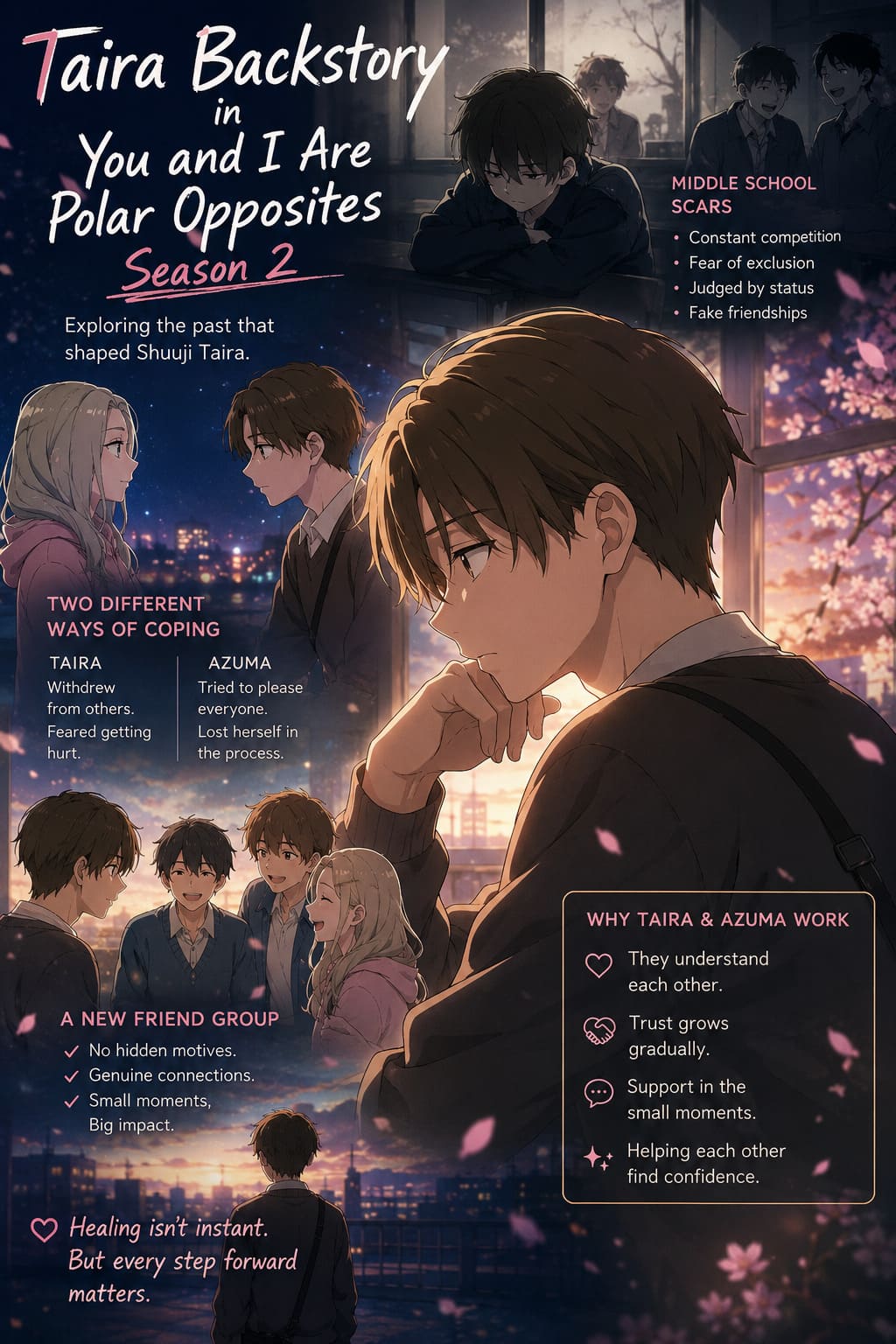
The biggest revelation this season isn’t some shocking plot twist. It’s simply learning where Taira’s worldview came from. Season 2 spends a surprising amount of time exploring his middle school years alongside Shino Azuma, and those episodes completely changed how I viewed both characters.
Their previous school wasn’t portrayed as an exaggerated nightmare filled with cartoon villains. Instead, it looked like a realistic environment where popularity mattered far too much. Students constantly competed with one another, friendships felt conditional, and rejection seemed to lurk behind every conversation. Ironically, that grounded approach makes the story even more painful.
What Defined Their Middle School Experience?
- Constant competition for popularity.
- Fear of being excluded from social circles.
- Students judging each other based on status.
- Friendships that often felt superficial.
None of these elements are particularly dramatic on their own. Together, however, they create an atmosphere where trusting other people becomes incredibly difficult. That’s exactly the environment that shaped both Taira and Azuma, even though they reacted to it in completely different ways.
Two Different Ways of Coping
Taira responded by emotionally withdrawing from everyone around him. Rather than risk rejection, he convinced himself he didn’t deserve meaningful friendships in the first place. It sounds irrational from the outside, but anxiety often works exactly like that. Once your mind accepts a negative belief about yourself, it starts collecting evidence to reinforce it every single day.
Azuma went in the opposite direction. She desperately wanted people to like her, so she kept changing herself to match everyone’s expectations. Over time, that habit left her emotionally exhausted and vulnerable to unhealthy relationships. Watching these two characters side by side makes it obvious that neither coping mechanism truly solved anything.
Taira and Azuma Compared
| Character | Response to Trauma | Long-Term Result |
|---|---|---|
| Taira | Withdrew from others and avoided emotional risks. | Isolation, self-doubt, and chronic insecurity. |
| Azuma | Tried to please everyone around her. | Low self-esteem and emotional exhaustion. |
Neither path brought happiness. That’s what makes their eventual relationship feel believable instead of forced. They aren’t drawn together because they’re opposites. They connect because they understand each other’s emotional wounds better than anyone else.

The New Friend Group Changes Everything
One of my favorite aspects of Season 2 is how subtle the healing process feels. Nobody delivers an inspirational speech that magically fixes years of insecurity. Nobody suddenly transforms into a confident person overnight. Instead, Taira slowly realizes that his new classmates genuinely enjoy spending time with him.
That sounds like a small detail, but it’s probably the strongest emotional moment in the entire season. When Suzuki, Tani, and the rest of the group invite him to spend time together without expecting anything in return, Taira almost doesn’t know how to respond. His instincts keep searching for hidden motives because that’s what he learned to expect years ago.
There aren’t any hidden motives. They’re simply treating him like a friend. Those scenes honestly hit harder than many romantic confessions in other anime because they demonstrate how difficult it can be for someone carrying emotional scars to accept genuine kindness.
Why Taira and Azuma Feel So Natural Together
Romance anime often pairs cheerful characters with gloomy ones because the contrast creates easy chemistry. Sometimes that works, but other times it feels artificial. Taira and Azuma avoid that problem because their relationship is built on shared experiences rather than personality differences.
Azuma’s playful nature encourages Taira to express himself instead of hiding behind sarcasm. Meanwhile, Taira offers Azuma something she rarely experienced during middle school—honest appreciation with no expectations attached. Their relationship grows through small conversations, awkward silences, and quiet moments instead of dramatic declarations.
Why Their Relationship Works
- They understand each other’s emotional struggles.
- Neither character tries to ‘fix’ the other overnight.
- Their trust develops gradually through everyday interactions.
- Both slowly regain confidence by supporting one another.
It’s classic slow-burn storytelling, and the anime gives every scene enough breathing room to feel authentic. Every little step forward feels earned because the series never rushes their emotional development.
A Surprisingly Honest Look at Social Anxiety
One reason Taira resonates with so many viewers is because the anime refuses to offer simple solutions. Social anxiety doesn’t disappear because someone smiles at you once. Low self-esteem isn’t cured after a single successful conversation. Personal growth is messy, inconsistent, and filled with setbacks.
Sometimes Taira makes real progress, only to fall back into old habits during the next episode. Sometimes he overthinks simple conversations until they become impossible inside his own mind. Watching that cycle can be frustrating, but that’s exactly why it feels believable. The series understands that emotional healing takes time.
Many romance anime treat personal struggles as temporary obstacles before the next confession scene. You and I Are Polar Opposites Season 2 treats recovery as a continuous journey instead. That patience gives every emotional breakthrough significantly more weight.
Why Taira Became My Favorite Character This Season
Going into this season, I expected another charming romantic comedy centered around Suzuki and Tani. What I didn’t expect was one of the strongest supporting character arcs I’ve seen in a romance anime in quite some time. Shuuji Taira quietly steals almost every episode because his fears, awkwardness, and gradual recovery never feel manufactured for dramatic effect.
That’s probably why anime fans continue discussing him across forums and social media. He isn’t the funniest character, the coolest character, or even the protagonist. Somehow, though, he has become the emotional center of the entire series.
If Season 2 continues developing him with the same level of care, I genuinely believe Taira will be remembered as one of the standout romance anime characters of this generation. Not because he’s perfect, but because he feels like someone who could genuinely exist. In an industry filled with exaggerated personalities and familiar tropes, that kind of authenticity is incredibly rare—and it’s exactly why his story has become my favorite part of You and I Are Polar Opposites Season 2.