What Happened to Shizue Izawa’s Soul in Tensura?
In the world of That Time I Got Reincarnated as a Slime (Tensura), few characters leave as deep an emotional impact as Shizue Izawa. Even though her screen time is limited compared to other major figures, her influence echoes throughout the entire story.
For many fans in the US anime community, especially on Reddit and YouTube discussion circles, one question continues to come up again and again: what actually happened to Shizue Izawa’s soul after her death?
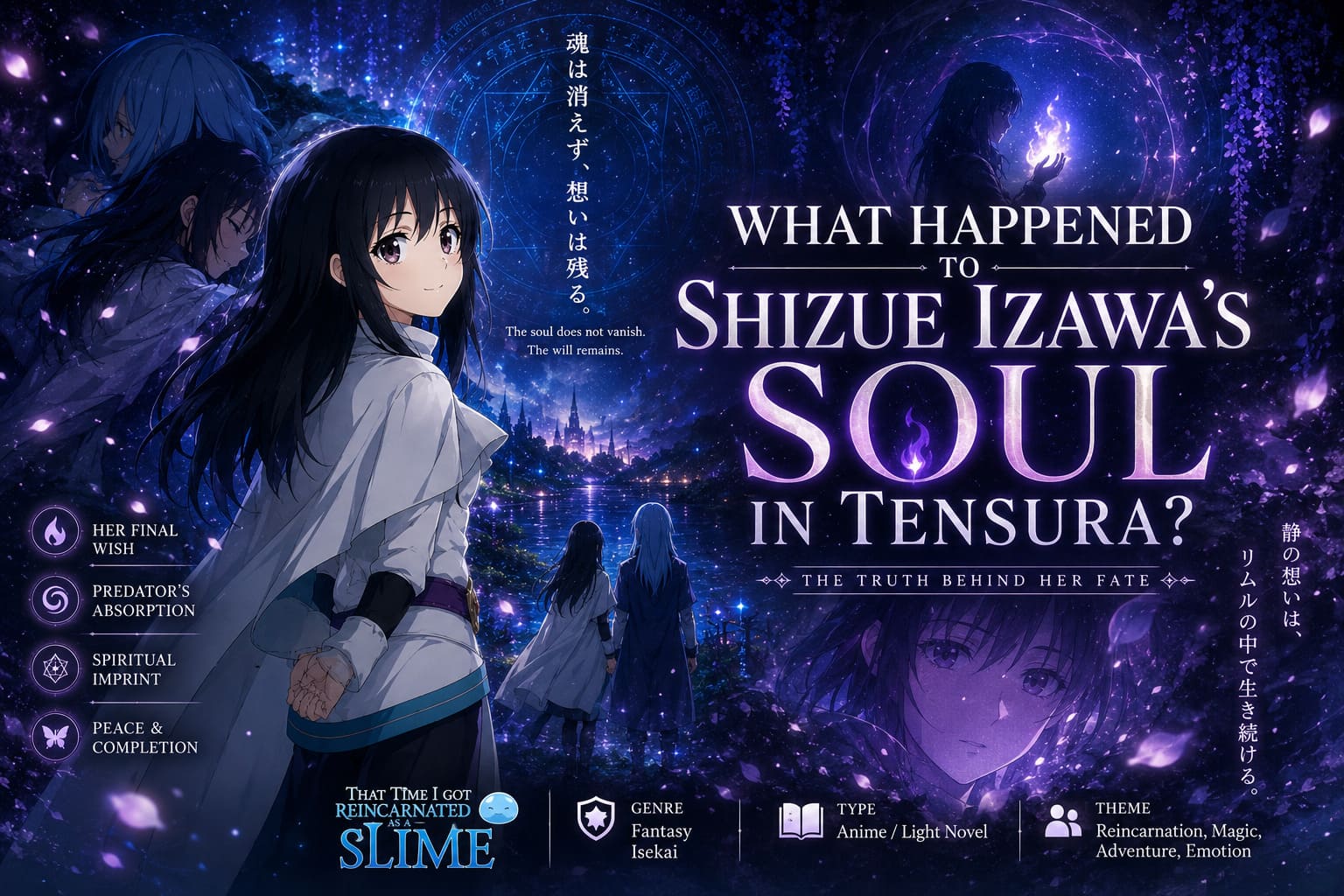
The answer is not as straightforward as a simple “she died and moved on.” Instead, Tensura builds a layered metaphysical system where memory, magicules, and spiritual identity can overlap. Shizue’s fate sits right in the middle of that complexity.
Shizue’s Final Wish and Its Emotional Weight
Before her death, Shizue Izawa makes a very specific request to Rimuru Tempest. She asks him to consume her body using his Unique Skill, Predator. This moment is often misunderstood as purely practical, but in reality it is deeply emotional.
Veldanava and Lucia: Tensura Tragic Love Story Explained
Shizue’s life was defined by suffering: being summoned from wartime Japan, bound to the Flame Spirit Ifrit, and slowly losing control over her own existence. By the end of her journey, she no longer wanted her body to remain in a world she never chose. Instead, she wanted peace and control over her final moment.
Rimuru agreeing to her request becomes one of the most important emotional turning points in the series.
The Core Question: Did Predator Consume Her Soul?
At the time of Shizue’s death, Rimuru only possessed the Unique Skill Predator. This skill was capable of absorbing physical matter, magicules, and living beings under specific conditions. However, it was not originally designed for precise soul capture or storage.
Voice of the World System Explained in Tensura
This leads to one of the biggest debates in the fandom. Shizue was not fully alive in the traditional sense when she passed. Her body was already deteriorating, and her spiritual state was unstable due to her long-term connection with Ifrit.
Because of this, most interpretations agree on two key points:
1. No Full Soul Containment Occurred
Predator primarily absorbed Shizue’s physical remains and residual magical data, not her complete soul entity.
2. A Spiritual Imprint Remained
Even without full soul capture, Tensura’s system allows emotional identity and skill-related data to leave behind residual impressions within a host.

Different Canon Interpretations of Shizue’s Soul
Depending on whether you look at the Light Novel, Web Novel, or anime adaptation, Shizue’s fate is described with slightly different emphasis. However, the core idea remains consistent: she does not simply “disappear.”
Light Novel Version
In the Light Novel continuity, Shizue’s soul passes on peacefully after death. She is implied to have moved beyond the mortal cycle, finding closure and release from her suffering. At the same time, fragments of her emotional and magical imprint remain within Rimuru.
Web Novel Version
The Web Novel presents a more direct lingering presence. Shizue’s spiritual echo remains within Rimuru for a longer period and can even be indirectly sensed during later events involving powerful soul interactions.
Anime Interpretation
The anime focuses more on emotional closure rather than metaphysical detail. Shizue’s presence is framed symbolically, emphasizing her influence on Rimuru rather than explicit spiritual mechanics.
The Raphael Incident: Strongest Evidence of a Remaining Echo
One of the most important moments supporting the idea that Shizue’s presence remained within Rimuru occurs during later arcs involving Wisdom King Raphael, the evolved form of Great Sage.
Raphael is able to reconstruct a temporary consciousness-like projection of Shizue within Rimuru’s mental space. This is not presented as a resurrection, but rather as an access point to stored spiritual and emotional data.

During this interaction, Shizue’s projection:
- Retains her original personality
- Recognizes Hinata Sakaguchi
- Expresses concern for her former students
- Delivers emotional closure and final messages
Once her unresolved emotional ties are settled, the projection disappears naturally, suggesting completion rather than imprisonment.
Why Shizue Cannot Be Revived
Many fans ask why Rimuru does not revive Shizue later in the story, especially after gaining near-godlike abilities. The answer lies in both system limitations and narrative intent.
True resurrection in Tensura requires a stable and retrievable soul, often stored or trapped in a controlled environment. Shizue’s soul, however, has already transitioned beyond that accessible state by the time Rimuru gains higher-level powers.
Even if revival were technically possible, it would contradict the emotional foundation of her character arc. Shizue’s death is framed as her final release from a life of suffering, not as a temporary narrative setback.
My Perspective: Shizue’s Soul Was Not Lost, Just Completed
From a long-time fan perspective, Shizue’s fate makes more sense when viewed as completion rather than disappearance. Her story does not revolve around survival in a physical sense, but emotional resolution.
In practical terms:
- Her body was consumed by Rimuru
- Her emotional identity left a lasting imprint
- Her soul moved on peacefully
- Her memory remained within Rimuru’s consciousness
This layered existence is part of what makes Tensura’s worldbuilding unique. Characters are not always simply “alive” or “dead” in a binary way.
Conclusion: Why This Mystery Still Resonates With Fans
Shizue Izawa’s soul remains one of the most discussed topics in the Tensura fandom because it exists between mechanics and meaning. The series never fully reduces her fate to a single explanation, and that ambiguity is intentional.
For many fans, especially in Western discussions, Shizue represents something more than a character. She is a symbol of lost control, final peace, and the emotional cost behind Rimuru’s growth.
And maybe that is why her story still matters so much: not because it is fully explained, but because it does not need to be.