Who Is the White Lady in The Apothecary Diaries Season 3? Sotei (Bai Niangniang) Backstory and Lore Explained
There is something I really love about The Apothecary Diaries: just when you think you understand what kind of story you are watching, it opens another door and reveals something much darker behind it.
That seems to be exactly what is happening with The Apothecary Diaries Season 3.
The new season is bringing Maomao and Jinshi into a much wider world of political intrigue, foreign powers, religion, and mysterious events far beyond the familiar walls of the Imperial Palace. And among all the new faces teased for Season 3, one character has immediately become impossible to ignore: the mysterious White Lady, also known as Sotei or Bai Niangniang.
At first glance, she looks almost supernatural. White hair, pale skin, brilliant red eyes, and an almost otherworldly presence make her look like someone who walked straight out of a legend.
But if you have watched enough of The Apothecary Diaries, you already know that appearances are rarely the whole story.
Sotei is not simply a mysterious “White Immortal.” Her story is tied to religion, political manipulation, albinism, and one of the most disturbing power structures introduced in the series.
And honestly, this is exactly the kind of character I wanted Season 3 to introduce.
Who Is Sotei in The Apothecary Diaries?
The woman known as the White Lady is Sotei, although she is also called Bai Niangniang, a title that can be understood as “White Lady” or “White Immortal.”
Her unusual appearance immediately makes her stand out from almost everyone else in the series.
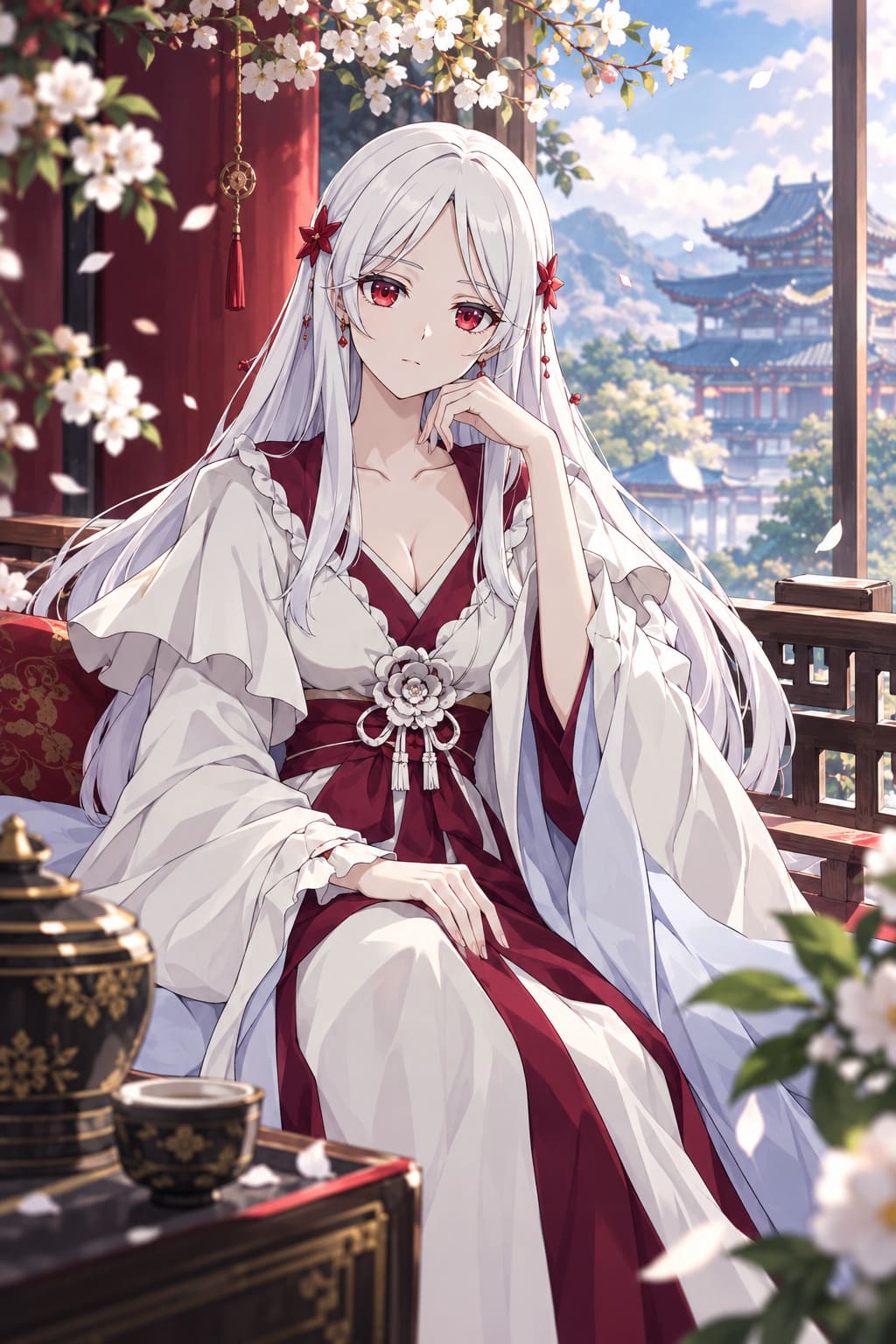
Sotei has albinism, giving her extremely pale skin, white hair, and distinctive red eyes. Her appearance has become the foundation for a supernatural reputation surrounding her. To ordinary people, someone who looks like Sotei can easily become the subject of legends, especially in a world where medicine and biology are not understood in the same way they are today.
This is one of the reasons I think she fits The Apothecary Diaries so well.
The series constantly plays with the difference between what people believe and what is actually happening. Maomao is practically built to destroy that difference.
Where other characters see curses, miracles, poisonings, ghosts, or divine punishment, Maomao usually sees symptoms, chemistry, biology, psychology, or simple human manipulation.
Sotei is basically the perfect opponent for that worldview.
Sotei at a Glance
| Detail | Information |
|---|---|
| Name | Sotei |
| Alias | Bai Niangniang / White Lady |
| Appearance | White hair, pale skin, red eyes |
| Condition | Albinism |
| Origin | Shaoh |
| Connection | Lady Ayla and the political conflict surrounding Shaoh |
| Role | Mysterious performer and political pawn |
| Major Conflict | Maomao’s investigation into the truth behind her “supernatural” image |
The Tragic Origin of the White Lady
Sotei’s story becomes considerably more complicated once the story moves toward Shaoh.
There, her unusual appearance is not simply considered rare or strange. Instead, characteristics associated with albinism are connected to religious beliefs.
White hair, extremely pale skin, and red eyes are treated as signs of something sacred.
This belief creates an extraordinary situation.
A girl born with these characteristics can potentially be viewed as someone destined for a religious position rather than simply being recognized as a person with a genetic condition. Sotei was therefore raised with expectations that went far beyond an ordinary childhood.
She was connected to the tradition surrounding the Shrine Maiden of Shaoh, a figure whose influence extends well beyond religion.
And this is where the story gets genuinely uncomfortable.
The Shrine Maiden is supposed to eventually relinquish her position when certain physical changes indicate that her supposed divine purity has ended. But the person currently holding the position has managed to avoid that fate through an enormous deception.
The truth behind the religious establishment is far stranger than the population realizes.
The reigning “Shrine Maiden” is actually a eunuch who was raised and presented as a woman. Because he cannot menstruate, the normal biological signs used to determine when a Shrine Maiden should step down never occur.
Instead of exposing the deception, the system has effectively turned it into a source of power.
The supposed miracle is actually biology being deliberately misunderstood and manipulated.
That is such a classic Apothecary Diaries twist.
Why Sotei Becomes a Political Pawn
Sotei should have been someone with a future.
Instead, the political and religious system surrounding her leaves her isolated.
She has the appearance that everyone considers sacred, yet she cannot claim the position she was raised to expect. Over time, that rejection leaves her vulnerable.
This is where Lady Ayla enters the picture.
Ayla recognizes something important: Sotei’s image could be incredibly useful.
Rather than simply helping her, Ayla turns Sotei into a political instrument.
Sotei desperately wants acceptance and purpose, while Ayla needs someone capable of challenging the influence of the existing religious establishment. Their relationship therefore becomes deeply manipulative.
This is one of the parts of Sotei’s story that I find particularly interesting. She is not simply another villain who wakes up one morning and decides to cause trouble.
She is someone whose weaknesses are deliberately exploited by people with much more political power than she has.
That makes her considerably more tragic.
The White Lady’s “Magic” vs. Maomao’s Logic
This is probably the part of the Sotei storyline I am most excited to see animated.
Sotei develops a reputation for performing seemingly impossible feats. To an audience unfamiliar with the tricks involved, she can appear almost divine.
Mist, sound, distractions, stage manipulation, and carefully coordinated assistance all contribute to the illusion.
But Maomao is not exactly the easiest person in the world to fool.
Once Maomao observes Sotei closely, she begins noticing details that other people completely miss.
Her red eyes are not evidence of supernatural power. They are connected to her albinism. Her eyesight is severely impaired, and she experiences nystagmus, an involuntary movement of the eyes.
Her sensitivity to light and difficulty seeing clearly become important clues.
The performance that looks like supernatural perception to the audience can instead be understood as a combination of limited vision, environmental conditions, preparation, and human assistance.
And that contrast is exactly why the White Lady works so well.
Sotei has spent her life surrounded by people who interpret her body as a symbol.
Maomao sees a human being.
Sotei and Maomao Are Almost Opposites
One of my favorite things about this storyline is the thematic contrast between these two characters.
Sotei represents mystery created by belief.
Maomao represents truth discovered through observation.
Neither woman is simply a one-dimensional character, though.
Maomao’s scientific approach can sometimes appear cold because she focuses on facts instead of emotions. Sotei, meanwhile, has spent years living inside a world where other people constantly project meanings onto her appearance.
That makes their encounters more interesting than a simple “detective catches magician” story.
Maomao is not merely exposing a trick.
She is gradually uncovering why people needed to believe in the trick in the first place.
And that is where the story becomes political.
The Darker Side of Sotei’s Story
There is a much more uncomfortable element to Sotei’s history as well.
Her relationship with Ayla is built around manipulation rather than genuine friendship. Ayla’s own attitude toward albinism makes the relationship even more disturbing because Sotei’s appearance is simultaneously something Ayla can exploit and something she personally dislikes.
Sotei therefore becomes trapped in a cruel contradiction.
Her appearance is the reason people consider her special, but it is also the reason she is treated as an object.
She is worshipped.
She is feared.
She is manipulated.
And eventually, she becomes useful to people who have no intention of allowing her to control her own destiny.
That makes the title “White Lady” feel increasingly tragic rather than simply mysterious.
What Sotei Means for Season 3
The arrival of Sotei also represents a major change in the scale of The Apothecary Diaries.
The early story was heavily focused on palace mysteries, poisonings, court relationships, and the strange daily politics surrounding Maomao.
Season 3 pushes much further outward.
The story begins dealing with:
- Foreign territories and political powers
- Religious influence
- Agricultural disasters and food shortages
- Medical mysteries
- International manipulation
- The mysterious White Lady
- The growing political importance of Maomao and Jinshi
The locust plague storyline adds another layer to all of this, because the consequences are no longer limited to individual characters inside the palace.
Now entire communities can be affected.
That larger scale makes Sotei’s storyline feel especially important. Her mystery is not isolated from the political situation around her. It is part of a much larger conflict.
Why I Think Sotei Could Be One of Season 3’s Best Characters
I’ll be honest: when I first heard about the White Lady, I expected her to be mostly a visually striking mysterious character.
But the more you look into Sotei, the more complicated she becomes.
She has one of those backstories that perfectly matches what The Apothecary Diaries does best. The series takes something that initially looks supernatural or fantastical and gradually reveals the human mechanisms underneath it.
That’s why Sotei works.
Her white hair and red eyes are memorable, but her tragedy is what makes her interesting.
She is not frightening because she is supernatural.
She is frightening because she exists in a world where people can take someone’s identity, body, beliefs, and vulnerabilities and turn them into political weapons.
And knowing Maomao, she is probably going to be the one person stubborn enough to keep pulling at that thread until the entire illusion falls apart.
Final Thoughts
Sotei, the White Lady of The Apothecary Diaries Season 3, is much more than another mysterious character.
She sits at the intersection of medicine, religion, politics, and human manipulation — basically everything this series does exceptionally well.
Her story also gives Maomao another fascinating mystery to solve. Instead of simply asking whether the White Lady possesses supernatural abilities, Maomao is interested in the much more important question:
How is the illusion being created?
That question is likely to lead her into a much deeper conspiracy involving Shaoh, the Shrine Maiden, Lady Ayla, and the political forces surrounding them.
Personally, I think Sotei could become one of the characters that defines the identity of The Apothecary Diaries Season 3. Her design may be what catches your attention first, but her backstory is what makes her worth remembering.
And if the anime adaptation manages to capture the eerie atmosphere surrounding her while keeping Maomao’s sharp observational humor intact, we could be looking at one of the strongest arcs in the entire series.
The White Lady may look like a supernatural figure, but in The Apothecary Diaries, the real monsters are usually the people behind the curtain.