Will Serfort vs Julius Reinberg: Power Comparison and Battle Analysis | Wistoria Wand and Sword
If you’ve been following Wistoria: Wand and Sword, you already know this matchup isn’t just about power — it’s about ideology. On one side, we’ve got Will Serfort, the so-called “failure” who can’t cast a single spell. On the other, Julius Reinberg, a textbook prodigy and one of the most gifted ice mages in the academy. And yet… somehow, this isn’t a fair fight. As someone who genuinely loves battle-driven anime with strong character dynamics, I’ll say this upfront: this clash is one of the most satisfying “underdog flips the system” moments in recent fantasy anime. Let’s break it down properly.
The Core Difference: System vs Anomaly
At its heart, this fight is about a broken system meeting something it can’t categorize. Julius Reinberg represents perfection within the rules of the world, while Will Serfort exists outside of those rules entirely. Julius plays chess, carefully calculating his next move, while Will flips the board and rewrites the game in real time.
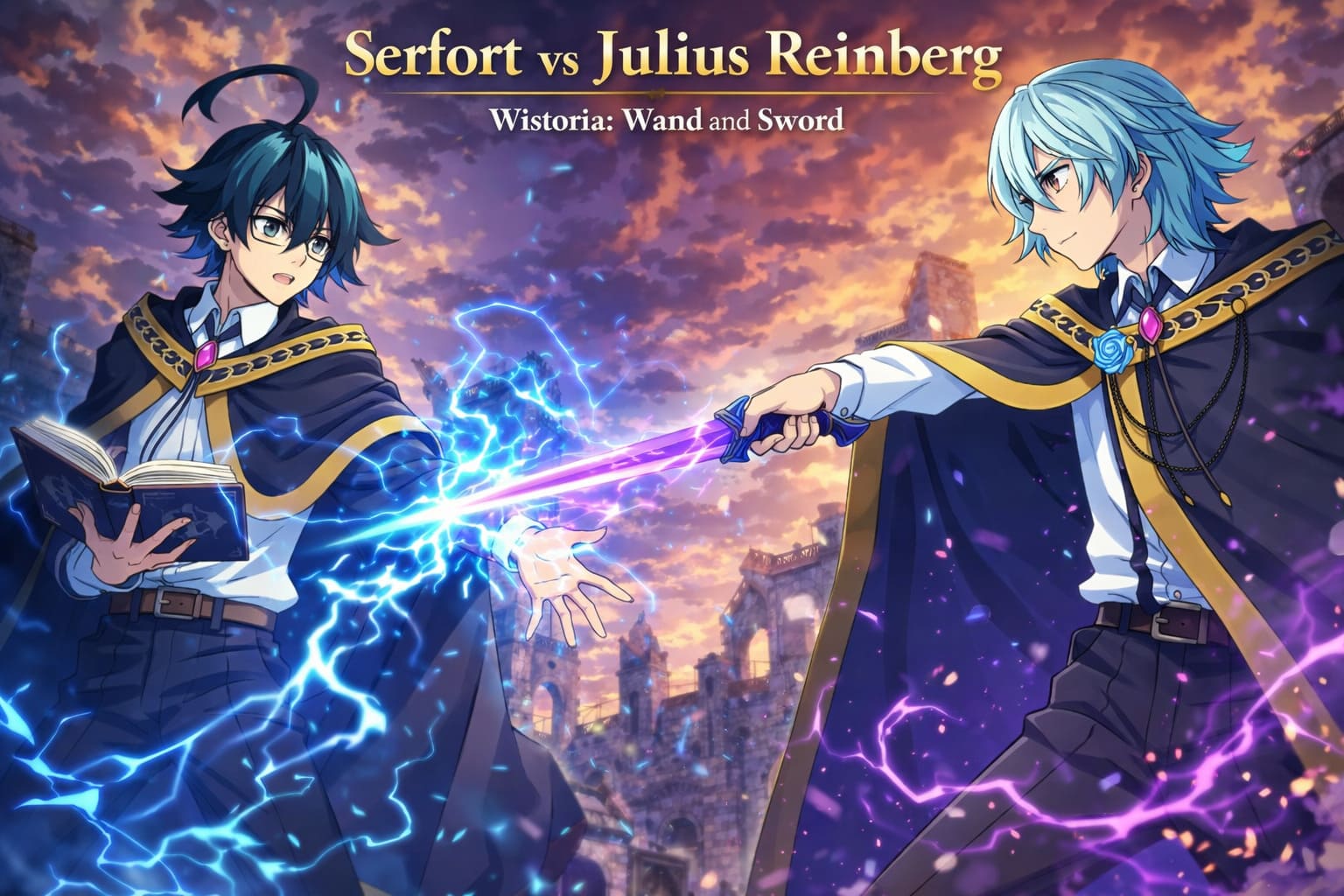
Will Serfort — A Walking Anti-Magic Weapon
Will isn’t just strong for a non-mage — he’s fundamentally built to destroy mages. What makes him terrifying isn’t one single ability, but how everything stacks together into a complete counter-system against magic users. His physical abilities alone already break expectations, but when combined with his adaptability, he becomes something far more dangerous.
- Insane physical stats — speed that feels borderline like teleportation
- Battle instinct — reads movements almost instantly after seeing them once
- Sword mastery — precise, efficient, and lethal with no wasted motion
- Wis ability — absorbs and repurposes magic into his own attacks
The Wis ability is the real turning point in any fight involving Will. The more magic his opponent throws at him, the more resources he gains. Instead of being overwhelmed, he adapts, absorbs, and returns that power in a more dangerous form.
Julius Reinberg — Elite, But Still a Mage
Julius is not weak by any means. In fact, in most other series, he would easily be considered top-tier. He combines intelligence, talent, and refined control over his magic to dominate standard battles. His combat style is structured, efficient, and highly strategic, making him extremely dangerous in controlled environments.
- High combat intelligence — calculates and adapts within magical frameworks
- Efficient mana control — maximizes output without wasting energy
- Ice clone techniques — creates multiple decoys to confuse opponents
- Large-scale magic — capable of controlling entire battlefields
However, the problem lies in the fact that everything Julius does still follows the established rules of magic. And Will is exactly the kind of opponent who punishes anything predictable or structured.
Can Will Serfort Use Magic? The Shocking Truth in Wistoria: Wand and Sword
Direct Comparison
| Category | Will Serfort | Julius Reinberg |
|---|---|---|
| Raw Power | High (physical + magic absorption) | High (pure magical output) |
| Speed | Extreme | Above average for a mage |
| Defense | Anti-magic and evasion | Ice barriers and clones |
| Versatility | Increases during battle | Tactical but structured |
| Weakness | Range (situational) | Close combat |
Fight Breakdown — What Actually Happens?
Close Range: It’s Not Even Close
Once the distance closes, the fight becomes heavily one-sided. Will’s speed allows him to reach Julius before complex spells can be executed, and his instincts help him bypass distractions like clones. Even advanced techniques lose effectiveness when the opponent can read and react faster than expected. In this situation, Will dominates the encounter.
Long Range: Julius Has a Chance (But…)
At long range, Julius has the advantage on paper. By maintaining distance, filling the battlefield with clones, and applying area-of-effect ice magic, he can theoretically control the pace of the fight. However, this advantage quickly becomes unstable due to Will’s ability to absorb and redirect magic. The more pressure Julius applies, the more opportunities he creates for Will to grow stronger during the battle.
The Ice Synergy Problem
One of the most overlooked aspects of this matchup is how well Will adapts specifically to Julius’s ice magic. Ice-based attacks are easier to visually track and predict, and once absorbed, they can be converted into powerful counterattacks. This creates a dangerous feedback loop where Julius’s own strength indirectly empowers Will, turning the battle into a losing exchange over time.

From Rivalry to Reality
What makes this fight even more compelling is the character development behind it. Julius initially views Will as a defective outlier who doesn’t belong in a magic-driven world. However, after witnessing Will’s abilities firsthand, that perspective begins to collapse. The dynamic shifts from arrogance to confusion, and eventually to reluctant respect, transforming their relationship into something far more complex than simple rivalry.
Final Verdict — Who Actually Wins?
Will Serfort wins (Mid Difficulty).
Julius is undeniably powerful and would dominate the majority of opponents within the academy. However, Will is not a standard opponent. His entire combat style is designed to counter magic users, and his ability to adapt mid-fight gives him a decisive edge. This isn’t just a matter of strength — it’s a matter of compatibility, and in this case, the matchup heavily favors Will.
Personal Take
This battle perfectly captures the appeal of characters who break established systems in anime. Watching a structured, rule-based fighter like Julius attempt to handle someone who exists outside of those rules creates a unique kind of tension. It forces both the characters and the audience to rethink how power works in this world, making the fight not just exciting, but meaningful.