Yuji Yanase Passing: The World’s Strongest Rearguard Anime Director Dies at 59
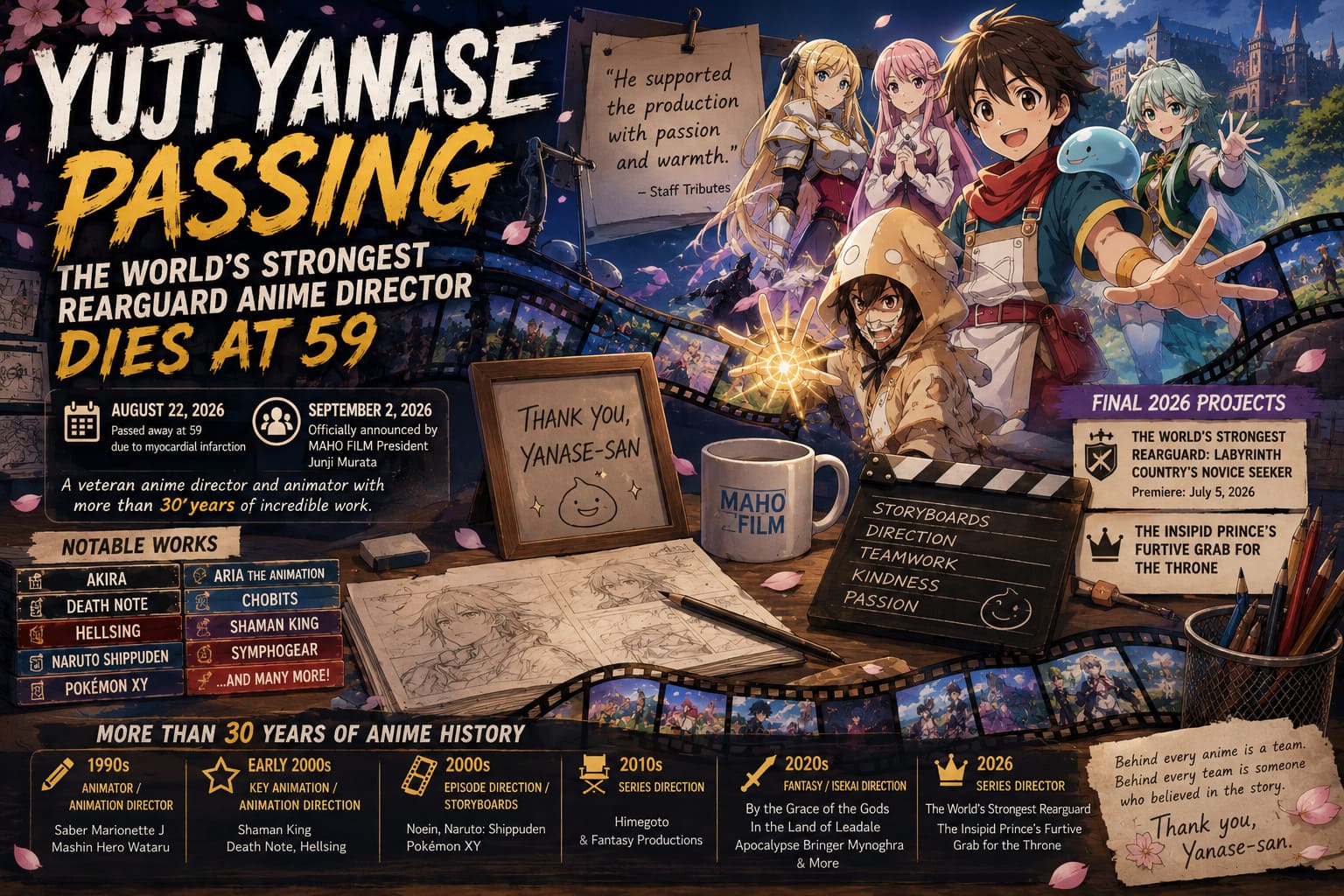
There are some anime industry news stories that feel strangely difficult to process. Yuji Yanase’s passing is one of them. On August 22, 2026, the veteran anime director and animator died at the age of 59 after suffering a sudden myocardial infarction. The news was officially announced on September 2 by MAHO FILM President and CEO Junji Murata, with the studio explaining that Yanase’s family had chosen to hold a private funeral attended only by close relatives.
For anyone who has followed anime for years, this is the kind of announcement that makes you stop scrolling for a second. Yanase wasn’t necessarily the name casual viewers would recognize immediately, but his work was everywhere. He spent more than three decades moving through the animation industry, working as an animator, animation director, episode director, storyboard artist, and eventually series director. He was one of those behind-the-scenes creators whose fingerprints are all over anime history, even when audiences don’t always know whose hands were responsible.
And what makes this loss particularly painful is the timing. Yanase wasn’t someone who had quietly stepped away from the industry. He was still working at full speed in 2026, directing The World’s Strongest Rearguard: Labyrinth Country’s Novice Seeker and The Insipid Prince’s Furtive Grab for the Throne during the Summer 2026 anime season.
That’s an unbelievable workload for someone who had already spent decades in the business.
Aoashi Season 2 Release Date Confirmed Main Trailer Previews Theme Songs and Crucial Studio Change
The Anime Community Wasn’t Ready for This News
The reaction online was immediate. Discussions spread through Reddit, MyAnimeList communities, social media, and anime forums as fans started revisiting Yanase’s filmography.
Personally, I think that’s one of the strangest things about anime fandom. We can spend hours debating our favorite characters, openings, animation cuts, studios, and voice actors, yet the people directing entire productions often remain almost invisible. Then something like this happens, and suddenly you realize just how many shows you watched were shaped by the same creative professionals.
Yanase is a perfect example.
He worked across completely different genres and tones. He could contribute to dark, intense productions like Death Note and Hellsing, then move into fantasy, comedy, romance, science fiction, or the increasingly popular isekai genre. That range is probably what impresses me most about his career.
He wasn’t locked into one recognizable ‘Yuji Yanase style.’ Instead, he seemed to understand what each project needed.
From Animation’s Old School to Modern Isekai
Yanase’s career began during an important period for Japanese animation. The 1990s were a fascinating time for anime, sitting between the traditional hand-drawn production culture of earlier decades and the increasingly digital workflow that would transform the industry.
He started from the ground up as an animator, working on fundamentals such as in-between animation and key animation. That’s significant because those early positions force artists to understand movement in a very practical way. Before you can direct hundreds of people, you need to understand what actually makes a character move convincingly on screen.
One of the major early credits associated with Yanase was Akira, the legendary 1988 cyberpunk film. Working on a production famous for its painstaking animation would have been an extraordinary experience for any young animator. Akira remains one of those movies that anime fans constantly return to when discussing the possibilities of hand-drawn animation.
From there, Yanase steadily expanded his credits.
| Period | Role / Focus | Notable Works |
|---|---|---|
| 1990s | Animator and Animation Director | Saber Marionette J, Mashin Hero Wataru |
| Early 2000s | Key Animation / Animation Direction | Shaman King, Death Note, Hellsing |
| 2000s | Episode Direction / Storyboards | Noein, Naruto: Shippuden, Pokémon XY |
| 2010s | Series Direction | Himegoto and fantasy productions |
| 2020s | Major Fantasy / Isekai Direction | By the Grace of the Gods, In the Land of Leadale, Apocalypse Bringer Mynoghra |
| 2026 | Series Director | The World’s Strongest Rearguard, The Insipid Prince’s Furtive Grab for the Throne |
That career progression tells its own story.
He Worked on More Anime Than You Probably Realize
If you only know Yanase from his recent fantasy projects, his older credits might come as a surprise.
He contributed to Saber Marionette J, Mashin Hero Wataru, and Shaman King, while also working on productions such as Chobits, Macross 7, Aria the Animation, Symphogear, and Saint Seiya Omega.
Then there are the titles that instantly grab the attention of fans who grew up watching mainstream anime: Death Note, where he worked as a key animator, and Hellsing, where he served as an animation director.
That’s an unusually broad resume.
I actually think this is the part of Yanase’s career that deserves more attention when people talk about his legacy. He wasn’t simply ‘the director of some isekai anime.’ He was part of multiple generations of anime production. His career stretches from the era of heavily hand-drawn television animation into today’s light-novel adaptations and seasonal anime machine.
That’s a massive transition to experience firsthand.
The Move Into Directing Changed Everything
During the 2000s, Yanase began moving beyond individual animation duties and into episode direction and storyboarding. That shift gave him a much larger role in determining how an episode actually felt.
His directing credits included work on Noein, Ghost Slayers Ayashi, and My Bride Is a Mermaid, followed by contributions to major franchises including Naruto: Shippuden and Pokémon XY.
In 2014, he took another major step by becoming the series director of Himegoto.
From there, his career increasingly became associated with fantasy and isekai productions.
Why Yuji Yanase Was So Good at Isekai Anime
Yanase developed a particularly strong reputation for adapting fantasy stories that weren’t necessarily trying to be relentlessly dark or edgy.
- In Another World With My Smartphone
- If It’s for My Daughter, I’d Even Defeat a Demon Lord
- By the Grace of the Gods
- In the Land of Leadale
- My Unique Skill Makes Me OP Even at Level 1
- I’ll Become a Villainess Who Goes Down in History
- Apocalypse Bringer Mynoghra
These are very different stories, but many share an important quality: they offer escapism.
That’s something I think gets overlooked when anime fans discuss ‘good direction.’ Not every series needs dramatic camera movements, insane sakuga sequences, or prestige-level cinematography. Sometimes the director’s job is to make a fantasy world feel comfortable enough that you actually want to spend time there.
Yanase seemed particularly good at that.
His work often allowed the softer side of fantasy anime to breathe. Characters could simply talk, explore a new town, build relationships, cook something, discover a new ability, or enjoy a peaceful moment. Those scenes may not become viral clips on social media, but they’re often exactly why viewers become attached to these shows.
His Final 2026 Projects Make His Passing Even Sadder
The timing of Yanase’s death is difficult to ignore.
In Summer 2026, he was simultaneously serving as series director on The World’s Strongest Rearguard: Labyrinth Country’s Novice Seeker and The Insipid Prince’s Furtive Grab for the Throne.
The first series premiered on July 5 and follows a reincarnated protagonist whose seemingly modest support-oriented abilities become crucial as he navigates dangerous labyrinths. The second explores a very different fantasy setup involving political maneuvering and a prince attempting to secure his position.
Two ongoing television productions.
At 59.
After more than thirty years in the industry.
That alone says a lot about Yanase’s dedication.
The production staff behind The World’s Strongest Rearguard publicly remembered him as someone who supported the production with passion and warmth. The staff of The Insipid Prince’s Furtive Grab for the Throne similarly highlighted his affection for the source material and his gentle approach toward the people working around him.
And those descriptions stand out to me.
In an industry famous for brutal schedules and enormous production pressure, being remembered primarily as kind, supportive, and passionate may be one of the best legacies an anime director can leave.

More Than a Director’s Name in the Credits
It’s easy to think about anime as a collection of finished products. We watch an episode, rate it, complain about the pacing, praise the animation, argue about the adaptation, and move on to the next seasonal show.
But behind every episode is a huge group of people.
Yanase spent decades moving through almost every part of that process. He knew animation from the artist’s perspective before becoming someone responsible for guiding entire productions. That kind of experience matters because a director who has actually spent years drawing and supervising animation understands the challenges facing the people underneath them.
That’s probably why the tributes emphasizing his personality hit harder than a simple list of credits.
A long filmography proves that someone was productive. The way coworkers remember that person tells you what kind of professional they were.
Remembering Yuji Yanase Through His Work
If you’re an anime fan discovering Yanase’s name for the first time because of this news, I don’t think you need to immediately binge his entire filmography.
Instead, I’d approach it by looking at the different stages of his career.
Start with something from his animation background, then explore his work in major franchises, and finally check out the fantasy series that defined his later career. You’ll get a much better sense of how dramatically the anime industry changed during his lifetime.
What stands out is the sheer variety:
From cyberpunk. To mecha. To supernatural thrillers. To shonen. To romance. To cozy fantasy. To isekai.
That’s an entire anime history lesson hidden inside one person’s career.
A Quiet but Enormous Legacy
Yuji Yanase may never have been one of the industry’s most famous celebrity creators. His name wasn’t guaranteed to generate headlines every time a new season started.
But perhaps that’s exactly why his passing deserves attention.
Anime is built by thousands of people whose names most viewers will never memorize. Animators, storyboard artists, episode directors, animation directors, production staff, and series directors quietly spend years turning someone else’s story into something we can emotionally connect with.
Yanase was one of those people.
For more than thirty years, he helped shape worlds that ranged from terrifying to hilarious, from chaotic to comforting. He worked on legendary franchises, supported newer productions, and continued directing television anime right up until the final chapter of his life.
For me, that’s the part I’ll remember most.
Yuji Yanase didn’t simply have a long anime career. He stayed part of the medium’s evolution for an astonishing length of time.
His work will continue appearing on screens even though he is no longer here to guide it. New fans will discover shows he directed without knowing the circumstances surrounding their creation. Older fans will eventually stumble across his name in the credits of something they loved years ago and realize just how many times his career intersected with their own anime journey.
And honestly, that’s a pretty beautiful way for an animator and director to be remembered.
Not through one giant masterpiece.
Not through one famous character.
But through decades of stories, scenes, characters, and worlds that became part of other people’s lives.
Rest in peace, Yuji Yanase. The anime community has lost another veteran, but the work remains.