How the Needy Streamer Overload Anime Secretly Expands Its Manga Universe
There’s a certain kind of anime that doesn’t just tell a story—it pulls you into a fragmented, uncomfortable headspace and lets you sit there.
That’s exactly what the adaptation of Needy Streamer Overload (aka Needy Girl Overdose) does—and honestly, it surprised me more than I expected.
At first glance, the anime looks like a stylish retelling of Ame-chan’s spiral into internet obsession. But if you’ve spent time with the anthology manga—especially Super Ten-Chan! Official Anthology—you start noticing something deeper.
This isn’t just adaptation. It’s a layered remix, full of quiet references, tonal shifts, and inside jokes that reward people who’ve been following this chaotic universe for a while.
Let me walk you through what stood out the most—not as a dry breakdown, but as someone who actually enjoys picking apart this kind of detail.
Minato Kusunoki’s Purification Handwriting: The Secret Power in Kusunoki’s Garden of Gods Explained
The Tone Shift That Feels… Intentional
One thing that immediately caught my attention is how the anime plays with tone in a way that feels almost uncomfortable on purpose.
If you’ve read the anthology, you know it leans heavily into absurd humor—chibi art, exaggerated expressions, almost parody-level comedy. The anime doesn’t ignore that. Instead, it sneaks those elements into brief moments.
We get sudden chibi-style cuts, over-the-top reactions from Ame-chan, and comedic timing that feels slightly off in a deliberate way. And then—without warning—it snaps back into something dark and grounded.
That contrast feels like a direct translation of how the manga operates, but in animation it hits much harder. It’s like the show is mimicking Ame-chan’s mental instability rather than simply depicting it.
New Characters, Old DNA
The anime introduces new elements, like the Karamazov streamer group. On paper, they’re original additions meant to expand the world.
But when you look closer, they don’t feel new at all. They feel like distilled versions of archetypes that the anthology already explored in different forms.
| Anime Element | Manga Influence | What It Represents |
|---|---|---|
| Purple Lollipop | Dark KAngel sketches | Repressed anger and burnout |
| Rival streamers | Denpa and Jirai Kei tropes | Internet identity competition |
| Background posters | Anthology cover art | Meta self-reference |
This is what makes the adaptation interesting—it doesn’t just reuse material, it reinterprets it and gives it a new function within the anime’s narrative.
Visual Storytelling Is Doing Heavy Lifting
If there’s one area where the anime truly evolves beyond the manga, it’s in its visual language.
The anthology experimented with broken panels and chaotic layouts to show Ame-chan’s mental state. The anime takes that idea and pushes it further by integrating the interface directly into the storytelling.
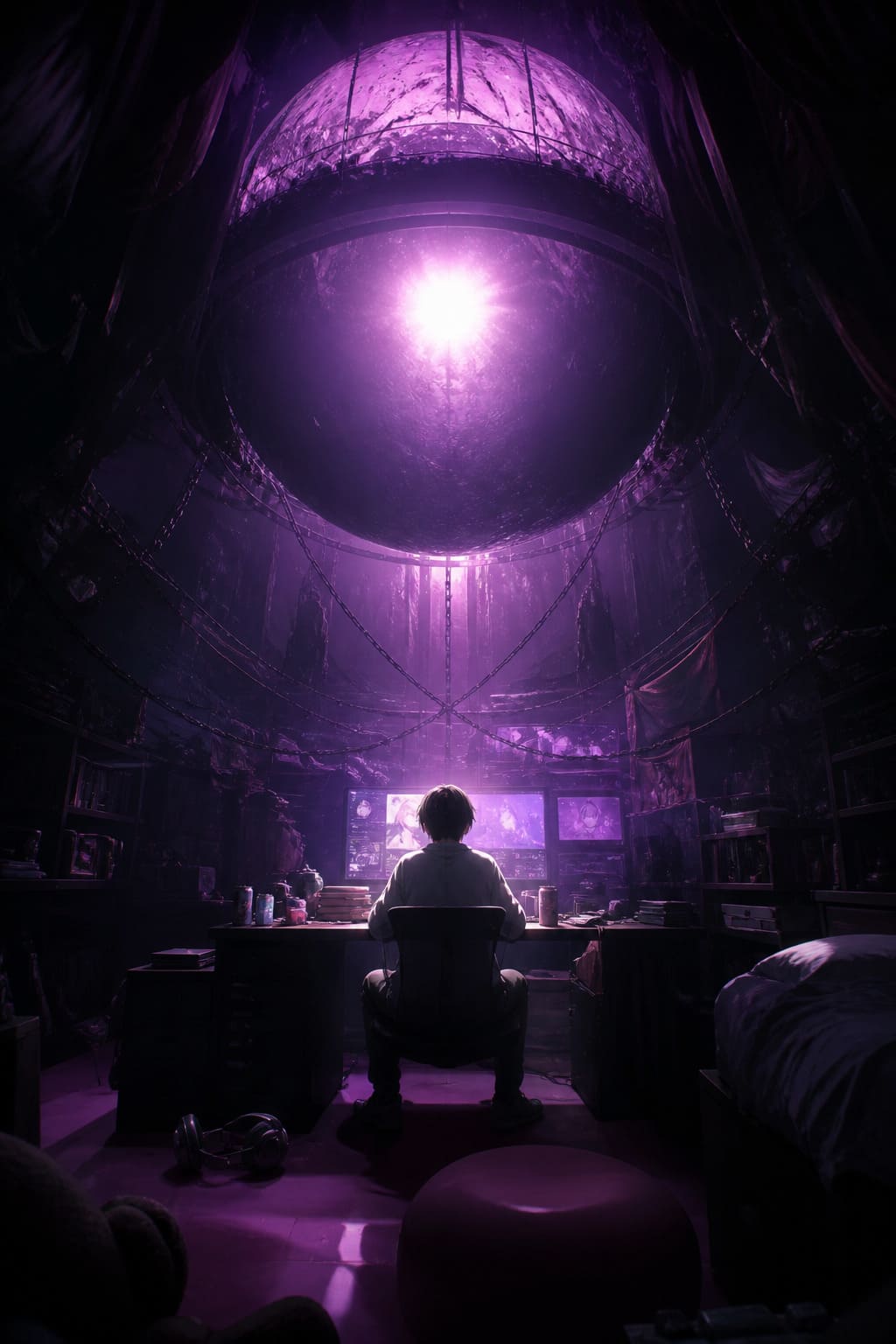
UI overlays interrupt scenes, chat messages become part of the frame, and glitches literally distort reality in real time. The viewer isn’t just watching Ame-chan’s breakdown—they’re experiencing it through the structure of the scene itself.
This approach strongly echoes the atmosphere of Serial Experiments Lain, where the boundary between the digital world and personal identity becomes almost impossible to define.
The “P-Chan Problem” Gets Even More Interesting
If you’ve played the game, you probably remember the ambiguity surrounding P-Chan.
The anthology tends to simplify this by portraying P-Chan as a physical character for comedic interactions. The anime, however, chooses a more nuanced and unsettling approach.
It deliberately keeps things unclear. There are moments where Ame-chan speaks to someone off-screen, followed by shots that reveal empty space. Perspective shifts suggest conflicting realities, leaving the audience unsure of what is actually happening.
Is P-Chan real, imagined, or something in between? The anime doesn’t answer this question, and that ambiguity becomes one of its strongest narrative tools.
Subtle References That Hit If You Know Them
This is where the anime becomes especially rewarding for attentive viewers.
There are numerous stylistic and thematic references woven into the presentation, many of which are never explicitly acknowledged but are clearly intentional.
The bright pink “blood” aesthetic immediately brings to mind Danganronpa. The wired, disconnected reality themes echo Serial Experiments Lain. Even the exaggerated social media interfaces feel like a continuation of the anthology’s satirical tone.
These elements don’t exist just for recognition—they help establish a consistent and immersive version of the internet as portrayed within the series.
Music Videos as Canon
One of the more unexpected aspects of the anime is how it incorporates visual ideas from the franchise’s music videos.
Tracks like Internet Yamero and Internet Overdose are not treated as separate promotional material. Instead, their visual identity becomes part of the anime’s language.
Transformation sequences, in particular, feel like refined versions of those music video concepts. There is even a clear magical girl parody influence, reminiscent of Sailor Moon, but filtered through a much darker and more unstable lens.
The result is something that feels both familiar and deeply unsettling at the same time.
Why This Actually Matters
It would be easy to dismiss all of this as fanservice, but that would miss the bigger picture.
The anime is effectively building a multi-layered narrative system that connects different forms of media into a single experience.
- The game serves as the core psychological framework.
- The manga explores alternative tones and interpretations.
- The anime merges and expands these ideas into something more cohesive.
The references act as connective tissue between these layers, creating a richer and more immersive world for the audience.
Personal Take: It Feels Uncomfortably Real
What stood out to me the most is how emotionally authentic the experience feels.
The anime blends humor, anxiety, attention-seeking behavior, and isolation in a way that mirrors real-life experiences on the internet.
The transitions between lighthearted moments and darker themes feel abrupt, but that abruptness is exactly what makes it effective. It reflects the unstable emotional rhythm of someone constantly navigating online validation and personal insecurity.
That’s why the references matter—they reinforce the central theme of identity fragmentation in a digital environment.
Final Thoughts
The Needy Streamer Overload anime isn’t just adapting existing content—it’s evolving it.
By drawing from the anthology manga, visual experimentation, and even music videos, it creates a layered experience that feels larger than any single version of the story.
It’s chaotic, uncomfortable, and at times overwhelming, but that’s exactly what makes it compelling.
If you enjoy discovering hidden details and analyzing deeper meanings, this anime offers far more than what appears on the surface.
And honestly, that’s what makes it so hard to look away.