
Why Rimuru Named the Primordial Demons in TenSura
In That Time I Got Reincarnated as a Slime (TenSura), few moments feel as reality-shifting as Rimuru Tempest naming the Primordial Demons.
What looks like a simple act of recognition or reward is actually one of the most important turning points in the entire series, changing political balance, power scaling, and even the structure of demon society itself.
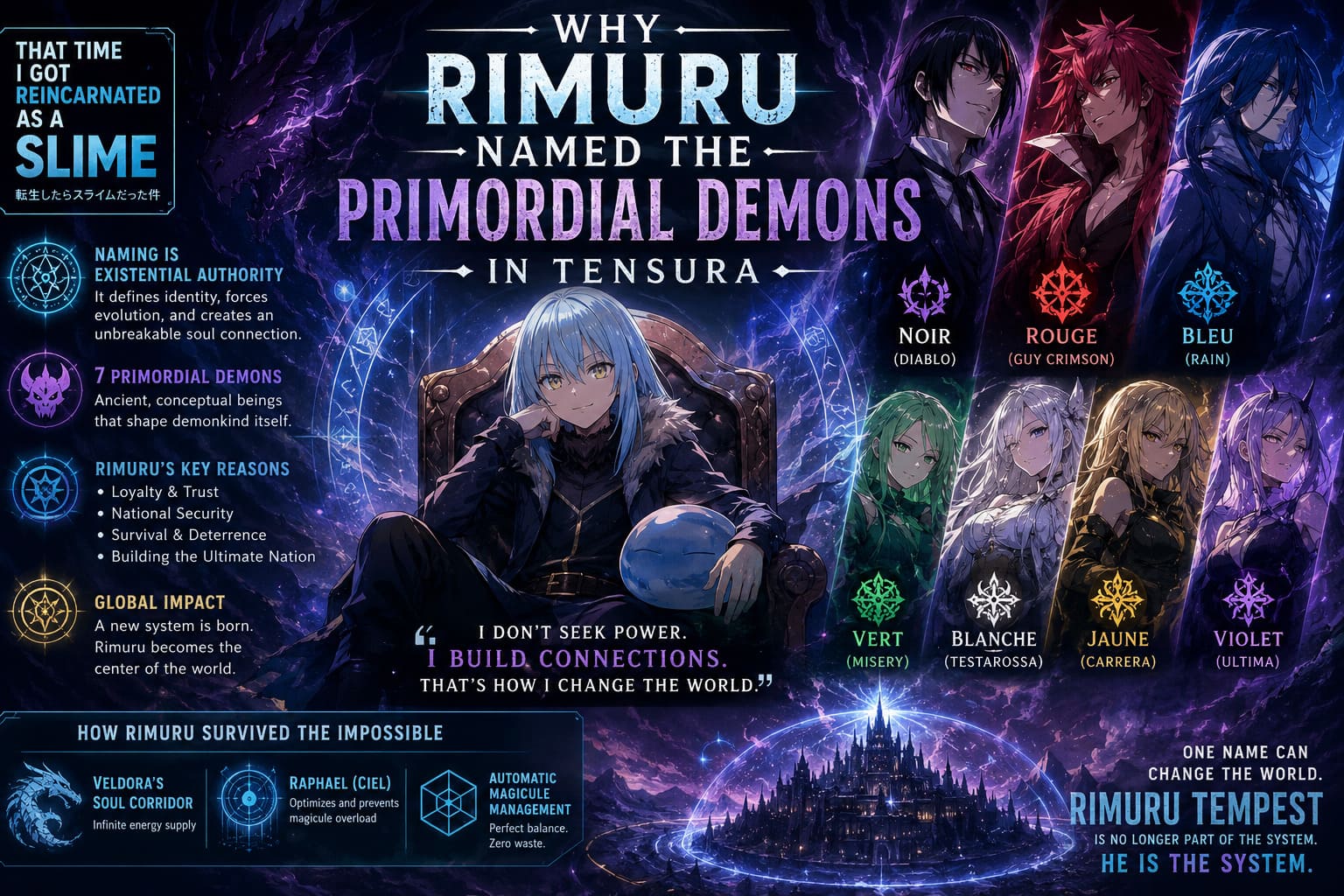
From a fan perspective, this isn’t just “Rimuru being nice again.” It’s the moment the world quietly stops operating under normal rules and starts adapting to something far beyond its original limits.
The True Meaning of Naming in TenSura
In TenSura, naming is not symbolic — it is existential authority. A name defines a being’s identity, stabilizes their soul, and forces evolution. It also consumes massive amounts of magicules from the one giving the name, often to dangerous levels.
Seven Primordial Demons in Tensura Explained
For weaker monsters, naming is risky. For high-ranking spiritual beings, it becomes life-threatening. And for Primordial Demons, it should theoretically be impossible.
What Naming Actually Does
- Forces spiritual evolution and transformation
- Creates a permanent soul connection between namer and named
- Consumes large quantities of magicules
- Stabilizes and strengthens the target’s existence
This is why Rimuru’s actions stand out so much — he is not just naming strong beings, he is naming entities that should not be nameable at all.
Who Are the Primordial Demons?
The Primordial Demons are the original demon entities in TenSura lore. There are seven of them, each tied to a color and fundamental aspect of demon existence. They are ancient, conceptual beings that existed long before modern civilizations formed.
Tensura Ultimate Skills Ranked: Strongest Abilities Explained
Primordial Overview
| Color | Name | Known Identity |
|---|---|---|
| Black | Noir | Diablo |
| Red | Rouge | Guy Crimson |
| Blue | Bleu | Rain |
| Green | Vert | Misery |
| White | Blanche | Testarossa |
| Yellow | Jaune | Carrera |
| Purple | Violet | Ultima |
These beings are not just powerful — they are foundational forces of demonkind. Most characters in the series cannot even properly perceive their true scale.
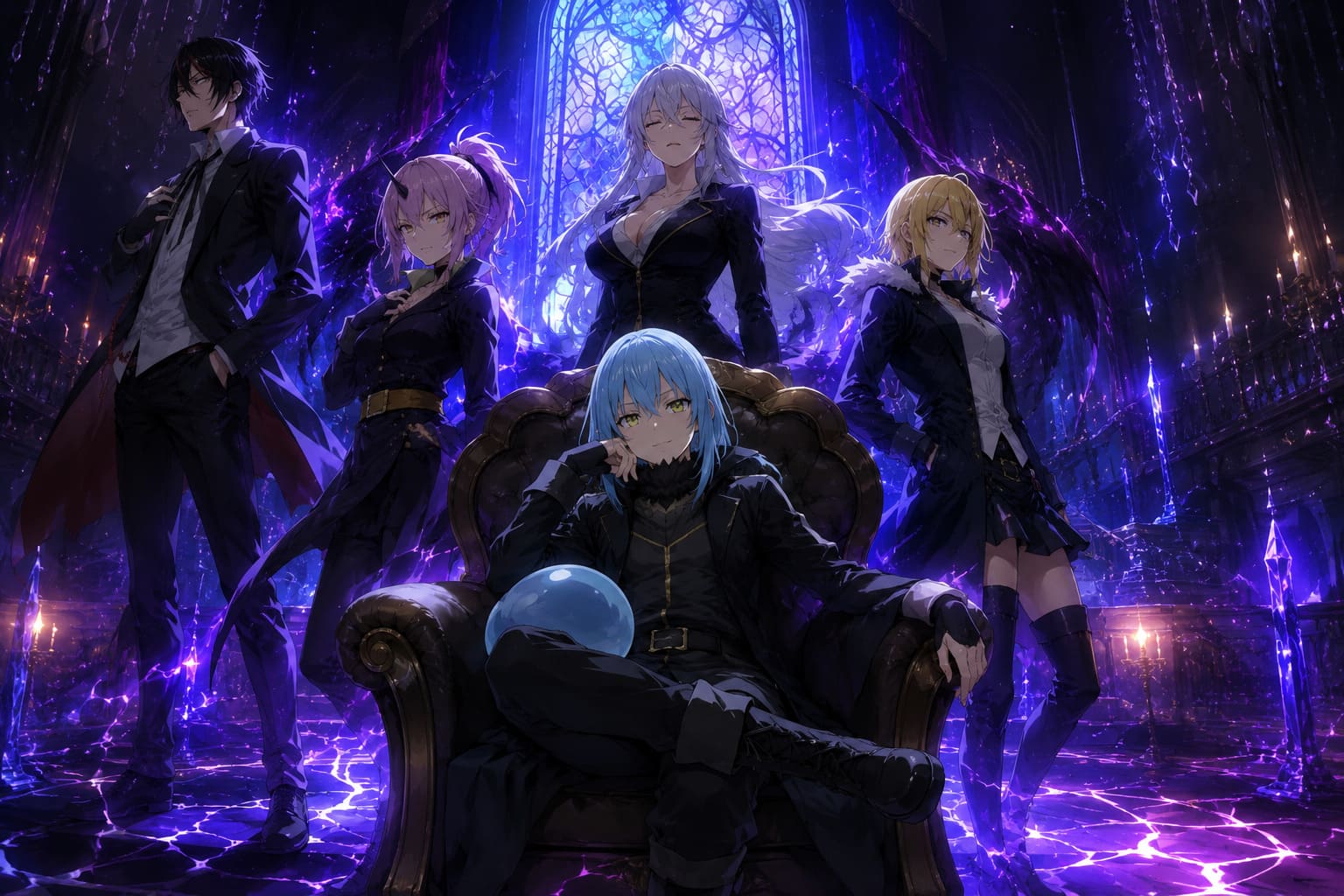
Why Rimuru Named Diablo (Noir)
Diablo’s naming is one of the most iconic moments in the series because it begins with misunderstanding and ends with absolute loyalty.
Rimuru originally did not realize Noir was a Primordial. He simply saw an extremely capable demon who offered loyalty, service, and unmatched efficiency.
Main Reasons Behind Diablo’s Naming
- Rewarding extreme loyalty and usefulness
- Need for a right-hand man after becoming a Demon Lord
- Requirement for intelligence and internal security control
- Accidental recognition of Diablo’s potential
From a fan interpretation, this moment highlights Rimuru’s pattern: he doesn’t seek power directly, but he always ends up collecting it through relationships and trust.
Why Rimuru Named the Demoness Trio
The later naming of Testarossa, Ultima, and Carrera feels less accidental and more like a structural upgrade to Rimuru’s entire nation. This wasn’t just about loyalty — it was about survival on a global scale.
These Primordials were introduced through Diablo, who essentially recruited them to serve Rimuru, recognizing the growing threats surrounding Tempest.
Key Motivations
- Strengthening Tempest’s defense against the Eastern Empire
- Establishing overwhelming deterrence against invasion
- Creating elite administrative and military structure
- Delegating complex governance to high-intelligence beings
Functional Roles After Naming
| Character | Role in Tempest |
|---|---|
| Testarossa | Diplomacy and political manipulation |
| Ultima | Intelligence and interrogation operations |
| Carrera | Military destruction and battlefield command |
At this point, Rimuru is no longer just building a nation — he is building a supernatural administrative system that rivals entire empires.
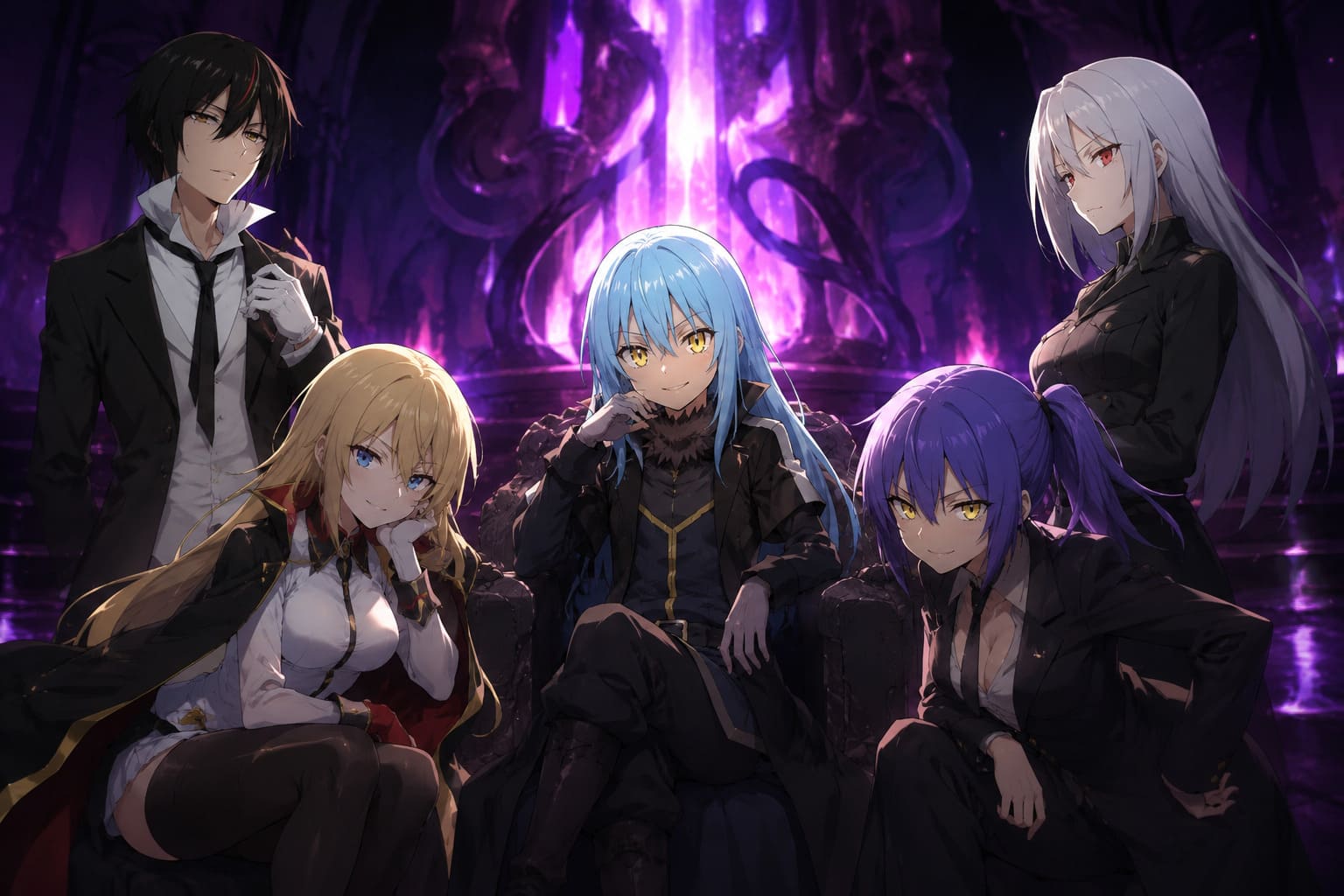
How Rimuru Survived Naming Them
Under normal conditions, naming multiple Primordial-level beings should completely drain a person’s magicules and lead to death. Rimuru survives through a combination of extraordinary factors that make his case unique in the entire series.
Survival Factors
- Veldora’s Soul Corridor acting as a massive external energy source
- Raphael (later Ciel) optimizing energy distribution and preventing overload
- Automatic magicule management during naming processes
Essentially, Rimuru is not operating under normal biological limitations. He is supported by a system that converts him into something closer to an energy-optimized entity than a traditional magic user.
The Global Consequence of Naming Primordials
Once Rimuru names the Primordial Demons, the balance of power in TenSura fundamentally changes. The world no longer operates on a simple hierarchy of Demon Lords and nations.
Instead, Rimuru becomes the central gravitational force around which multiple apex-level beings orbit.
Major Shifts in Power Structure
- Tempest becomes a top-tier global superpower
- Primordial Demons become loyal subordinates rather than independent threats
- Demon Lords like Guy Crimson are forced to reassess global balance
- Traditional political structures lose relevance against supernatural forces
This moment marks the transition of Rimuru from a rising power into a world-defining existence.
Final Thoughts
From a fan perspective, Rimuru naming the Primordial Demons is not just a power moment — it is a narrative turning point that defines the entire trajectory of TenSura. It blends accidental genius, emotional loyalty, and overwhelming cosmic luck into one event that permanently reshapes the world.
Rimuru does not conquer the world through force alone. He changes it by forming connections that slowly accumulate into unstoppable power. Naming the Primordials is the clearest example of that philosophy in action.
In the end, this is the moment the world of TenSura quietly realizes something irreversible: Rimuru Tempest is no longer part of the system — he is the system itself.


