Tetia and Tartah, A Deep Character Analysis: The Light and Shadow of Witch Hat Atelier
When people discuss Witch Hat Atelier, the focus usually lands on Coco, Qifrey, Agott, or the Brimhat conflict shaping the magical world.
But after spending a long time with Kamome Shirahama’s story, I’ve started to feel that two quieter characters—Tetia and Tartah—carry some of the most emotionally important themes in the entire series.
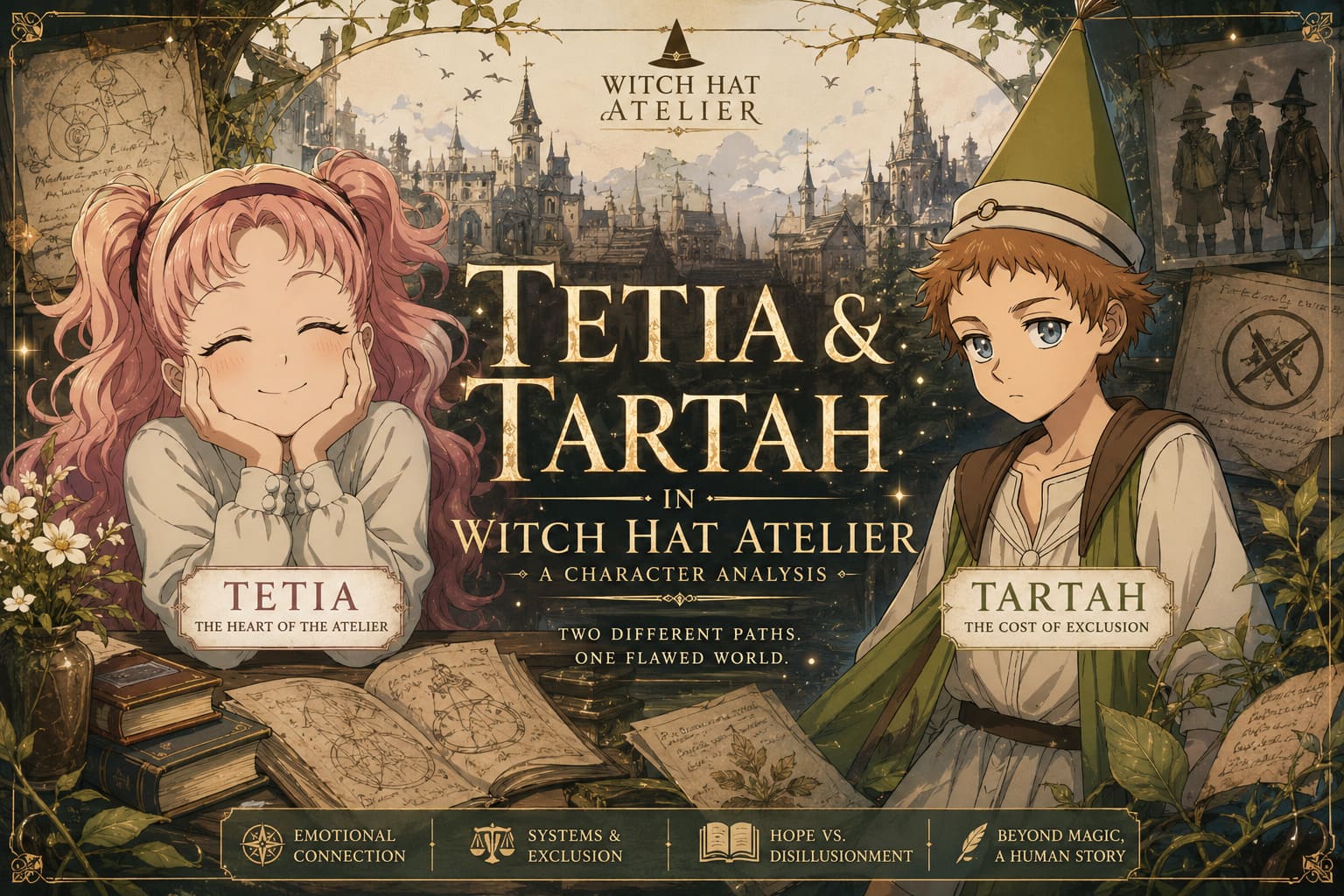
They don’t dominate the plot in a traditional sense, yet their presence reveals how deeply Witch Hat Atelier thinks about society, exclusion, kindness, and the cost of belonging.
In many ways, Tetia and Tartah represent two opposite emotional reactions to the same flawed system.
Why Do the Brimmed Caps Target Coco? The Dark Truth About Witch Hat Atelier’s Forbidden Magic
Tetia: The Emotional Core of the Atelier
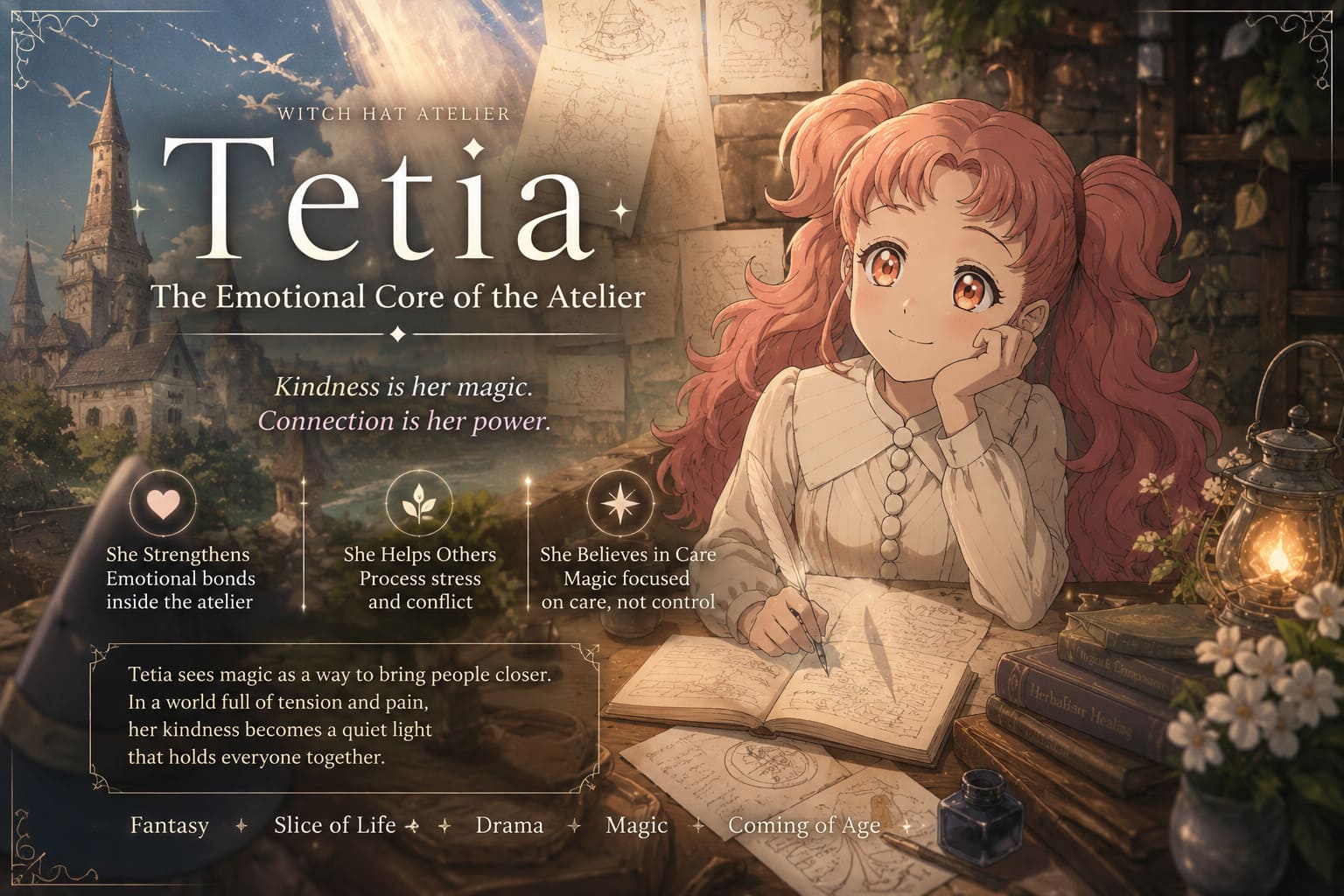
Tetia initially appears as the classic cheerful apprentice. She is bright, friendly, and endlessly supportive, often acting like the emotional glue holding Qifrey’s atelier together. In many fantasy stories, this kind of character would be reduced to comic relief, but Witch Hat Atelier treats her with far more depth.
What stands out most about Tetia is that her kindness is not ignorance. It is a choice. She understands tension and emotional pain, but she actively decides not to let those things define her interactions with others.
Kindness as a Magical Philosophy
Tetia’s dream of spreading gratitude across the world might sound simple, but it reflects a deeper worldview. She treats magic not as power or status, but as connection between people. For her, every spell carries emotional weight, and every interaction is an opportunity to create comfort.
Rather than dominating conversations, Tetia listens, observes, and gently supports those around her. This makes her incredibly important in a group often filled with strong personalities and emotional isolation.
Witch Hat Atelier: Coco and Agott Relationship Evolution Manga vs Anime
Why Tetia Stands Out
Even though she is not the center of major plot twists, Tetia consistently plays a stabilizing role in the story. Her presence can be understood through a few key traits:
- She strengthens emotional bonds inside the atelier
- She helps other characters process stress and conflict
- She represents an ideal version of magic focused on care rather than control
As the story becomes darker and more politically complex, Tetia’s optimism feels increasingly fragile. That contrast makes her one of the most emotionally charged characters in the series, even when she is not directly involved in major conflicts.
Tartah: The Cost of Exclusion
If Tetia represents emotional openness, Tartah represents systemic rejection. His story is much more grounded in frustration, realism, and institutional failure.
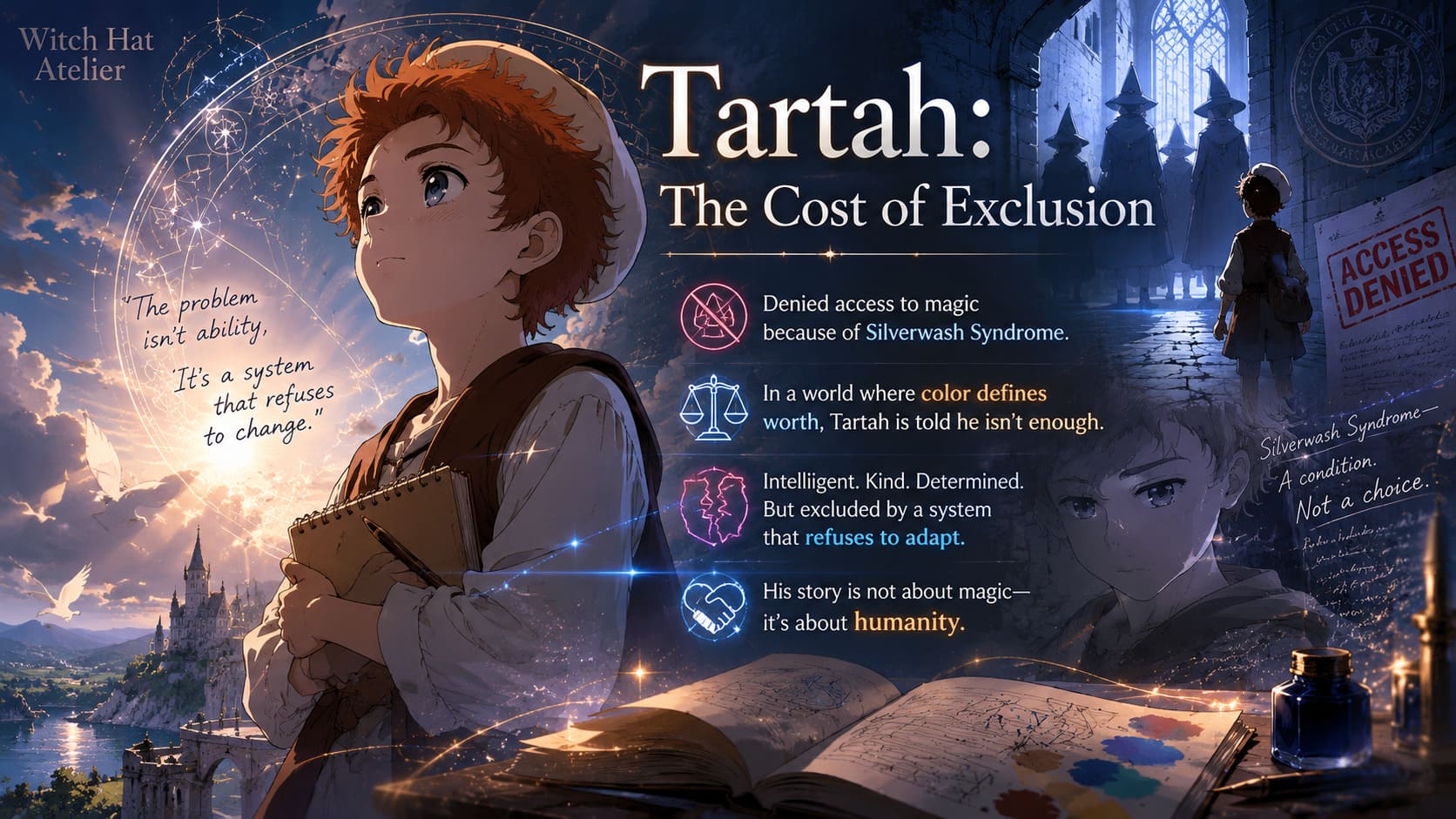
Tartah is intelligent, hardworking, and genuinely motivated to help others, yet he is denied access to formal magical training because of Silverwash Syndrome, a condition that affects his perception of color. In a system where color accuracy is essential to spellcasting, this becomes a barrier that society refuses to adapt to.
A System That Refuses to Adapt
What makes Tartah’s situation so powerful is not just his limitation, but how the system responds to it. Instead of developing accommodations or alternative teaching methods, witch society effectively excludes him.
This creates a quiet but devastating message: the problem is not ability, but the unwillingness of institutions to change.
Psychological Impact
Over time, Tartah develops a mindset shaped by distrust and constant questioning. From his perspective, authority figures hide information, restrict access, and decide who is “worthy” without transparency.
Even when his suspicions are not entirely correct, they are understandable. His worldview is built from repeated experiences of exclusion, making his paranoia feel less like villainy and more like survival.
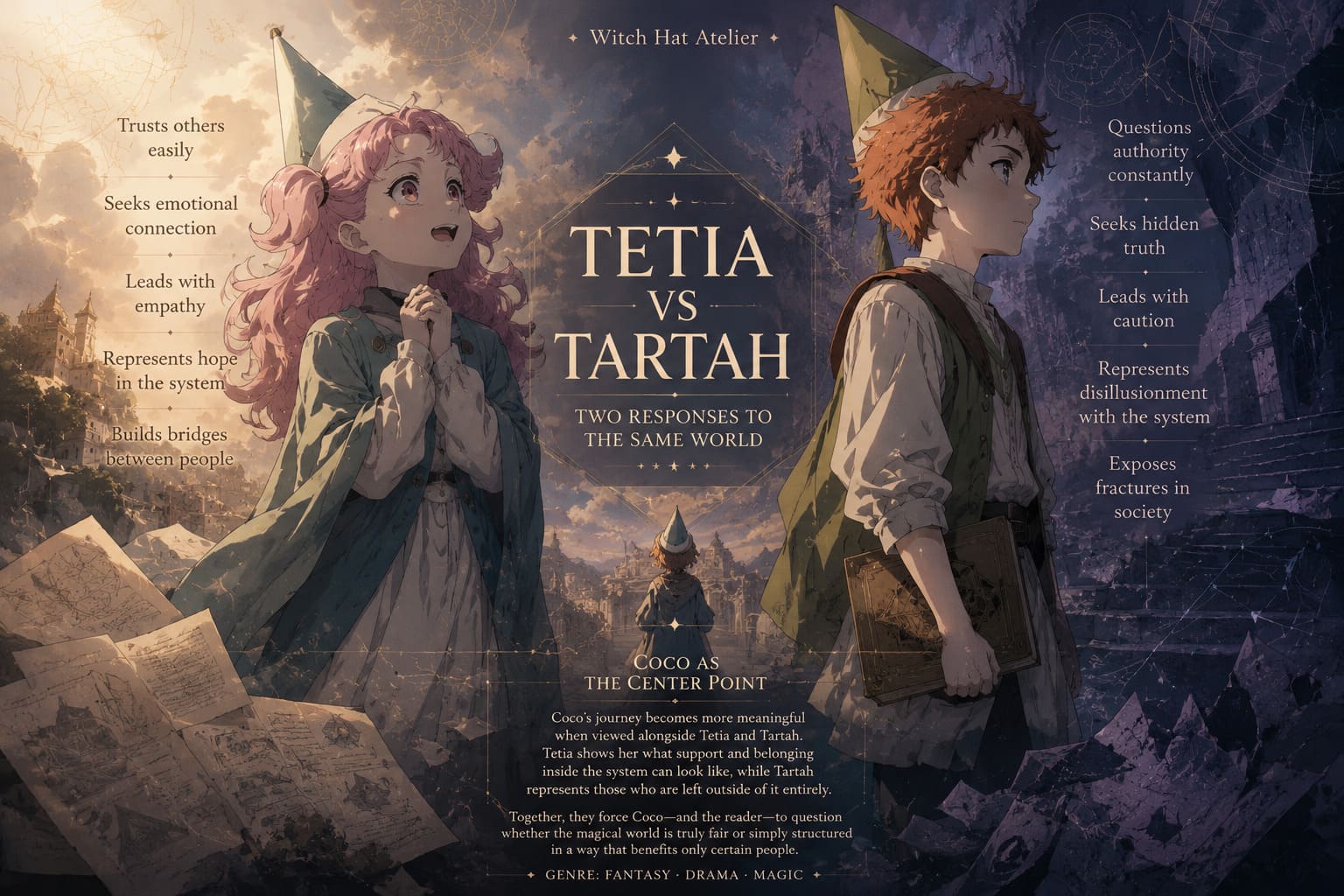
Tetia vs Tartah: Two Responses to the Same World
One of the most interesting aspects of Witch Hat Atelier is how these two characters mirror each other without ever directly opposing one another.
| Tetia | Tartah |
|---|---|
| Trusts others easily | Questions authority constantly |
| Seeks emotional connection | Seeks hidden truth |
| Leads with empathy | Leads with caution |
| Represents hope in the system | Represents disillusionment with the system |
| Builds bridges between people | Exposes fractures in society |
Neither perspective is presented as fully correct or incorrect. Instead, both feel like natural human responses to a complicated world.
Coco as the Center Point
Coco’s journey becomes more meaningful when viewed alongside Tetia and Tartah. Tetia shows her what support and belonging inside the system can look like, while Tartah represents those who are left outside of it entirely.
Together, they force Coco—and the reader—to question whether the magical world is truly fair or simply structured in a way that benefits only certain people.
The Emotional Balance of the Story
Without Tetia, the atelier would feel colder and more isolated. Without Tartah, the world would feel too controlled and unquestioned. Together, they create emotional balance, highlighting both the beauty and the flaws of Witch Hat Atelier’s society.
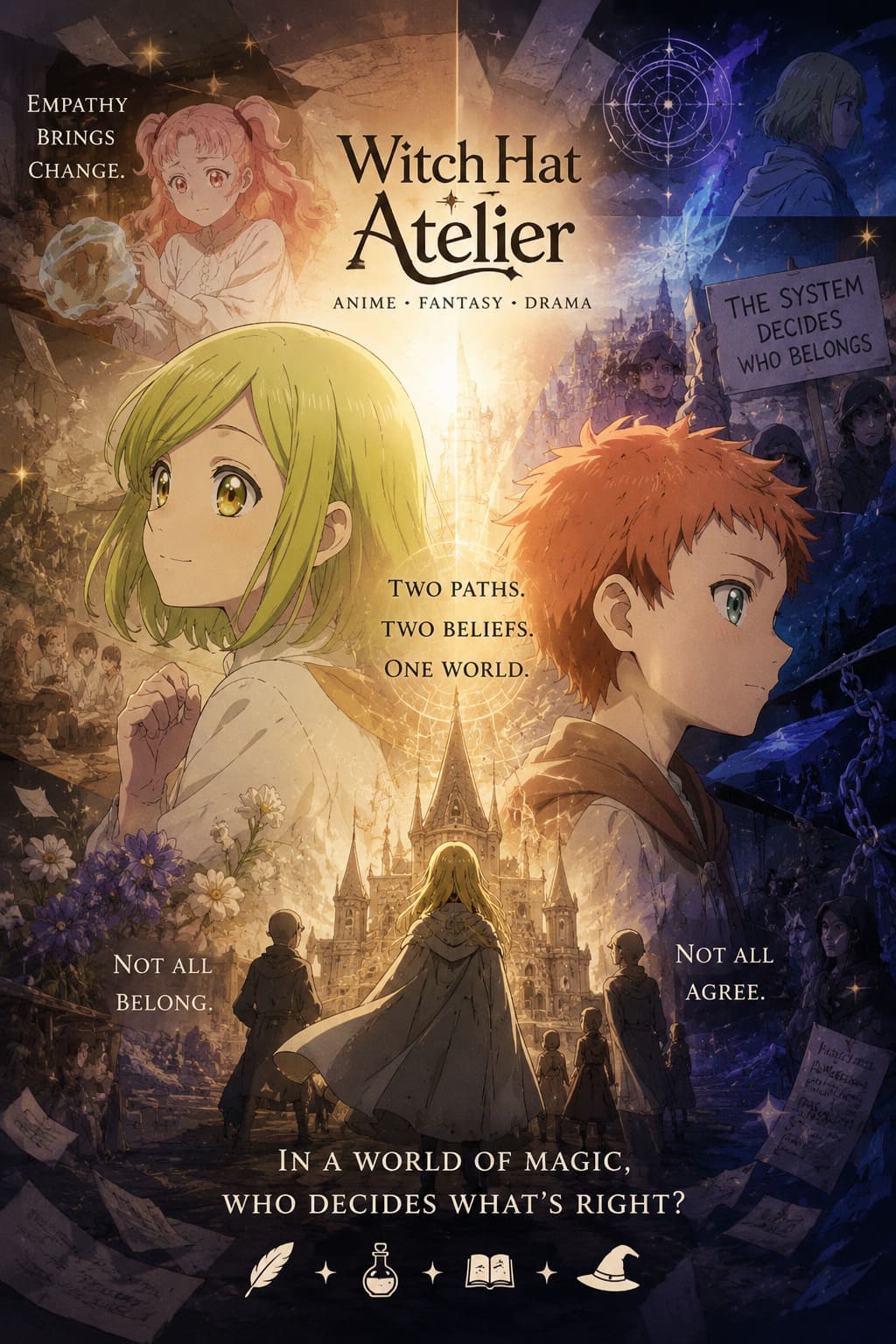
The Bigger Theme: Systems vs Individuals
At its core, Witch Hat Atelier is not just a story about magic. It is a story about systems—who they include, who they exclude, and how individuals survive inside them.
Tetia represents the belief that systems can be softened through empathy and understanding. Tartah represents the belief that systems must be challenged when they fail people. Neither approach is simple, and both come with emotional cost.
A Fragile Future
As tensions rise between different magical factions, it becomes increasingly likely that characters like Tetia and Tartah will play symbolic roles in shaping what comes next. One represents emotional unity, while the other represents uncomfortable truth.
The future of the story may depend on whether these two forces can ever exist in balance.
Final Thoughts
Tetia and Tartah may not be the main protagonists of Witch Hat Atelier, but they are essential to its emotional depth. Their stories explore two very human reactions to the same world: one filled with hope, and one shaped by disappointment.
What makes them compelling is that neither feels like a symbol first and a person second. They feel real, flawed, and deeply human in ways that elevate the entire story around them.
In the end, Witch Hat Atelier uses them to ask a difficult question: not just who can use magic, but who gets to belong in the world that magic creates.