Dragon Ball Super Beerus Release Date: Super Surge Trailer Reveals Remake Shock
There are anime announcements that make you nod and move on, and then there are Dragon Ball announcements that instantly send the entire fandom into chaos. The reveal of Dragon Ball Super: Beerus definitely belongs in the second category. Toei Animation has finally shown the new Super Surge trailer, and after watching it, I honestly understand why fans are already arguing about it everywhere from Reddit to YouTube.
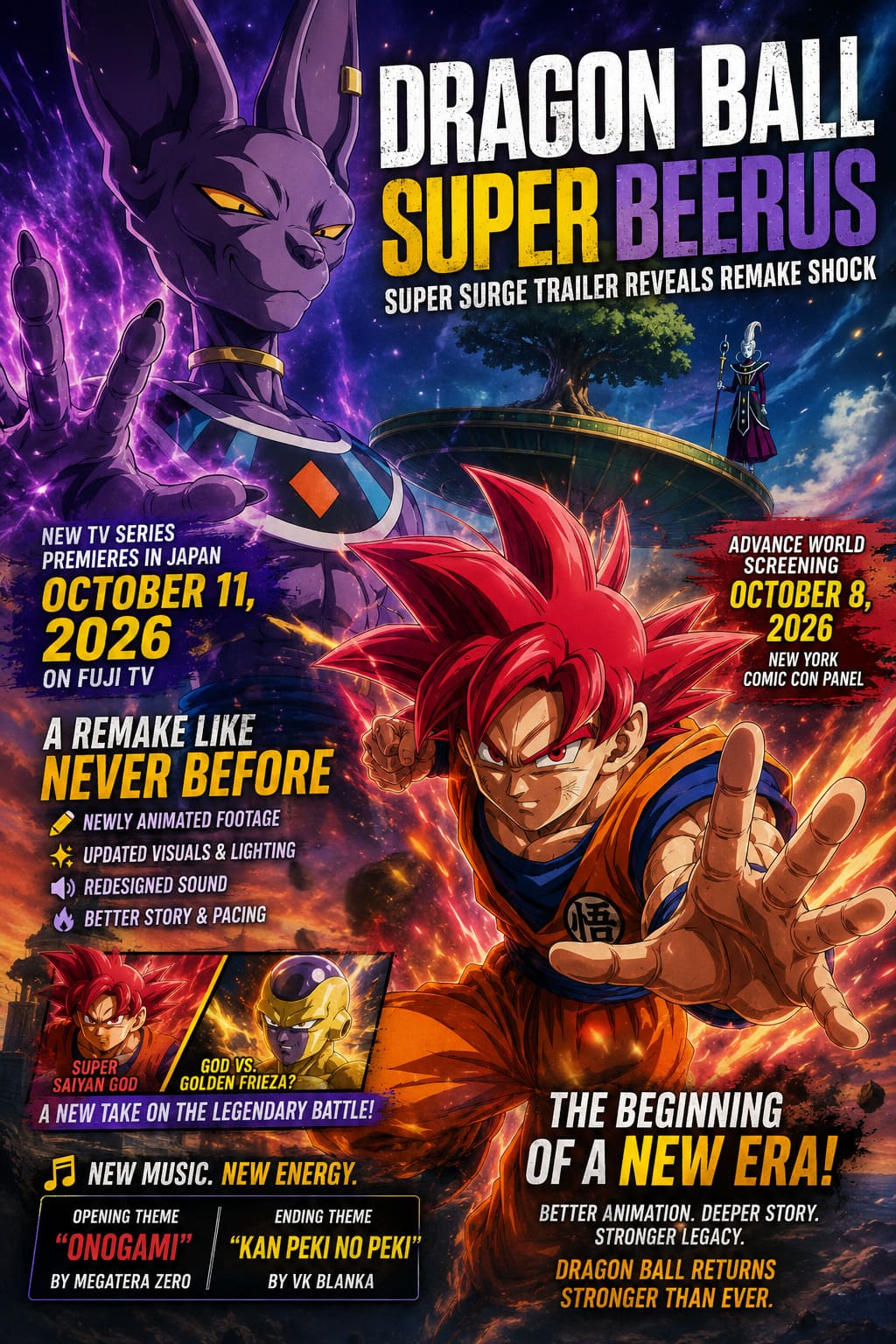
The big news is official: Dragon Ball Super: Beerus premieres in Japan on October 11, 2026, with the series heading to Fuji TV. North American fans will get an even earlier look, as the first episode is scheduled for an advance world screening on October 8 during a special New York Comic Con panel. After years of waiting for Dragon Ball to properly return to weekly television, seeing Goku and Beerus back in the spotlight feels strangely nostalgic.
But there is an important catch. This isn’t the long-awaited continuation that many of us expected. Instead of immediately adapting the Moro or Granolah arcs from the manga, Toei is going back to the beginning of Dragon Ball Super and rebuilding the Battle of Gods and Resurrection F material from the ground up.
And honestly? I’m more interested than I expected to be.
Dragon Ball Super: Beerus Is More Than a Simple Remaster
The first thing that jumped out at me from the Super Surge trailer is how different this project looks compared with the original television version of Dragon Ball Super. Calling it a remaster would actually undersell what Toei appears to be doing.
This new edition is being presented as a reconstructed television series with newly produced footage, redrawn sequences, improved lighting, updated digital effects and redesigned sound work. In other words, Toei isn’t simply taking old episodes, increasing the resolution and putting them back on streaming services.
That distinction matters because the opening episodes of Dragon Ball Super remain one of the most frequently criticized parts of the modern franchise. The original series eventually found its visual identity, particularly during its later arcs, but the early episodes had plenty of rough drawings, inconsistent character models and fights that didn’t always have the impact fans expected from Dragon Ball.
For a series built around spectacular transformations and ridiculous levels of power, that was a problem.
Now imagine Super Saiyan God Goku vs. Beerus with modern animation, more expressive character acting, cinematic lighting and choreography that actually gives every hit some weight. That’s the version of the story many fans have wanted for years.
The Super Saiyan God Detail Everyone Is Talking About
The most interesting part of the trailer isn’t necessarily the animation quality, though. It’s one particular story detail that could have much bigger consequences.
During footage connected to Resurrection F, Goku appears to use Super Saiyan God against Golden Frieza instead of immediately relying on Super Saiyan Blue. That might sound like a tiny change, but longtime Dragon Ball fans know exactly why people are freaking out over it.
Super Saiyan God has always been one of the strangest transformations in Dragon Ball Super. It was introduced with enormous importance, looked completely different from the traditional Super Saiyan forms and represented an entirely new level of power. Yet the story moved toward Super Saiyan Blue surprisingly quickly.
Personally, I think that transition always felt too abrupt.
Giving the red-haired God form more attention could make the progression from ordinary Super Saiyan to divine ki and eventually Super Saiyan Blue feel much more natural. Instead of Goku unlocking a new form and almost immediately moving on to the next one, Dragon Ball Super: Beerus could establish a clearer hierarchy between these transformations.
Why This Change Could Be Important
The potential advantages are pretty obvious:
- Better power-scaling progression between Super Saiyan God and Super Saiyan Blue.
- More meaningful use of the original God transformation instead of treating it as a short-lived stepping stone.
- Cleaner continuity between Battle of Gods, Resurrection F and the later arcs.
- A chance to incorporate ideas closer to Toriyama’s original vision for the story.
Of course, we shouldn’t assume every trailer shot confirms a massive retcon. Dragon Ball trailers are famous for making fans analyze individual frames like they’re decoding classified documents. Still, if Toei is deliberately changing the order and context of Goku’s transformations, I wouldn’t be surprised if the reconstructed series makes several similar adjustments.
Yes, We’ve Seen Battle of Gods Before. A Lot.
This is where I completely understand the criticism surrounding the project.
We’ve already experienced the Battle of Gods story multiple times. First came the 2013 movie, then the Dragon Ball Super television adaptation, followed by appearances and adaptations in games and other Dragon Ball media.
So when fans say, ‘Why are we doing this again instead of adapting Moro?’, that’s a completely fair question.
The Moro Arc has never received an anime adaptation, and neither has the Granolah storyline. Those are the stories many modern Dragon Ball fans are desperate to see animated. After such a long wait for the anime to return, spending production time revisiting material that audiences already know can feel like a strange decision.
If I were only thinking as a fan who wants new content, I’d absolutely prefer Moro.
But I also think there is another side to this.
Why Toei Might Be Starting Over
Dragon Ball is no longer simply continuing the exact television franchise that existed in 2015. A huge portion of today’s audience discovered Goku through streaming, clips, games and newer Dragon Ball projects rather than watching the original Super episodes when they first aired.
For younger viewers, Battle of Gods isn’t necessarily old news.
A polished 2026 version could effectively become the definitive introduction to Dragon Ball Super for a new generation. It also gives Toei an opportunity to clean up continuity before moving into future material.
That makes the project much easier to understand strategically.
Rather than asking new viewers to watch an older-looking 2015 adaptation before jumping into whatever comes next, Toei can establish a visually consistent version of the story from the beginning. And if the planned continuation eventually moves toward the Galactic Patrol storyline, having this reconstructed foundation could make the transition considerably smoother.
I’m still impatient for the unreleased manga arcs, but I can’t deny that this approach makes more sense when you look at the franchise as a long-term project.
The Music Is Getting a Complete Makeover Too
The visual overhaul isn’t the only major change. Dragon Ball Super: Beerus is also getting a new musical identity, which I think could make a surprisingly big difference.
The new opening theme, “ONOGAMI,” will be performed by MEGATERA ZERO. The ending theme, “Kan Peki No Peki,” comes from VK Blanka, whose connection to Dragon Ball apparently goes beyond simply being hired to make a theme song.
That’s something I always like seeing with anime music. When an artist actually has a personal connection to the franchise, there’s a better chance the song captures the emotional energy fans associate with it rather than feeling like another interchangeable seasonal anime opening.
And let’s be honest: Dragon Ball fights live or die partly on presentation.
A familiar scene can feel completely different when the music, sound effects, editing and animation all hit at exactly the right moment.
My Biggest Hope for Dragon Ball Super: Beerus
If Toei is genuinely rebuilding this era of Dragon Ball, I don’t want it to stop at making the punches prettier.
The biggest opportunity here is storytelling.
The original Dragon Ball Super sometimes moved incredibly quickly through concepts that deserved more breathing room. The introduction of Beerus, Whis, divine ki and the new transformation system could all benefit from additional character moments and better pacing.
I would love to see more time spent showing Goku learning what it actually means to fight with godly power. Vegeta’s relationship with Beerus and Whis could also use more attention. Even Frieza’s return could benefit from stronger buildup.
If the new series simply turns every old scene into prettier animation, I’ll probably enjoy it. I’m a Dragon Ball fan; that’s almost guaranteed.
But if Toei actually uses this opportunity to rewrite weak transitions, strengthen character development and fix awkward pacing, then suddenly this remake becomes much more exciting.
The October 2026 Premiere Could Be Huge
The timing is also interesting. The first episode will premiere in Japan on October 11, 2026, while fans attending New York Comic Con can see it several days earlier on October 8.
That screening could become one of the most important moments for the project.
The reaction from those first viewers will probably determine the online conversation immediately. If the episode delivers the kind of animation shown in the trailer, social media is going to explode. If it feels like little more than a polished recap, expect the backlash to be just as loud.
Dragon Ball fandom doesn’t exactly do quiet reactions.
For me, though, the most exciting possibility is that Dragon Ball Super: Beerus becomes something of a second chance for the beginning of Super.
The original series had incredible highs, but its early production problems became part of its reputation. Now Toei has an opportunity to revisit that material with years of experience, better technology and a much clearer understanding of what modern Dragon Ball fans expect.
Final Thoughts: Is This Really What Dragon Ball Fans Need?
I’m not going to pretend I wasn’t initially disappointed that the announcement wasn’t for the Moro Arc. After waiting this long, seeing another version of Goku’s first encounter with Beerus is a little frustrating.
But after seeing the Super Surge trailer, I’m starting to come around.
If Dragon Ball Super: Beerus really delivers newly animated material, improved pacing, stronger continuity and a better explanation of the God forms, this could be much more than a nostalgia project. It could become the version of the opening Dragon Ball Super storyline that fans actually wanted from the beginning.
And that Super Saiyan God vs. Golden Frieza detail? I’m keeping an eye on it.
Because if Toei is willing to change something as fundamental as Goku’s transformation progression, there may be far more surprises waiting for us than this trailer reveals.
For now, I’m cautiously excited. October 11 can’t come soon enough.
The era of Beerus, Whis and divine ki is coming back — and this time, Dragon Ball might finally get the beginning it deserved.