Dark Machine The Animation Release Date, Cast, and Mecha Plot Details Explained
Original anime always make me a little nervous. When there is no beloved manga sitting behind the production committee, there is no built-in audience waiting to tell everyone how good the next episode is going to be. Dark Machine: The Animation is taking exactly that risk, but after looking at its premise, cast, creative team, and absolutely ridiculous collection of mecha talent, I have to admit: this is one of the Fall 2026 anime I’m genuinely curious about.
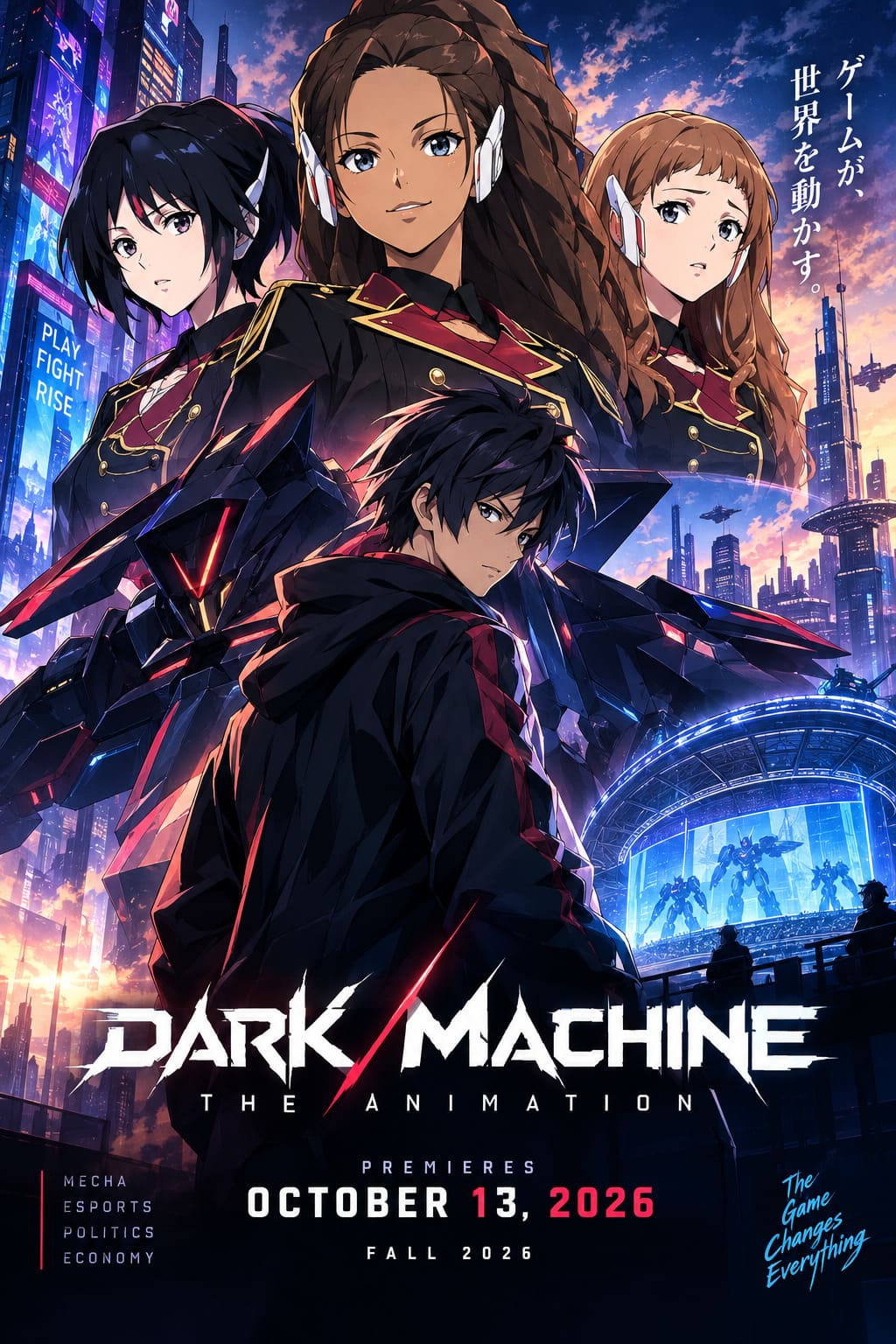
The important date is now locked in. Dark Machine: The Animation premieres in Japan on October 13, 2026, putting it directly into what is shaping up to be an extremely crowded anime season. The series will air across Fuji TV, Kansai TV, and BS Fuji, with the Fuji TV broadcast scheduled for Tuesdays at 1:45 AM JST, while Kansai TV follows on Thursdays at 2:45 AM JST and BS Fuji carries the series on Tuesdays at 12:30 AM JST.
But honestly, the release date is probably the least interesting thing about this project. What caught my attention is the bizarre combination of competitive gaming, giant robots, political power, and a futuristic economy. It sounds like someone threw several anime genres into a blender, pressed the button, and somehow came out with something that could actually work.
Dark Machine: The Animation Release Date and Broadcast Details
After a long promotional buildup, Project Carbuncle has finally given fans a firm premiere date. The Japanese television debut is scheduled for October 13, 2026, although viewers outside Japan need to pay attention to the late-night scheduling because the Fuji TV broadcast technically lands in the early hours of October 14 depending on the local interpretation of the timetable.
| Detail | Information |
|---|---|
| Anime | Dark Machine: The Animation |
| Premiere | October 13, 2026 |
| Season | Fall 2026 |
| Animation Studio | Production +h. |
| Director | Kazumi Terada |
| Creative Producer | Goro Taniguchi |
| Opening Theme | Sonzai Riyu Kai |
| Opening Artist | BUCK-TICK |
The one piece of information international viewers are still waiting for is just as important: which streaming service will carry the show outside Japan? Global distribution is planned, but specific North American platform details have not been finalized. That means fans may have to wait a little longer before knowing whether this becomes an easy weekly watch or another show that requires an annoying amount of detective work just to find legally.
A Mecha Anime Where Esports Controls Society
The setting is where Dark Machine really starts to separate itself from the usual giant-robot formula. Forget another distant galaxy, another ancient alien civilization, or another ruined Earth where teenagers somehow become the only people capable of saving humanity. Here, the world has become obsessed with a competitive game called Dark Machine, and the game has grown powerful enough to reshape Japan’s economy and political structure.
The center of that strange new world is Golden Valley, a city officially designated as a specialized Dark Machine economic zone. In this place, being good at the game isn’t simply a hobby or a way to become famous online. Your performance inside the virtual battlefield can determine your social position, wealth, influence, and political power. That’s an idea I really like because it gives the mecha fights consequences beyond simply winning or losing a match.
At the top of this bizarre hierarchy is Ajima, the player known as Senki. He isn’t merely the best competitor around; his dominance has effectively allowed him to take control of Golden Valley. That immediately gives the story a much more interesting conflict than “rookie player wants to become champion.” Kairi isn’t just climbing an esports leaderboard. He’s entering a system controlled by someone who has turned competitive gaming into an instrument of power.
Kairi’s Journey Starts With a Dying Wish
The protagonist is Kairi, a young man who arrives in Golden Valley because of one final request from his late grandfather: find Senki. That’s a wonderfully suspicious setup, because obviously nobody sends their grandson into the most dangerous competitive gaming city in Japan for a completely normal reason.
Kairi’s arrival becomes even more complicated when he encounters Rudra, a mysterious girl running from Arudamiru, one of Ajima’s powerful associates. Kairi attempts to help her and ends up dragged into the world he was originally trying to investigate from the outside. Before long, he’s forced to enter Dark Machine himself.
And then comes the classic protagonist problem: apparently, Kairi is absurdly talented at piloting mecha. His ability develops rapidly as he survives increasingly brutal battles, eventually putting him on a collision course with the Thousand Demons faction and, inevitably, Ajima himself.
I know the “ordinary newcomer secretly has incredible talent” setup isn’t exactly revolutionary. Anime has been using it forever. What could make it work here is the larger mystery surrounding Kairi’s grandfather and Senki. If the story actually connects those pieces instead of using them as convenient excuses for increasingly flashy battles, Dark Machine could have a surprisingly strong narrative hook.
The Creative Team Is the Real Reason I’m Paying Attention
If the premise alone isn’t enough to convince you, look at the people making this thing. Goro Taniguchi is involved as Creative Producer, and that’s a name that immediately gets my attention. He directed Code Geass: Lelouch of the Rebellion and later worked on major projects such as One Piece Film Red. Anyone familiar with Code Geass already knows why that matters: tactical battles, political manipulation, rivalries, betrayals, and characters constantly trying to outsmart one another are exactly the kind of ingredients this premise needs.
Then there’s Hidetaka Tenjin as Chief Mechanical Designer. His association with the Macross franchise and other mecha-heavy projects is another major positive. If Dark Machine is going to sell itself on giant robots fighting in a competitive arena, the machines cannot look like interchangeable blocks with glowing swords slapped onto them. They need personality, weight, and silhouettes that make you recognize a machine before you even know who’s piloting it.
Production +h. is handling animation, with Kazumi Terada directing. The character side is being handled by Ko Yoshinari and Akira Mitani, while Team Carbuncle oversees the scripts and series composition. The writing team includes Takaaki Suzuki, Tatsuhiko Urahata, Atsuo Ishino, and Satohito Sata, giving the project plenty of experienced anime industry talent behind its unusual concept.

Dark Machine: The Animation Voice Cast
The cast has also grown into one of the show’s biggest attractions. Kensho Ono voices Kairi, while Miyuki Sawashiro plays Rudra. Those two alone give the central story plenty of vocal firepower, but the supporting lineup has become surprisingly huge.
- Kairi — Kensho Ono
- Rudra — Miyuki Sawashiro
- Shinn — Koki Uchiyama
- Bran — Riho Sugiyama
- Isana — Saya Aizawa
- Ajima — Yuichi Nakamura
- Myojin — Kazuyuki Okitsu
- Ryo — Ryota Suzuki
- Kinji — Genta Nakamura
- Hiru — Sohei Horikane
- Nyudo — Ryunosuke Watanuki
- Hachiman — Jun Kousaka
- Bianca — Minori Suzuki
- Weiss — Rikuya Yasuda
- Ark — Nao Toyama
- Denebora — Nonoka Obuchi
- Spica — Rei Nakashima
That is a seriously crowded roster, and I’m actually hoping the anime gives these characters enough room to breathe. Mecha anime can easily fall into the trap of introducing twenty cool-looking pilots and then barely developing half of them. With factions, rivalries, and the Thousand Demons involved, Dark Machine has an opportunity to make its massive cast feel like part of a living competitive ecosystem rather than a collection of names appearing whenever the plot needs another opponent.
BUCK-TICK’s Opening Theme Could Be Perfect
Then there is the music. BUCK-TICK performs the opening theme, Sonzai Riyu Kai, translated roughly as “Reason to Live, Renewed.” This might be my favorite piece of the entire announcement because the band’s dark rock identity feels completely appropriate for what Dark Machine is trying to sell.
The combination of heavy guitars, gothic atmosphere, futuristic machinery, and high-pressure competitive battles sounds like an incredibly natural match. A strong opening can do a lot for an original anime, especially when viewers don’t already have a manga or game storyline telling them what to expect. If the opening visuals go as hard as the promotional material suggests, I can easily see this becoming one of those songs people associate with the entire season.
The Web3 Connection Is Either Brilliant or a Huge Gamble
Here’s the part that could divide viewers: Dark Machine isn’t designed as just an anime. It is part of a much larger transmedia project involving a Web3 gaming ecosystem and metaverse. The broader concept includes competitive mecha battles, digital ownership, and an economy built around player participation.
I’m cautiously interested rather than immediately sold. The good news is that the anime has a genuine story premise that can stand on its own. The bad news is that whenever a fictional universe starts talking too much about digital assets and decentralized economies, I start worrying that the actual narrative will eventually become an advertisement for the surrounding project.
If Project Carbuncle keeps the anime focused on Kairi, Rudra, Ajima, the rival factions, and the mystery surrounding Senki, I don’t really care what happens behind the scenes in the wider metaverse. Give me great characters and spectacular robot fights first. Everything else can stay optional.
Why Dark Machine Could Be a Fall 2026 Sleeper Hit
Fall 2026 is going to be brutal for original anime. Established franchises have a massive advantage because viewers already know the characters and have emotional investment before episode one even airs. Dark Machine has to earn that attention from scratch, which is always dangerous.
Still, the ingredients are unusually strong. You’ve got:
- A completely original sci-fi setting built around competitive gaming.
- A heavyweight creative team led by Goro Taniguchi and Hidetaka Tenjin.
- A large voice cast packed with recognizable Japanese talent.
- A mecha-focused action premise with actual economic and political stakes.
- BUCK-TICK handling the opening theme.
For me, the biggest question isn’t whether Dark Machine looks cool. It absolutely does. The real question is whether the writers can balance all of these ideas without letting the world-building collapse under its own weight. Esports, political control, family secrets, rival factions, mecha warfare, a mysterious girl, and a Web3 metaverse is a lot to cram into one series.
My Verdict Before the Premiere
I’m not ready to call Dark Machine: The Animation a masterpiece before I’ve seen a single full episode. That’s the kind of hype that usually comes back to bite you. But as far as original anime go, this is exactly the sort of weird, ambitious project I want to see succeed.
The October 13 premiere gives it a chance to make a serious impression during the Fall 2026 season. If Production +h. can deliver convincing mechanical animation, Taniguchi’s experience can translate into genuinely smart rivalries, and the story remembers that characters matter just as much as the machines, Dark Machine could become one of those shows nobody expected to dominate the conversation.
And honestly, I’m here for the possibility. Give me giant robots, morally questionable champions, ridiculous esports politics, a BUCK-TICK opening, and a protagonist with a suspicious family history. That’s a strange enough recipe that I need to know what happens next.