Bleach TYBW Part 4 The Calamity Creditless Opening Ending Videos Released: Song Details, Fan Reactions, and Streaming Guide
When Bleach: Thousand-Year Blood War Part 4 – The Calamity finally premiered, I expected incredible animation. I expected explosive fights. I even expected Studio Pierrot’s team to raise the visual bar one last time. What I didn’t expect was that the creditless opening and ending would end up stealing almost as much attention as the episode itself.
As someone who grew up watching Bleach after school and endlessly replaying classics like ‘Asterisk,’ ‘Rolling Star,’ and ‘Ranbu no Melody,’ seeing these new sequences felt strangely emotional. They’re not simply another pair of anime songs meant to hype viewers for the next episode. They feel like a farewell letter to a series that has been part of anime culture for more than twenty years.
That feeling is exactly why fans have been dissecting every frame since the videos appeared online.
Star Detective Precure Movie Release Date, Trailer, Music and Crossover Details Revealed
Why the Creditless Versions Matter More Than You Think
Anime fans love creditless openings for obvious reasons—you finally get to appreciate every animation cut without text covering half the screen. But with Bleach, there’s another reason.
This final cour is packed with visual symbolism. Every color choice, camera angle, and character placement seems intentional. Removing the staff credits lets viewers catch details that would otherwise disappear after one viewing.
After watching the opening several times, I noticed something interesting. Instead of chasing flashy spectacle from beginning to end, the sequence slows down whenever major characters appear. The pacing almost forces you to think about what each shot means rather than simply admiring gorgeous animation.
That’s the kind of confidence only a production team completely invested in its work can have.
‘I-BULL’ Gives Bleach a Different Kind of Energy
I’ll admit it—I was expecting another loud rock anthem.
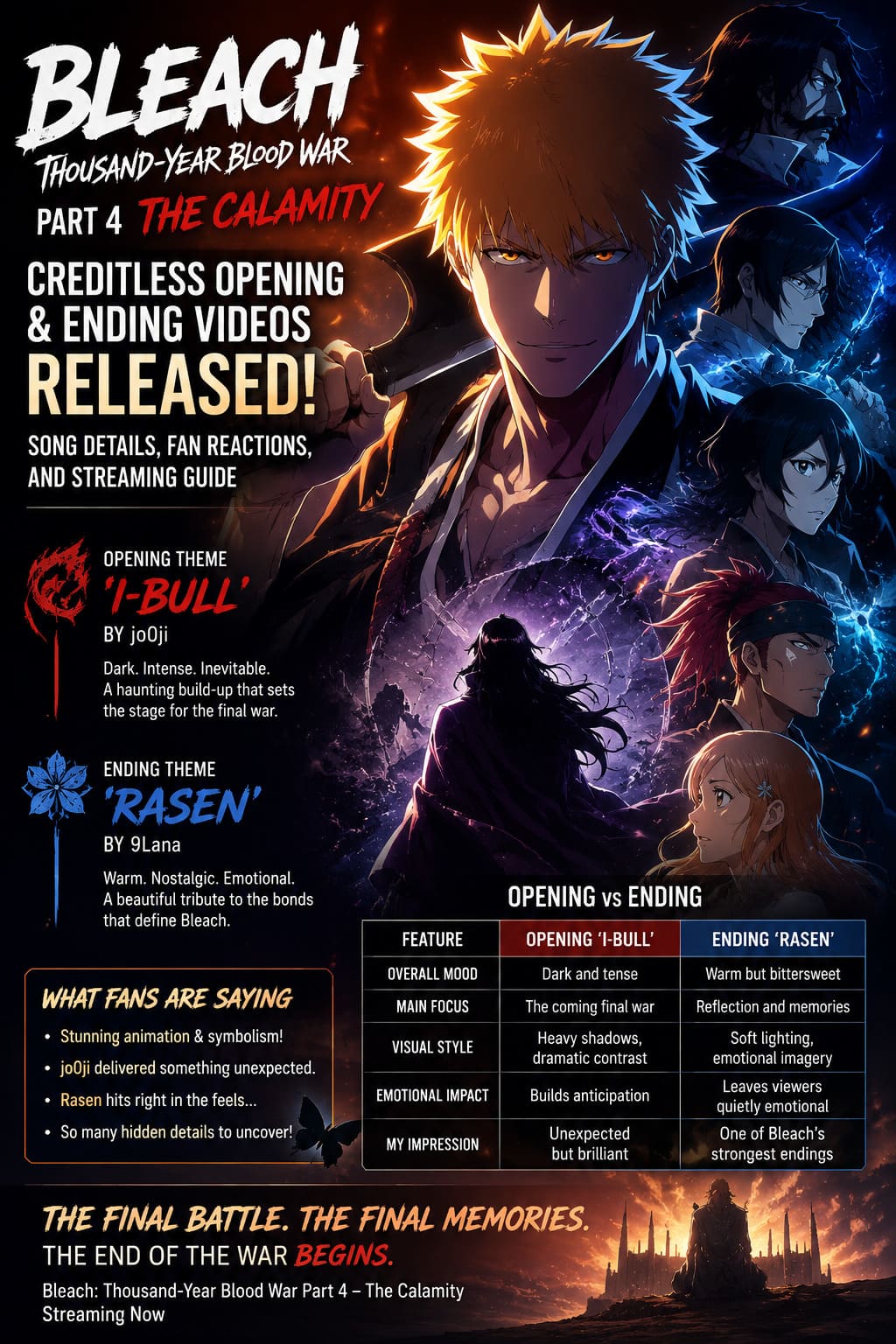
Instead, jo0ji’s ‘I-BULL’ surprised me. The song doesn’t explode immediately. It builds tension little by little until everything feels like it’s about to collapse.
Oddly enough, that fits this stage of the story much better.
Earlier Bleach openings were built around excitement. This one feels built around inevitability.
The visuals match that atmosphere perfectly. Soul Society looks exhausted rather than heroic. Characters aren’t introduced like unstoppable warriors anymore. They’re presented as people carrying impossible responsibilities while the world falls apart around them.
Moments That Immediately Stood Out
- Ichigo’s quiet determination instead of flashy hero poses.
- Uryu Ishida’s lingering shots, making his role feel more mysterious than ever.
- Yhwach’s overwhelming presence, even when he isn’t dominating the screen.
- Clever use of shadows instead of nonstop action scenes.
As a longtime fan, I actually appreciated this restraint. It reminds viewers that the biggest battles aren’t always about who throws the strongest attack.
Sometimes they’re about impossible choices.
‘Rasen’ Might Be One of Bleach’s Most Emotional Ending Themes
If the opening prepares you for war, the ending reminds you what everyone is fighting to protect.
9Lana’s ‘Rasen’ instantly became one of my favorite Bleach endings.
Rather than delivering dramatic action, it leans into nostalgia.
Warm lighting replaces the cold blues dominating the opening. Familiar faces appear almost like fading memories. The animation quietly reminds viewers how far characters like Ichigo, Rukia, Orihime, Chad, and Renji have come since the series first aired.
There are subtle callbacks longtime manga readers will instantly recognize, but nothing feels forced. Even anime-only viewers can understand the emotion without needing every reference explained.
Honestly, I wasn’t expecting an ending theme to hit this hard.
Opening vs Ending
| Feature | Opening ‘I-BULL’ | Ending ‘Rasen’ |
|---|---|---|
| Overall Mood | Dark and tense | Warm but bittersweet |
| Main Focus | The coming final war | Reflection and memories |
| Visual Style | Heavy shadows, dramatic contrast | Soft lighting, emotional imagery |
| Emotional Impact | Builds anticipation | Leaves viewers quietly emotional |
| My Impression | Unexpected but brilliant | One of Bleach’s strongest endings |
Fans Are Already Turning Every Frame Into a Theory
If you’ve spent even five minutes browsing anime communities after the premiere, you’ve probably seen countless screenshots with giant red circles pointing toward tiny background details.
That’s just the Bleach fandom being itself.
People are debating hidden symbolism, predicting expanded anime-original scenes, and comparing the opening with manga panels released years ago. Others are ranking this sequence against legendary openings from earlier arcs.
The funniest part is that almost nobody agrees.
- Some viewers wanted heavier guitars.
- Others immediately called ‘I-BULL’ a masterpiece.
- Many fans are already hunting for hidden foreshadowing frame by frame.
Personally, I think the divided opinions actually prove the opening succeeded. Safe openings rarely spark passionate discussion. The memorable ones usually surprise people first.
The ending, on the other hand, has earned almost universal praise.
That isn’t something you see very often.

The Final Cour Already Feels Different
One thing became obvious after Episode 1.
This isn’t trying to be another standard battle-heavy shonen season.
Everything feels more cinematic.
Fight choreography receives plenty of attention, but quieter conversations suddenly matter just as much. Character expressions linger longer. Background art carries emotional weight instead of simply filling space.
That’s probably the biggest advantage of the anime adaptation over the original manga’s final chapters.
Back when the manga concluded, many readers felt the ending moved too quickly. Now, with additional supervision and expanded material, the anime has a chance to flesh out battles, relationships, and lore that originally passed by at breakneck speed.
Even readers who already know every major twist have reasons to stay excited.
Why This Feels Like the Bleach Ending Fans Waited Years For
I’ve watched plenty of anime finales that promised something unforgettable before delivering a perfectly average conclusion.
So far, The Calamity doesn’t feel like one of those.
The production clearly understands what made Bleach special in the first place. Yes, there are spectacular fights. Yes, there are ridiculously stylish character designs.
But beneath all that, Bleach has always been about people refusing to give up despite impossible odds.
These new opening and ending sequences capture that spirit better than any marketing trailer could.
They’re stylish without becoming empty.
They’re emotional without becoming melodramatic.
Most importantly, they remind older fans why they stayed with this franchise for so many years while giving newer viewers something visually stunning to obsess over every Saturday.
If the remaining episodes maintain the same level of care shown in these creditless videos, Bleach: Thousand-Year Blood War Part 4 has every chance to be remembered as one of the strongest final acts in modern shonen anime—not simply because of its battles, but because it understands that endings should leave memories long after the screen fades to black.