Jyu-Oh Mujin Dandivine Anime Release Date, New Cast Members, and Plot Details Revealed
If you told me a few years ago that one of the mecha anime projects I’d be most curious about in 2026 would revolve around a forgotten robot toy brand, a bankrupt company, and an old war hero getting dragged back into the cockpit, I probably would’ve laughed. Yet here we are. Jyu-Oh Mujin Dandivine, also known as Beast King War God Dandivine, has that wonderfully strange combination of retro super-robot energy and modern anime storytelling that immediately caught my attention.
The series is especially interesting because it isn’t another adaptation of an established manga or game. It’s an original Japanese mecha anime and the first project in Good Smile Company’s ambitious Gattaishin Series, created to celebrate the company’s 25th anniversary. That alone gives Dandivine a different kind of appeal. There are no decades of source material telling us what will happen, so every character reveal, mechanical design, and plot detail actually feels like a piece of a much larger puzzle.
Jyu-Oh Mujin Dandivine Release Date
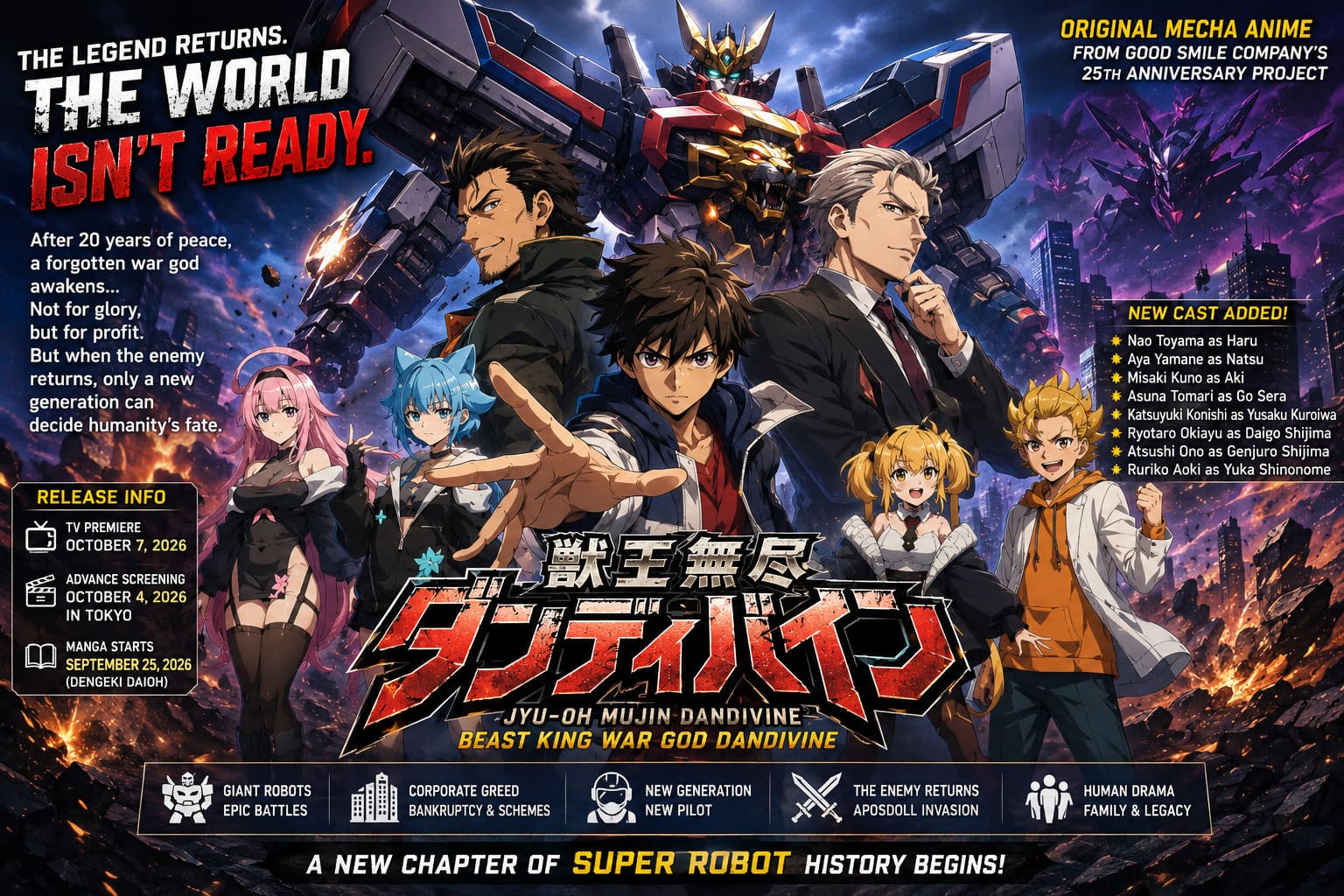
The big date to circle on your calendar is October 7, 2026. That’s when Jyu-Oh Mujin Dandivine is scheduled to begin its Japanese television broadcast, with episodes airing on Tokyo MX, BS11, Gunma TV, Tochigi TV, Chukyo TV, and MBS. The late-night broadcast is listed for 24:30, which is one of those classic anime scheduling quirks that technically puts the premiere in the early hours of October 8.
There is also an opportunity for some fans to see the anime before the television premiere. A special advance theatrical screening is scheduled for October 4, 2026, in Tokyo. For a completely original mecha series, getting an early theatrical presentation is pretty exciting. I wouldn’t be surprised if early reactions from that screening end up generating even more conversation before the regular broadcast starts.
The franchise isn’t waiting until October to expand beyond animation either. The manga adaptation, Beast King War God Dandivine Kai, illustrated by Toguchi, is scheduled to begin serialization in Dengeki Daioh on September 25, 2026. So fans will have a chance to enter this world through manga before the anime officially launches.
Eight New Cast Members Join the Mecha Anime
One of the biggest recent announcements is the addition of eight new voice actors. And honestly, this is where Dandivine started looking much more interesting to me. The casting mixes younger performers with some seriously recognizable veteran voices, giving the series enough experience to sell both its dramatic human moments and its larger-than-life robot battles.
- Nao Toyama voices Haru, bringing experience from The Devil is a Part-Timer! and Laid-Back Camp.
- Aya Yamane voices Natsu, known for Hana-Kimi.
- Misaki Kuno voices Aki, with credits including The Seven Deadly Sins and Durarara!!x2.
- Asuna Tomari voices Go Sera, previously appearing in Don’t Hurt Me, My Healer!.
- Katsuyuki Konishi voices Yusaku Kuroiwa, a veteran known for Tengen Uzui and Kamina.
- Ryotaro Okiayu voices Daigo Shijima, with major roles including Byakuya Kuchiki and Kunimitsu Tezuka.
- Atsushi Ono voices Genjuro Shijima.
- Ruriko Aoki voices Yuka Shinonome.
The presence of Katsuyuki Konishi immediately caught my attention. Anyone who has heard him as Kamina in Gurren Lagann knows he can bring an enormous amount of personality to a character, and putting that kind of voice behind a former giant-robot pilot feels almost too appropriate. Meanwhile, the previously announced central cast features Takuma Terashima as Gekiha Shijima, Haruka Shiraishi as Akane Kuzumi, and Saya Aizawa as Kirei Shijima.
The Story Has a Surprisingly Weird Corporate Twist
Here’s the part of Jyu-Oh Mujin Dandivine that really sold me on the concept. The story takes place after twenty years of global peace. That peace exists because Dandivine, a powerful combining robot, once defeated an invading force known as the Aposdoll. Normally, that would be the perfect ending for a super-robot story: humanity survives, the hero retires, and everyone lives happily ever after.
But that’s not what happens here. Instead, Dandivine becomes a commercial product. The toy manufacturer Kasuga turns the legendary robot into a hugely successful merchandise line, effectively transforming a symbol of humanity’s survival into something children can buy in a store. It’s a surprisingly clever idea because it asks what would realistically happen to a legendary war machine after the war was over.
Of course, the problem is that nostalgia doesn’t always pay the bills forever. Twenty years later, Kasuga is struggling financially, and its dependence on an aging Dandivine brand has become a serious liability. That’s where Genjuro Shijima, the company’s current president, enters the picture with a truly questionable business strategy: bring the real Dandivine back.
Genjuro Wants the Robot Back for All the Wrong Reasons
Genjuro’s motivation is one of the strangest parts of the premise. He isn’t simply trying to save the world from an alien invasion. He wants the actual Dandivine revived because he believes its return could reignite public interest in the Kasuga brand and potentially rescue the company from bankruptcy.
Then reality decides to make his terrible idea come true. The Aposdoll suddenly return over Tokyo, ending two decades of peace and throwing the city into chaos. It’s the kind of setup that makes me wonder whether Genjuro’s actions somehow contributed to the invasion or whether he simply got unbelievably unlucky. Either possibility could create some very interesting character drama later.
Who Pilots Dandivine?
The new pilot is Gekiha Shijima, an ordinary high school student who has absolutely no reason to expect that he’ll be responsible for piloting a legendary combining robot. His life changes when his uncle, Yusaku Kuroiwa, forces him into the role. The important detail is that Yusaku isn’t just some random relative—he was Dandivine’s original pilot twenty years earlier.
That creates an obvious generational conflict. Yusaku knows what it means to fight in Dandivine, while Gekiha has grown up in a world where the robot is essentially a piece of commercial nostalgia. To Gekiha, the machine probably feels more like an old toy than a weapon capable of deciding the fate of humanity. Watching him gradually understand what Dandivine actually represents could become one of the strongest parts of the anime.

A Creative Team Built for Classic Mecha Drama
The production lineup is another reason I’m keeping an eye on this one. Liden Films, the studio behind Tokyo Revengers and the modern Rurouni Kenshin anime, is co-producing the project with Kayac Animation. Yi Cao is directing, while veteran writer Toshiki Inoue handles series composition and scripts.
Inoue’s involvement is particularly notable. His work spans major productions such as Kamen Rider 555, Death Note, and Avataro Sentai Donbrothers. That background makes him a fascinating choice for a story that mixes superhero-style robot mythology, family relationships, corporate desperation, and science-fiction warfare.
The character designs come from Majiro, with Robin adapting them for animation, while An of God Brave Studio is responsible for the mechanical designs. Based on the project’s concept, I’m hoping the robot itself gets the attention it deserves. Modern anime can sometimes make giant robots look incredibly sleek but forget that the fun of a combining robot is watching the individual machines come together and feeling the sheer weight of the final form.
TM Revolution Is Handling the Opening Theme
And then there’s Takanori Nishikawa, better known as T.M.Revolution, performing the opening theme. That’s almost unfairly perfect casting for a super-robot anime. His energetic style has been attached to plenty of anime and action projects over the years, so hearing him kick off Dandivine should immediately establish the right atmosphere.
For me, this combination of old-school robot aesthetics, an experienced writer, a veteran voice cast, and a high-energy opening singer is exactly what makes the project worth watching. It doesn’t feel like the series is trying to pretend classic mecha never existed. Instead, it seems to be taking those familiar ingredients and putting them into a very unusual modern setup.
Why I’m Watching Jyu-Oh Mujin Dandivine
There are plenty of mecha anime announced every year, but Dandivine has one advantage that I think could make it stand out: its premise has an actual sense of personality. A bankrupt toy company wanting to revive a legendary robot for publicity, only for the alien enemy to return at exactly the wrong moment, is wonderfully ridiculous in the best possible way.
I’m also curious about how seriously the show will treat its corporate storyline. If Kasuga is simply a joke villain organization, some of the concept’s potential will be wasted. But if the series explores what happens when people commercialize a symbol of war and then become dependent on that mythology, there could be a surprisingly thoughtful story underneath all the giant robots and explosions.
For now, the most important dates are simple: the manga begins on September 25, 2026, the advance Tokyo screening takes place on October 4, and the television anime arrives on October 7. I’m definitely keeping this one on my seasonal watchlist. If Jyu-Oh Mujin Dandivine can combine its bizarre corporate premise with satisfying robot action and characters who actually matter, it could become one of the more memorable original anime of fall 2026.