
BLEACH: TYBW Part 4 Changes Uryu Ishida Ending Video in Episode 6 “THE END”
There are anime episodes that you watch once and move on from, and then there are episodes that make you immediately pause the credits because something looks different. BLEACH: Thousand-Year Blood War Part 4: The Calamity has turned its ending sequence into exactly that kind of experience. Episode 6, “THE END,” doesn’t just deliver another brutal chapter in the final war—it quietly changes the ending visuals to put Uryu Ishida under the microscope.
Honestly, I love this approach. After years of anime endings being something many viewers simply skip, BLEACH: TYBW has made its credits feel like part of the actual episode. The ending theme “Rasen” by 9Lana continues to evolve, with new shots, altered imagery, and character-focused details appearing as the story reaches different turning points. Episode 6 might be one of the most interesting examples yet because the changes surrounding Uryu aren’t just pretty animation—they reinforce what is happening inside his head.
And considering where Uryu currently stands, that’s a pretty big deal.
Jyu-Oh Mujin Dandivine Anime Release Date, New Cast Members, and Plot Details Revealed
Uryu Ishida Finally Gets the Spotlight He Deserves
Uryu has always been one of the strangest and most fascinating characters in BLEACH. He started as Ichigo’s Quincy rival, gradually became a genuine friend, and then found himself on the opposite side of the battlefield when Yhwach recruited him into the Wandenreich.
That betrayal has never been as simple as “Uryu became evil.” Anyone who has followed the Thousand-Year Blood War knows there is something much deeper happening. Uryu has his own reasons, his own history with the Quincy, and his own complicated relationship with the people he cares about.
That’s why the Episode 6 ending changes work so well.
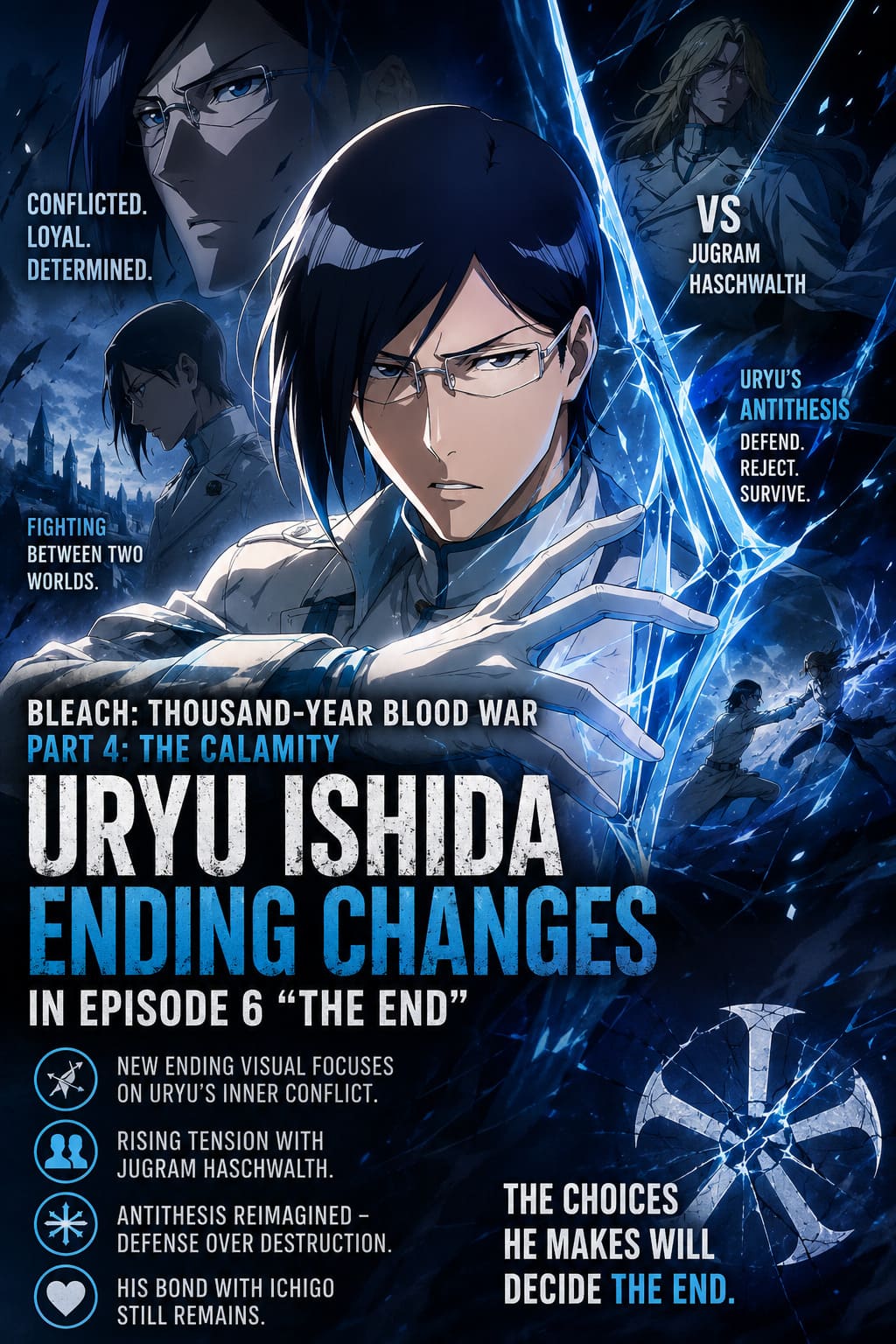
The updated visuals give Uryu a much more emotionally fractured appearance. Instead of presenting him as the cold, distant Quincy standing alongside Yhwach’s forces, the sequence emphasizes someone who looks like he’s being pulled apart from the inside.
That’s Uryu’s entire TYBW story in one image.
He’s surrounded by people who expect loyalty, yet his heart is still connected to Ichigo and the others. He’s technically standing with the enemy, but everything about his actions suggests that his motivations are far more complicated.
“Rasen” Is Becoming a Weekly Storytelling Tool
The clever part is that Studio Pierrot isn’t treating the ending as a fixed piece of animation anymore.
The “Rasen” ending sequence has effectively become a visual timeline for the final arc. Certain shots can change depending on what happened in the episode, allowing the credits to reflect the emotional state of the characters we just watched.
That’s something I genuinely wish more anime would experiment with.
Normally, an ending sequence gets created once and then plays unchanged for weeks. With BLEACH: TYBW, viewers have learned that skipping those final minutes might actually mean missing something interesting.
Previous updates have drawn attention toward characters such as Rukia Kuchiki and Kisuke Urahara. Episode 6, however, shifts the focus heavily toward Uryu, which makes perfect sense given his confrontation with Jugram Haschwalth.
The ending essentially becomes a visual aftershock of the episode.
The Light and Shadow Around Uryu Say a Lot
One of the most noticeable differences is the way Uryu is presented through light, shadow, and blue reishi imagery.
His appearance feels colder and more fractured, almost as if the visual composition itself is breaking apart around him. That isn’t just a cool aesthetic choice. Uryu has spent this entire part of the story hiding what he truly thinks, and the ending gives us something the character himself refuses to say openly.
He’s conflicted.
He’s exhausted.
And he’s running out of room to keep pretending.
The blue reishi effects also fit perfectly with Uryu’s Quincy identity. The visual language reminds us that this isn’t simply a battle between two random warriors. Uryu is fighting within the legacy of his own people while simultaneously resisting the person who claims absolute authority over that legacy.
That’s a fantastic character conflict, and the anime is finally giving it the visual attention it deserves.
Antithesis Makes the Imagery Even More Important
Then there’s Uryu’s Antithesis, one of the most dangerous abilities in the entire arc.
The ending imagery reportedly shifts the arrangement of Uryu’s Quincy weaponry and arrows, giving them a more fragmented, defensive appearance rather than presenting them as straightforward offensive weapons.
That distinction is small, but thematically it works.
Uryu isn’t fighting simply to destroy Haschwalth. He’s trying to survive an opponent whose power, The Balance, makes direct confrontation incredibly dangerous. The imagery surrounding Uryu therefore feels less like a victory pose and more like a visual representation of someone desperately trying to turn an impossible situation around.
And that’s exactly what makes Uryu interesting.
His greatest weapon isn’t just Antithesis. It’s his willingness to stand between two worlds.
Uryu vs. Haschwalth Is More Than a Simple Fight
The confrontation between Uryu and Haschwalth is one of those battles where the physical action is only half the story.
On the surface, you’ve got two Quincy warriors throwing absurd amounts of power at each other. Underneath that, however, they’re representing completely different ideas of loyalty.
Haschwalth represents absolute devotion to Yhwach and the Quincy emperor’s vision. Uryu, meanwhile, has reached a point where loyalty to his heritage is colliding with something much more personal: his friendship with Ichigo.
That emotional contradiction is what makes the ending update hit harder.
When Uryu’s expression becomes more determined rather than simply emotionless, it feels like the anime is telling us something without spelling it out.
Uryu has made his choice.
He may not be able to explain it to everyone around him. He may not even survive long enough to explain everything himself. But the visual language strongly suggests that his connection to Ichigo hasn’t disappeared.

Why Fans Are Paying Attention to the Credits
Anime communities have understandably gone wild over these little changes because BLEACH: TYBW has trained viewers to look for details.
A normal ending might give you attractive character shots and a song. Here, fans are comparing different broadcasts, freezing frames, analyzing composition, and looking for hints about what’s coming next.
Some of the most interesting things to watch for include:
- Character-specific visual changes tied to the latest episode.
- Symbolic imagery connected to abilities and character motivations.
- Altered facial expressions that reveal emotional shifts.
- New compositions and background details that may foreshadow later events.
For a longtime BLEACH fan, this is ridiculously fun.
It also rewards people who pay attention rather than simply consuming the episode and immediately moving on to the next show.
Tite Kubo’s Influence Is Clearly Being Felt
One of the biggest reasons fans are excited about the final BLEACH: TYBW cour is the increased sense that the anime can expand on material that originally moved too quickly.
The manga’s final stretch famously had to rush through a huge amount of story. The anime adaptation has the opportunity to give certain characters and confrontations additional breathing room.
Uryu benefits enormously from that.
His motivations were always important, but the anime has more room to explore the emotional contradiction behind his actions. The relationship between Uryu, Ichigo, the Quincy, and Yhwach becomes much more compelling when the story allows those choices to actually hurt.
And when the ending sequence changes alongside the narrative, it makes the entire production feel more connected.
What This Could Mean for the Final Episodes
With the final stretch approaching, Uryu’s role is becoming increasingly important. He’s not just another member of the cast waiting for the final battle to end. His powers and his unique position within the Quincy hierarchy make him potentially crucial to the outcome of the war.
More importantly, his personal journey is reaching its breaking point.
Uryu has spent far too long walking between identities: Quincy and human, enemy and friend, successor and rebel. Eventually, he has to stop standing in the middle and decide exactly who he wants to be.
Episode 6 feels like that moment getting closer.
Final Thoughts
I think the changing BLEACH: TYBW ending sequences are one of the smartest little production ideas in this final adaptation. They’re easy to overlook, but once you realize that the visuals can change according to the episode, suddenly the credits become another piece of the story.
And the Uryu-focused changes in Episode 6, “THE END,” are particularly effective because they don’t scream their message at you. They use lighting, composition, symbolism, and expression to show a character who is mentally and emotionally reaching his limit.
For me, that’s what makes this adaptation so exciting. BLEACH isn’t simply recreating the final arc panel for panel anymore. It’s finding new ways to make familiar moments feel fresh.
If the remaining episodes continue using the ending sequence this creatively, I’m absolutely going to be watching every second of the credits. At this point, skipping them feels like voluntarily turning off a hidden part of the episode.


