PSYREN Anime Cast Expansion: Van and Elmore Tenjuin Voice Actors Revealed
Some manga adaptations arrive with years of hype behind them, and then there are the ones fans have practically begged the industry to make for as long as anyone can remember. PSYREN belongs firmly in the second category. Toshiaki Iwashiro’s dark sci-fi battle manga spent years building a loyal following among readers who never quite understood why such a compelling mix of psychic warfare, time-related mysteries, and apocalyptic horror had been left without an anime adaptation. Now that the series has finally reached television in Fall 2026, every new casting announcement feels like another small victory for the people who refused to forget it.
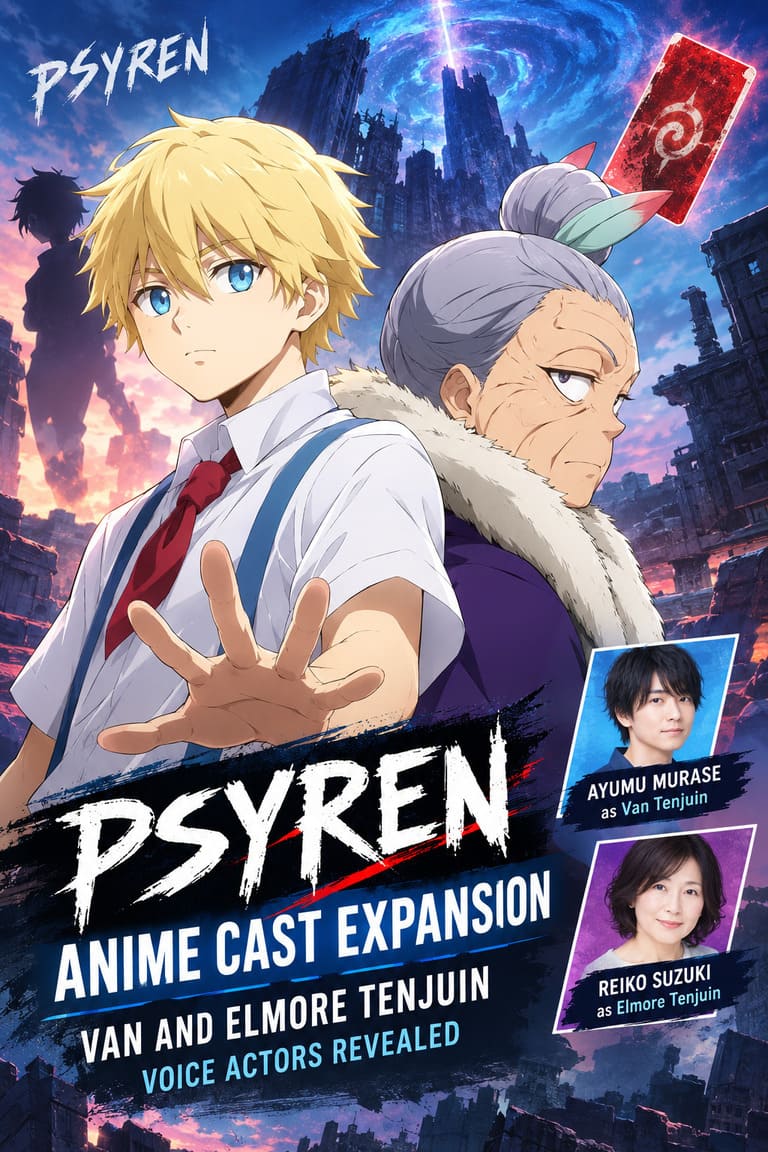
The latest reveal is particularly interesting. Ayumu Murase has joined the Japanese voice cast as Van Tenjuin, while veteran voice actress Reiko Suzuki will play Elmore Tenjuin. These aren’t additions that exist merely to pad out a promotional announcement. The Tenjuin family brings important emotional and narrative dimensions to the PSYREN universe, and the choice of performers suggests that the production wants these characters to make a lasting impression. For longtime manga readers, that’s exactly the kind of news worth discussing between episodes.
With the anime premiering on October 5, 2026, the conversation surrounding the adaptation has shifted from whether the project could do justice to the source material to how much of Iwashiro’s original vision the series will preserve. And honestly, that is a much better problem to have.
Ayumu Murase as Van Tenjuin: A Casting Choice Worth Watching
Ayumu Murase is one of those voice actors who can make a character memorable without relying on volume or exaggerated delivery. His performance as Shoyo Hinata in Haikyu!! demonstrated his ability to capture enthusiasm, vulnerability, and stubborn determination in the same breath. That emotional flexibility is a major reason his casting as Van Tenjuin feels promising.
What interests me most is the possibility of seeing Murase work with a character whose place in the story depends on more than straightforward battle-shonen energy. PSYREN frequently places its characters in situations where fear, desperation, and psychological pressure matter just as much as raw strength. The PSI power system isn’t simply an excuse for spectacular fights; it reflects the characters’ abilities, limitations, and willingness to survive in a world that seems determined to destroy them.
Murase’s range should suit that environment particularly well. He can make a character sound approachable one moment and unsettlingly intense the next, provided the direction gives him room to explore those contrasts. Van Tenjuin has the potential to become one of the season’s more intriguing additions, and I am curious to see how Murase handles the character’s emotional layers as the story develops.
There is also a practical advantage to bringing in a recognizable performer. Anime fans often discover supporting characters through the actors behind them, especially when those actors already have a strong following. Murase’s involvement gives viewers another reason to pay attention to the Tenjuin storyline instead of treating it as a side excursion from Ageha Yoshina’s main journey.
Of course, a famous voice actor cannot magically fix weak dialogue or rushed character development. The writing and direction still have to do their jobs. But this particular casting decision gives the production a solid opportunity to make Van feel like a meaningful part of the larger narrative.
Reiko Suzuki as Elmore Tenjuin Brings a Different Kind of Weight
If Murase brings youthful intensity to the new lineup, Reiko Suzuki offers something entirely different. Her long career in voice acting makes her a natural choice for a character who needs authority, experience, and emotional depth. Elmore Tenjuin occupies an important place in the wider mythology of PSYREN, and the character needs to feel like someone whose knowledge carries genuine consequences.
I always appreciate it when an anime production remembers that older characters deserve more than a generic wise-person voice. A convincing veteran character should sound like somebody who has experienced enough to recognize danger before everyone else does, but who may still carry personal regrets, fears, or unresolved questions. That balance is especially valuable in a series built around hidden information and a world that gradually reveals how much worse things are than they first appear.
Suzuki’s casting makes me hopeful that Elmore will receive the kind of thoughtful performance the character deserves. A seasoned voice actress can bring subtle shifts in tone to a scene without turning every line into a dramatic declaration. Sometimes a pause or a quieter delivery communicates more than an entire speech.
Her involvement also strengthens the contrast between the different generations of characters inhabiting the PSYREN universe. Younger fighters are often forced to react immediately, while older figures may understand the larger stakes but struggle with the consequences of what they know. When those perspectives collide, the story has an opportunity to become much more interesting than a simple contest of psychic abilities.
For me, that’s one of the reasons this announcement matters. The Tenjuin casting is about more than recognizable names; it is an opportunity to give the series’ deeper mythology the emotional credibility it needs.
What Makes PSYREN Such an Appealing Anime in 2026?
For anyone who missed the original manga, PSYREN follows high school student Ageha Yoshina, whose ordinary life begins to unravel after he discovers a mysterious red telephone card. His childhood friend, Sakurako Amamiya, disappears, and Ageha soon finds himself drawn into a dangerous system connected to a mysterious organization known as Psyren.
Using the card transports participants into a hostile, desolate world filled with lethal creatures and threats that make ordinary survival instincts almost useless. The rules are brutal, the environment is unforgiving, and the people trapped there must learn how to fight if they want to return alive. Ageha’s search for answers gradually becomes something much bigger as he and his allies uncover connections between the deadly wasteland and humanity’s possible future.
The premise is already strong, but what makes PSYREN stand out is the way it combines several genres without feeling like it needs to choose just one. There is supernatural action, certainly, but also mystery, psychological tension, dystopian science fiction, and the creeping horror of realizing that the world may be heading toward catastrophe.
The PSI system is another major selling point. Rather than treating every supernatural ability as an interchangeable beam attack, the series divides psychic powers into categories such as Burst, Trance, and Rise. These distinctions help establish different approaches to combat and give the characters room to develop specialized abilities.
That creates opportunities for fights that require more than having the biggest attack. Strategy, observation, teamwork, and understanding an opponent’s capabilities can make the difference between surviving and becoming another victim of the wasteland. When PSYREN is firing on all cylinders, its battles feel like dangerous puzzles rather than predictable power contests.
The mystery surrounding the red card also gives the action a sense of purpose. Every new discovery can change how viewers understand the setting, the people controlling the game, and the danger facing the real world. That is the kind of storytelling that encourages weekly theories and late-night discussions, particularly when an episode ends with a revelation instead of a neatly resolved conflict.
Satelight’s Adaptation Has a Difficult Job
The anime is being produced by Satelight, a studio with experience handling visually ambitious science-fiction and action projects, including Aquarion and Symphogear. That background makes the studio an interesting fit for a property that requires both atmospheric world-building and energetic supernatural combat.
Director Katsumi Ono leads the television adaptation, with Shin Yoshida handling series composition and Akira Okuma responsible for character design. The production’s musical team includes Takashi Ohmama, Tatsuhiko Saiki, and Shu Kanematsu. Together, these creative elements need to establish a consistent identity for a story that moves between ordinary life, psychological suspense, and a nightmarish alternate world.
The challenge is not simply animating the fights well. A convincing PSYREN adaptation must also make its wasteland feel oppressive, its mysteries genuinely unsettling, and its characters recognizable even when the pressure becomes overwhelming. If the anime spends all its resources on flashy psychic attacks while rushing through the quieter scenes, it risks losing the very qualities that made the manga worth remembering.
The reported soundtrack choices are encouraging for fans who enjoy a strong musical identity. CLAN QUEEN performs the opening theme, WARNING!!, while Who-ya Extended provides the ending theme, ICARUS. The contrast between an energetic opening and a more emotionally charged ending suits a series that constantly balances adrenaline with the consequences of survival.
My biggest hope is that the production maintains that balance throughout the season. Good action animation attracts attention, but suspense is what makes people return for another episode. A genuinely frightening encounter should linger in the audience’s mind after the battle is over.

PSYREN Japanese Voice Cast: Who Plays the Main Characters?
The newly announced performers join an established Japanese lineup that brings Ageha’s group and the surrounding cast to life. Here is a look at the principal names reported for the adaptation.
| Character | Japanese Voice Actor |
|---|---|
| Ageha Yoshina | Rikuya Yasuda |
| Sakurako Amamiya | Mayuko Kazama |
| Hiryu Asaga | Shunsuke Takeuchi |
| Oboro Mochizuki | Soma Saito |
| Kabuto Kirisaki | Yukihiro Nozuyama |
| Matsuri Yagumo | Yuko Kaida |
| Dholaki | Nobuyuki Hiyama |
| Van Tenjuin | Ayumu Murase |
| Elmore Tenjuin | Reiko Suzuki |
The lineup combines performers associated with youthful energy, commanding delivery, and more understated dramatic work. That variety matters because PSYREN relies on the personalities of its characters as much as their abilities. A battle becomes much more compelling when the audience understands what each participant stands to lose.
Murase and Suzuki are particularly interesting additions because they bring very different performance histories to the same family storyline. Their eventual scenes together could provide a welcome change of pace from the series’ more explosive confrontations.
The English Dub Is Here, Too
For viewers who prefer watching anime in English, there is another reason to pay attention. Crunchyroll’s English-dub rollout reportedly began on October 19, 2026, expanding the series’ reach beyond its Japanese-language audience.
The reported English voice cast includes Dylan Ray Owen as Ageha Yoshina, Kelly Greenshield as Sakurako Amamiya, Katelyn Barr as Fubiki, Kevin D. Thelwell as Hiroki, Jacob Browning as Miyake, Abigail Blythe as Nemesis Q, Derrick Snow as Okumura, Mauricio Ortiz-Segura as Saka, and Daniel Van Thomas as Usui. Dani Chambers is credited as voice director, with Zach Bolton serving as producer.
I am glad to see the English version arriving while the season is still underway. Simultaneous access to subbed and dubbed episodes gives more viewers a chance to participate in the weekly conversation, and it helps prevent a promising series from remaining confined to one section of the anime community.
The quality of the adaptation will ultimately matter more than which language viewers choose. A good dub needs to preserve the urgency of the dialogue, the personalities of the characters, and the emotional rhythm of the original performances. With a story as dependent on tension as PSYREN, those details can make a substantial difference.
International viewers should check Crunchyroll’s current regional listings for availability and episode schedules, since streaming arrangements can vary by territory.
Fifteen Years of Waiting: Why the Anime Means So Much to Manga Fans
The original PSYREN manga ran in Shueisha’s Weekly Shonen Jump from December 2007 to November 2010, eventually collecting its story across 16 volumes. It shared the magazine’s pages with enormous franchises such as One Piece, Naruto, and Bleach, which makes its enduring reputation particularly interesting.
Not every great manga becomes a global commercial phenomenon. Some series develop a devoted following because readers recognize something special in their storytelling, even when the wider market moves on to the next big hit. PSYREN became one of those titles for fans who wanted more ambitious science-fiction concepts in their battle shonen.
Its appeal was never limited to psychic powers or monster fights. The manga offered a steadily expanding mystery, a bleak atmosphere, and a sense that seemingly minor discoveries could eventually become essential to the larger plot. Readers who finished the series continued recommending it to people looking for an overlooked shonen worth their time.
That long-running affection helps explain why the anime announcement generated so much excitement. The adaptation was revealed in late 2025, with REMOW and Shueisha associated with the project, giving longtime supporters a reason to believe that their favorite series might finally reach a much wider audience.
There is something satisfying about watching a title with a dedicated cult following receive a new opportunity. It is not just nostalgia. A good adaptation can introduce the story to viewers who were not even following anime when the manga originally ended, allowing a new generation to experience its twists without knowing what is coming.
What Fans Are Discussing After the Latest Casting Reveal
The addition of Murase and Suzuki gives the community plenty to speculate about, particularly regarding how the Tenjuin storyline will fit into the season. Fans naturally want to know which major developments the adaptation intends to cover, how much room the production will give its supporting characters, and whether the anime can maintain a satisfying pace without sacrificing important details.
There is a temptation to treat every casting announcement as proof that a particular story arc will be adapted in full. I would be careful with that assumption. New voice actors confirm that characters are part of the production, but they do not automatically guarantee a specific episode count, a complete adaptation, or a particular ending.
Still, the announcement is encouraging because these characters are not simply interchangeable background figures. Their presence gives the anime more opportunities to explore the history and mechanics of the world beyond Ageha’s immediate struggle. If the writing allows those connections to develop naturally, the result could be one of the season’s most rewarding stretches.
The discussion around the show’s visual presentation is just as important. PSI battles need to communicate what is happening without turning every encounter into a confusing blur of effects. The best supernatural action makes each ability feel distinct, gives viewers a clear sense of danger, and leaves enough room for character reactions to matter.
For me, that is the real test of this adaptation. Can PSYREN deliver spectacular fights while preserving the uncertainty and emotional tension that make the story work? The expanded cast is a promising step, but the series still has to earn its reputation episode by episode.
Final Thoughts: PSYREN Finally Has Its Moment
The casting of Ayumu Murase as Van Tenjuin and Reiko Suzuki as Elmore Tenjuin is welcome news for anyone invested in the future of the PSYREN anime. Both performers bring different strengths to the project, and their involvement creates an opportunity to give the Tenjuin family the presence and emotional depth it deserves.
More importantly, the announcement highlights what makes this adaptation worth following. PSYREN has always had the ingredients for an engaging anime: a memorable central mystery, a distinctive psychic combat system, a threatening dystopian setting, and characters forced to confront consequences much larger than themselves. Satelight now has the chance to bring those elements together for viewers who have never read the manga.
I am cautiously optimistic. A beloved source material does not guarantee a perfect adaptation, and even the strongest casting cannot compensate for poor pacing or rushed storytelling. But the expanding voice cast, the creative team’s genre experience, and the enthusiasm surrounding the series all give fans legitimate reasons to keep watching.
For longtime readers, this is the moment they have waited years to experience. For newcomers, it is an opportunity to discover why a manga that ended in 2010 still inspires passionate recommendations today. If the anime continues to balance its psychological mystery with smart, visually compelling battles, PSYREN could become one of Fall 2026’s most satisfying discoveries for battle-shonen and sci-fi fans.