Shinra vs Evangelist final fight details “Fire Force”
The final confrontation in Fire Force isn’t a typical shonen showdown full of punches and explosions. Instead, it’s a bold, philosophical finale that asks a much bigger question: why does humanity keep choosing to live, even when the world is burning?
As an anime fan, this is one of those endings that sticks with you long after the last chapter.
The Great Cataclysm: Where Reality Breaks
The fight takes place during the Great Cataclysm arc, when the barrier between the real world and Adolla—the realm born from human perception and emotion—completely collapses. At this point, battles are no longer just physical. Thoughts, fear, belief, and imagination directly reshape reality.
This is where Shinra Kusakabe stops being just a fire soldier and starts becoming something far more symbolic.

Shinrabansho-Man: The Birth of a God
Shinra’s ultimate transformation, Shinrabansho-Man, is the emotional core of the finale.
- Soul Resonance links Shinra, his brother Sho, and the soul of their mother, Mari Kusakabe
- Mari is revealed as the Evangelist’s doppelgänger, representing humanity’s hope, love, and protection
- This creates a “trinity” that directly opposes the Evangelist’s embodiment of collective despair
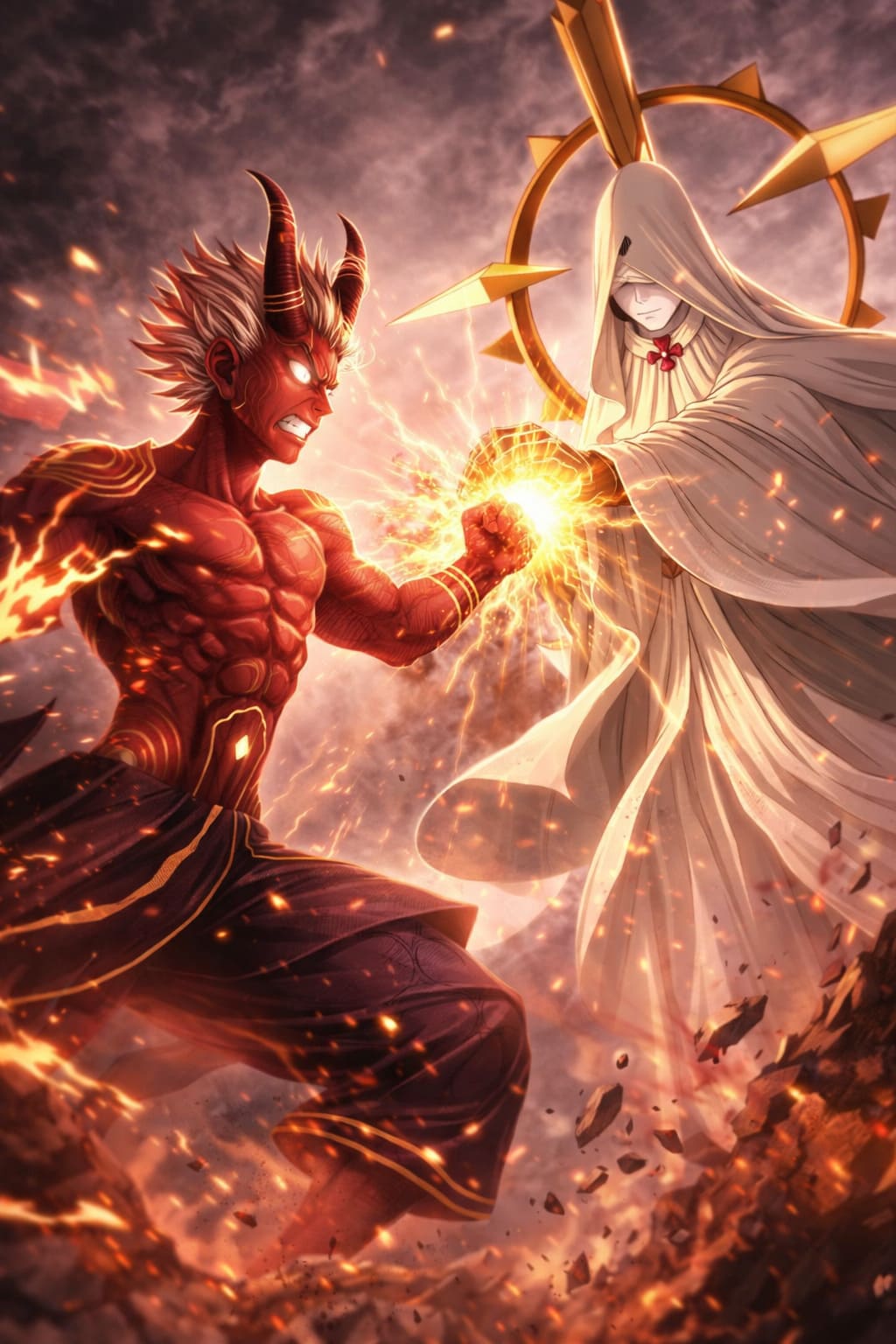
In this state, Shinra isn’t just strong—he’s author-level powerful. He can recreate landscapes, undo mass destruction, and nullify attacks on a nuclear scale. The series fully leans into mythological storytelling here, and honestly, it works.
Despair vs Imagination: The Real Fight
The Evangelist acts through Haumea, transforming her into a terrifying, black-skinned, three-eyed vessel of humanity’s death wish.
Haumea’s argument is chillingly simple:
Suffering is unavoidable, so non-existence is mercy.
Shinra’s answer is pure Fire Force:
If humans can imagine despair, they can also imagine a better world.
This clash isn’t about strength—it’s about belief.
One of the most striking moments comes when the Earth, warped into a sun by the Cataclysm, is literally stomped by Shinra to reignite life. It’s absurd, symbolic, and unforgettable.
The Final Victory: Hope Over Oblivion
Shinra doesn’t kill the Evangelist in a conventional sense.
- He purges despair from Haumea
- He overwhelms the Evangelist’s darkness with the light of human hope
- The Evangelist’s form collapses once humanity’s desire for annihilation is rejected
It’s a victory of ideals, not violence.
Aftermath: Rewriting the World
The true weight of the final battle is felt after it ends.
Using his godhood, Shinra reshapes reality itself:
- Ignition abilities are removed, ending spontaneous human combustion
- Death is given form, creating Lord Death (Shinigami)
- Everyone lost during the Cataclysm—friends and enemies alike—is revived
This directly sets the stage for Soul Eater, confirming Fire Force as its prequel and reframing the entire series as a cosmic origin story.

Why This Ending Hits So Hard
Fire Force doesn’t end with domination—it ends with responsibility. Shinra doesn’t rule humanity; he gives it another chance, in a world governed by madness, sanity, and choice rather than endless fire.
Want to see more? – Is Fire Force manga ending good? Season 3 Part 2 is it the final season?
For anime fans, this finale is wild, emotional, and unapologetically ambitious. It’s not perfect, but it’s memorable, and that matters far more.