Hal Formula Chapter 5: Release Date, Real Chapter 4 Climax Analysis, and Full Predictions
Hal Formula is starting to feel like one of those rare sports manga that doesn’t just entertain you — it pulls you into the mechanics of the sport so hard that you can almost feel the machine fighting back. After the explosive ending of Chapter 4, I’m convinced this series isn’t simply trying to be “the next racing manga.” It wants to become the racing manga for a new generation of readers who love both shonen intensity and real motorsport logic.
And honestly? Chapter 4 was the first moment where Hal Formula stopped looking like a promising series and started looking like a serious contender.
With Hal Formula Chapter 5 scheduled for release on July 12, 2026, the big question isn’t just “what happens next?” It’s how far Kento Terasaka is willing to push Miharu Suzukaze now that he’s crossed an invisible line between talent and true racing instinct.
Hal Formula Chapter 5 Release Date
Before getting into the analysis, here’s the quick release info fans are looking for:
| Detail | Information |
|---|---|
| Chapter | Hal Formula Chapter 5 |
| Official Release Date | Sunday, July 12, 2026 |
| US Release Time | 8:00 AM PST / 11:00 AM EST |
| Where to Read | MANGA Plus and VIZ Media Shonen Jump app |
That part is straightforward. The real conversation starts with what Chapter 4 actually did to Miharu, Hinokura, and the story’s central rivalry.
Chapter 4 Recap: “Steering the Wheel” Was More Than a Training Chapter
At first glance, Chapter 4 looks like a setup chapter before the Autopolis Oita race. But once you read it closely, it’s clear Terasaka was doing something much smarter. He used the chapter to show the gap between privateer desperation and manufacturer-backed perfection, then smashed that gap open with one terrifying moment of growth.
1) The chapter begins with warmth — and immediately turns brutal
The opening with Miharu and Haruka is deceptively gentle. It gives the story a little emotional air before throwing us back into the pressure cooker of junior formula racing. That contrast works incredibly well because it reminds us what Miharu is racing for: not just victory, but survival, stability, and a future.
Then the manga slams us into the world of Millepiedi Jr., where the atmosphere is completely different. Suddenly it’s all money, scholarship politics, and corporate expectations. The detail about a junior driver costing 20 million yen a year is one of those worldbuilding touches that makes Hal Formula stand out. This manga understands that racing is not just about speed — it’s about access, funding, pressure, and the cruel reality that talent alone doesn’t guarantee anything.
That’s why Masaomi Hinokura works so well as an early rival. He isn’t just “the arrogant genius.” He’s a driver trapped inside a system that will discard him if he slips.
2) Hazama Racing Sim becomes a battlefield, not a training room
When Miharu challenges Hinokura at Hazama Racing Sim, it’s such a good character moment because it tells you exactly who Miharu is. He’s not polished, he’s not politically careful, and he definitely doesn’t know when he’s “supposed” to be intimidated. He sees a stronger driver and immediately thinks: race me.
That simple decision changes the whole tone of the chapter.
What follows isn’t a friendly practice session. It feels like a miniature war. Hinokura doesn’t treat Miharu as a fellow racer trying to improve — he treats him like an insult to the system. In his mind, Miharu is just a lucky outsider who somehow wandered into elite territory.
And that’s why the mock race has so much bite. Miharu is driving against more than a rival. He’s driving against the idea that he doesn’t belong here.
3) Hinokura’s driving is frightening because it’s almost inhuman
One of my favorite parts of Chapter 4 is how Terasaka frames Hinokura’s driving. Miharu doesn’t react to him like a shonen hero watching a flashy special move. He reacts like someone seeing a machine operate with impossible efficiency.
That’s such a strong choice.
Hinokura isn’t presented as “cool” in the usual manga sense. He’s presented as terrifyingly optimized. His lines are clean, his inputs are minimal, and everything about him screams professional conditioning. Miharu doesn’t just notice that Hinokura is fast — he notices that there is zero waste in what he does.
That’s important because it raises the ceiling of the series. Miharu isn’t trying to beat some hotheaded rival with obvious weaknesses. He’s trying to catch a driver who represents the ideal product of a high-budget racing system.
The Real Climax of Chapter 4: Miharu Stops Fighting the Wheel and Starts Understanding the Car
This is where Hal Formula completely won me over.
The steering wheel resistance sequence is brilliant because it turns a technical racing concept into a genuine life-or-death-feeling manga climax. Miharu reaches the point where brute force stops working. The harder he tries to force the car, the more the machine punishes him. The simulator doesn’t feel like a game anymore — it feels like a wall he keeps smashing into.
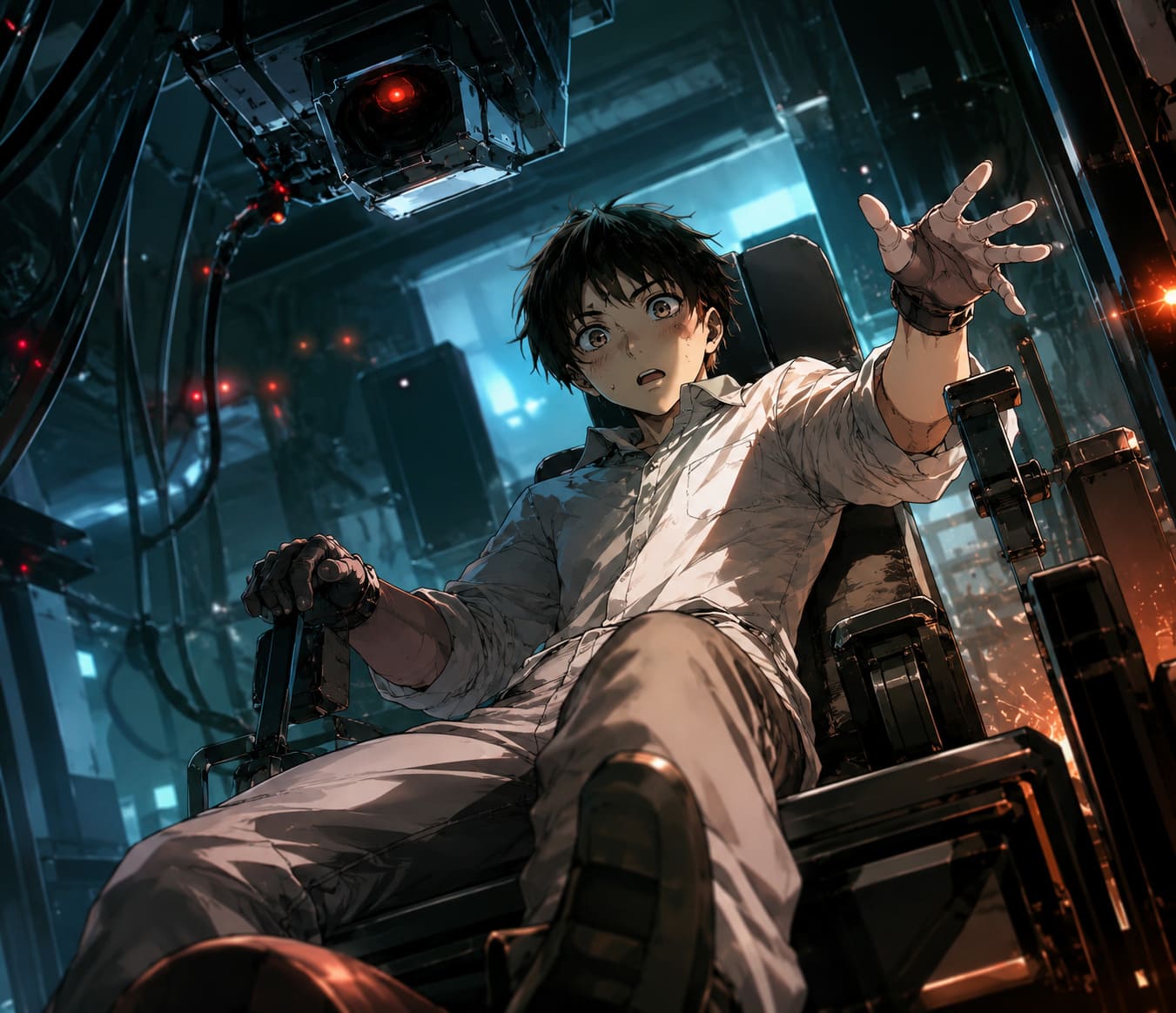
And then the chapter lands on its most important idea:
high-level driving isn’t about overpowering the car — it’s about working with the forces inside it.
Miharu’s breakthrough with throttle steering matters because it doesn’t feel like a random “anime power-up.” It feels earned, desperate, and messy. He doesn’t suddenly become a perfect genius. He stumbles into the right answer because he’s cornered badly enough to stop thinking like a beginner.
That detail is everything.
Instead of muscling the steering input, Miharu changes the balance of the car through the throttle. He uses the rear of the machine, the load transfer, the rotation of the chassis — and for one brief moment, the wheel goes light.
That panel, conceptually, is one of the coolest moments in any recent sports manga I’ve read.
Because what actually happened there wasn’t “Miharu got stronger.”
It was this:
- He recognized the car as a dynamic system, not a stubborn object
- He responded with instinct instead of panic
- He discovered a solution that elite drivers intentionally train for
- He terrified a supposedly superior rival without even fully understanding what he had done
That’s not just growth. That’s the first sign of a driver becoming dangerous.
Why Hinokura’s Reaction Is the Most Important Part of the Chapter
If Miharu’s breakthrough is the mechanical climax, Hinokura’s reaction is the emotional one.
Up to this point, Hinokura has been able to dismiss Miharu as a reckless privateer with a lucky result. But Chapter 4 destroys that mental safety net. Miharu doesn’t just survive the duel — he evolves in front of him.
And for a driver like Hinokura, that’s horrifying.
He comes from a world where growth is supposed to be structured. It’s supposed to happen through expensive coaching, professional data analysis, and years of disciplined repetition. Miharu, meanwhile, looks like chaos in human form. He’s rough, impulsive, and underfunded — yet he just touched something real.
That means Hinokura can no longer file him away as a fluke.
I think that’s why the final reaction hits so hard. It’s not simple anger. It’s fear. It’s the look of someone realizing that the rival he underestimated might be evolving faster than the system can control.
My Hal Formula Chapter 5 Prediction: Miharu Won’t Be “Stronger” Yet — He’ll Be Obsessed
A lot of fans are expecting Chapter 5 to go straight into another big confrontation, but I actually think the smarter move is something more grounded. If Chapter 4 was the discovery, Chapter 5 should be the obsession phase.
Miharu has found something, but he absolutely does not own it yet.
What I expect from Chapter 5
1. Miharu will try to recreate the feeling — and fail at first
This is the most natural next step. Chapter 4 made it very clear that Miharu didn’t unlock throttle steering through polished understanding. He found it while hanging on for dear life. That means Chapter 5 has a perfect opportunity to show the ugly side of improvement: repetition, mistakes, frustration, and trying to turn instinct into skill.
2. Kyogoku will probably explain the breakthrough in practical terms
I’d be surprised if Terasaka skips this. Hal Formula clearly enjoys making technical concepts part of the emotional storytelling, so Chapter 5 feels like the perfect place for Miharu to report what he felt and for Kyogoku to translate that sensation into real racing language. Not a dry lecture — more like a mentor helping a driver understand why the car suddenly “opened up.”
3. Hinokura’s confidence will start cracking
I don’t necessarily think Hinokura is going to collapse immediately, but the damage is done. He has now seen something he can’t easily explain away. If he starts overthinking Miharu during training or practice, that could become the first real fracture in his polished “works driver” identity.
4. The manga may start accelerating toward Autopolis Oita
I’d expect at least part of Chapter 5 to move the story closer to the actual race weekend. A training-focused chapter doesn’t need to stay trapped inside the simulator environment forever. The next big emotional payoff is seeing Miharu bring this new understanding into a real circuit setting where the stakes are no longer virtual.
Animal Signal Chapter 6: Release Date, Full Chapter 5 Ending Explained, and Fan Speculations
Why Hal Formula Is Already Standing Out in the Sports Manga Crowd
There’s a reason this chapter has generated so much attention. Hal Formula understands a very difficult balance that a lot of sports manga never quite hit: it makes the technical side of the sport feel dramatic without turning it into nonsense.
Here’s the difference in simple terms:
| Typical Sports Manga Escalation | What Hal Formula Does |
|---|---|
| Hero unlocks a dramatic “special move” | Miharu discovers throttle-based car rotation and control |
| Rival underestimates hero for generic reasons | Hinokura underestimates Miharu because of class, funding, and training pedigree |
| New power appears and is instantly mastered | Miharu openly admits it was messy, accidental, and incomplete |
| Tension comes from shouting and hype | Tension comes from telemetry, pressure, mechanics, and psychological collapse |
That’s why the series feels fresh. It respects the reader enough to believe that real racing concepts can be exciting if they’re dramatized correctly.
And Terasaka absolutely nailed that in Chapter 4.
Final Thoughts: Chapter 5 Has a Chance to Confirm Hal Formula’s Identity
For me, Chapter 5 is important not because it needs to top Chapter 4 in pure hype, but because it needs to prove that Hal Formula understands the value of follow-through.
Chapter 4 gave Miharu a breakthrough. Great. Now the manga has to show us the cost of keeping it.
If Chapter 5 leans into Miharu’s trial-and-error process, Hinokura’s shaken pride, and the looming Autopolis Oita showdown, then this series could lock in the exact thing every great sports manga needs: a believable path from raw instinct to earned greatness.
And if Terasaka keeps writing Miharu this way — not as a chosen one, but as a kid clawing his way toward understanding a machine that keeps trying to throw him off — then Hal Formula might become one of the easiest weekly reads to root for in all of modern Shonen Jump.