MyGO Exclusive KANA-BOON Naimononedari Cover Analysis: Musical Shifts, Franchise Evolution, and Fan Reception
There are anime covers that sound like simple tributes, and then there are covers that make you go back to the original song just to figure out what the new band changed. MyGO!!!!!’s take on KANA-BOON’s Naimononedari belongs firmly in the second category for me. I knew the original as one of those ridiculously catchy early-2010s J-rock songs that can get stuck in your head after a single listen, but hearing MyGO!!!!! attack it with their much rougher emotional style completely changed the way I hear the track.
That is what makes this cover interesting beyond the usual BanG Dream! cover-song formula. MyGO!!!!! aren’t simply copying KANA-BOON’s guitars and putting Tomori’s voice on top. They are taking a song with a playful, restless personality and pushing it through the emotional filter that made BanG Dream! It’s MyGO!!!!! stand out in the first place. The result feels familiar for a few seconds, then suddenly becomes something much more intense.
Makeine Too Many Losing Heroines Explodes Online with New Toyohashi Visual and Season 2 Hype
KANA-BOON’s Naimononedari Was Already a Difficult Song to Mess With
The original Naimononedari, released by KANA-BOON in 2013, has exactly the kind of energy that defined a lot of memorable Japanese rock from that period. The guitars are bright, the rhythm moves constantly, and the whole song has this slightly chaotic feeling of two people arguing while neither of them is willing to admit they might be wrong. It is catchy without feeling overly polished, which is a huge part of its charm.
What I particularly like about the original is how conversational it feels. KANA-BOON’s delivery doesn’t treat the lyrics like some grand romantic confession. There is humor, impatience and a little bit of childishness in the way the song moves between its ideas. Even if you don’t understand every Japanese lyric immediately, the performance itself communicates that restless back-and-forth.
That creates a pretty obvious problem for MyGO!!!!!. Their entire musical identity is built around emotional discomfort, fractured relationships, insecurity and characters who often struggle to say what they actually mean. So the question isn’t whether they can play Naimononedari. Of course they can. The interesting question is whether they can make a song this playful feel like a MyGO!!!!! song.
And honestly, they can.
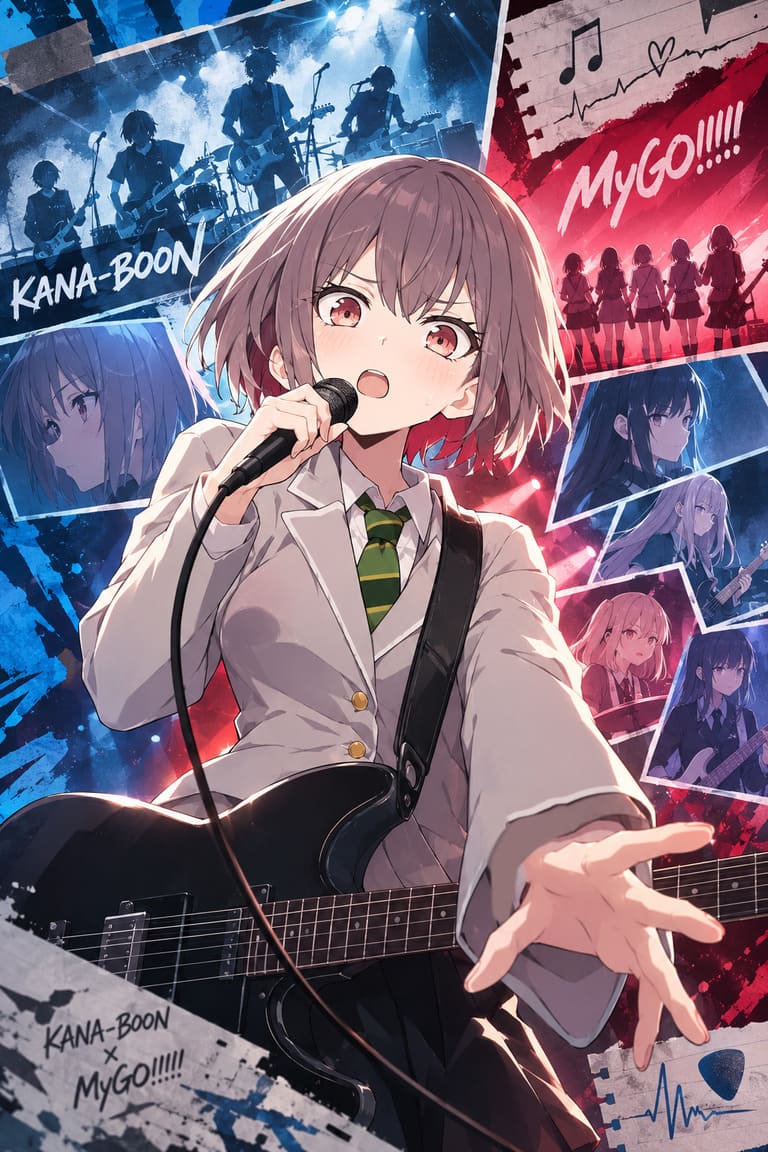
MyGO!!!!! Turns the Song’s Energy Into Something Heavier
The biggest difference becomes obvious in the instrumental arrangement. KANA-BOON’s version has that clean, bouncy guitar sound that immediately screams early-2010s indie rock. MyGO!!!!! keep the recognizable foundation, but the guitars have considerably more weight behind them. Instead of simply bouncing along, the riffs feel like they are being pushed forward by a band that wants the song to hit harder.
That change works surprisingly well because MyGO!!!!! already have such a recognizable relationship with heavier alternative rock. The distortion doesn’t erase the identity of the original song; it gives the familiar riffs a different emotional temperature. I can still hear KANA-BOON underneath it, but the performance feels less like a carefree argument and more like someone is getting genuinely frustrated.
The guitar contrast is especially fun to listen to. Anon and Raana bring completely different flavors to the arrangement, with the rhythm guitar providing weight while the lead work adds sharper details. Raana’s playing has that precise, almost unnervingly controlled quality that fits her character perfectly. It is the kind of performance where you start paying attention to small guitar details instead of just waiting for the chorus.
The Rhythm Section Gives Naimononedari a New Backbone
The bass and drums might actually be the part of this cover that surprised me the most. Soyo’s bass gives the song a thicker low end, while Taki’s drumming makes the whole performance feel more aggressive. The original has a strong danceable pulse, but MyGO!!!!! make that pulse feel heavier and more physical.
Taki in particular doesn’t seem interested in simply keeping time. Her playing adds accents and fills that make the song feel slightly more unpredictable. That’s something I’ve come to expect from MyGO!!!!!, and it works here because the original already has plenty of rhythmic movement to build on.
Instead of destroying the structure of Naimononedari, the arrangement basically asks: what would this song sound like if the band performing it carried years of emotional baggage? That’s a very MyGO!!!!! way of approaching a cover.
Tomori Changes the Entire Emotional Meaning
Then Tomori starts singing, and that’s where the cover really becomes its own thing. Hina Yomiya’s performance as Tomori has always been one of the most distinctive parts of MyGO!!!!! because her voice rarely sounds perfectly comfortable. There is vulnerability in it. Sometimes it almost sounds like she’s trying to catch up with her own emotions, which is exactly what makes her performances so memorable.
That approach changes Naimononedari dramatically. The original vocal performance has a playful, talkative quality that matches the song’s relationship argument. Tomori doesn’t completely remove that quality, but she makes the words feel much more emotionally exposed. Lines that might have sounded like teasing or frustration in the KANA-BOON version suddenly feel like they could actually hurt someone.
The repeated “Yurayura, yurayura” section is a great example. In the original, it has an infectious quality that makes you want to sing along. In MyGO!!!!!’s hands, the repetition feels more unstable. There is almost a sense of emotional hesitation behind it, and that fits Tomori’s character ridiculously well.
This is why I don’t think the cover should be judged simply by asking whether it is “better” than KANA-BOON’s version. That’s the wrong comparison. The two performances are trying to communicate different feelings. KANA-BOON makes the song feel restless and playful; MyGO!!!!! makes it feel restless and emotionally painful. Both interpretations have their own reason to exist.
Why This Cover Makes Sense for BanG Dream!
One of the things I appreciate about the BanG Dream! franchise is that its covers can reveal something about the band performing them. With some franchise covers, the song is mainly there because it is recognizable and fun to play in a rhythm game. MyGO!!!!! make the idea feel much more character-driven.
Their version of Naimononedari feels like something that could actually belong to these five characters. Tomori’s emotional delivery, Taki’s aggressive drumming, Soyo’s bass presence, Anon’s guitar work and Raana’s technical playing all contribute to the interpretation. You don’t just hear a famous song being covered; you hear MyGO!!!!! interpreting someone else’s song through their own personality.
That distinction matters. MyGO!!!!! have always felt somewhat different from the more straightforwardly upbeat side of BanG Dream!, and this cover reinforces that identity instead of smoothing it out. Even when they’re performing somebody else’s material, they still sound unmistakably like themselves.
What Anime Fans Are Likely to Notice First
If you’re coming into this as a MyGO!!!!! fan, the obvious attraction is hearing Tomori sing something outside the band’s regular repertoire. If you’re a longtime KANA-BOON listener, however, the appeal is almost the opposite: you get to hear a familiar song transformed without losing its recognizable skeleton.
For me, those two perspectives make this cover much more interesting than a standard nostalgia play. It can introduce younger anime fans to an older J-rock favorite while also giving longtime listeners another reason to pay attention to MyGO!!!!!. That’s a pretty good crossover when it happens naturally instead of feeling like marketing.
- KANA-BOON fans get a heavier reinterpretation of a familiar song.
- MyGO!!!!! fans get another example of the band’s distinctive emotional style.
- BanG Dream! fans get a cover that fits the personalities of its performers.
- J-rock newcomers get an easy gateway into both artists.
My Take: This Is Exactly the Kind of Anime Cover I Want More Of
What sticks with me after listening to the MyGO!!!!! Naimononedari cover is how little it feels like a safe remake. The band could have played the song almost exactly like KANA-BOON and still delivered something enjoyable, but that wouldn’t have been nearly as memorable. Instead, they lean into the tension between the original’s upbeat personality and their own heavier emotional identity.
I especially like that the cover doesn’t try to hide the differences. The guitars are heavier. The rhythm section feels more aggressive. Tomori’s vocals sound more fragile and emotionally exposed. Rather than treating those qualities as problems that need to be corrected, the arrangement makes them the entire point.
And that’s probably why this song works so well within the modern anime music landscape. Fictional bands are no longer limited to sounding like generic pop-rock groups created to sell a character. Projects like MyGO!!!!! can have their own musical language, and covers become another way of showing exactly what that language sounds like.
Final Thoughts on the MyGO!!!!! Naimononedari Cover
MyGO!!!!!’s Naimononedari cover is a fascinating meeting point between classic KANA-BOON J-rock and the emotionally messy alternative-rock identity of BanG Dream! It’s MyGO!!!!!. The original song remains the foundation, but nearly every part of the performance gets a different emotional emphasis. The guitars carry more weight, the rhythm section hits harder, and Tomori’s vocals turn playful uncertainty into something much more vulnerable.
As an anime fan, this is the kind of cover I enjoy discussing because there is actually something to discuss. It isn’t simply a familiar song with different voices. It demonstrates how arrangement, instrumentation and vocal interpretation can completely change the emotional reading of material that has been around for years.
If you already love KANA-BOON, I think the most interesting thing to do is listen to both versions back to back. If you’re a MyGO!!!!! fan, listen specifically to the rhythm section and Tomori’s phrasing. And if you’re completely new to either band, this is a pretty great excuse to explore both sides of Japanese rock music and see just how different the same song can feel when another band makes it their own.
BanG Dream!, MyGO!!!!!, KANA-BOON, Naimononedari and modern J-rock make a surprisingly good combination. I didn’t expect this particular crossover to work quite this well, but that’s exactly why I ended up replaying it instead of treating it as just another anime cover.